
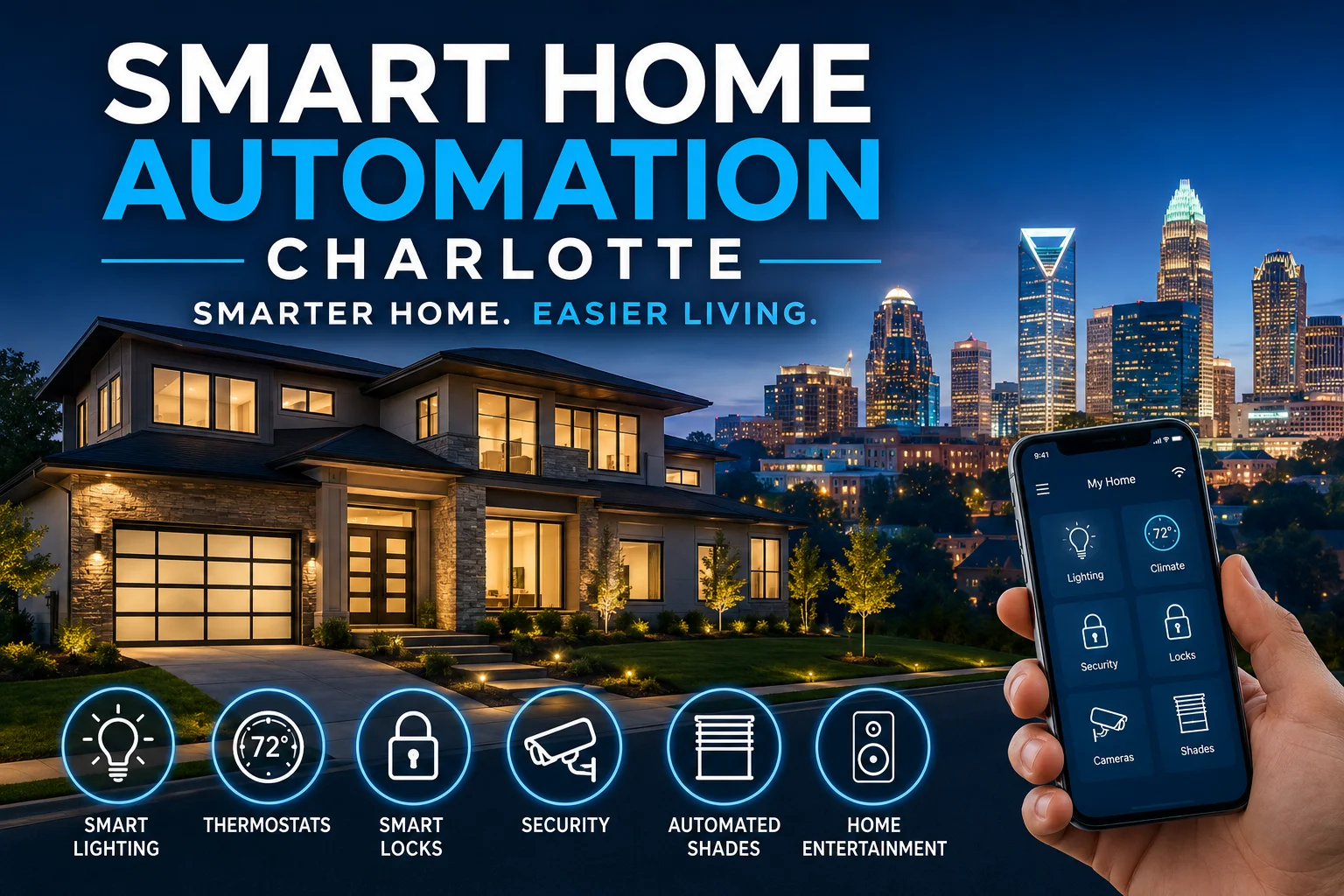
Smart home automation in Charlotte connects devices like lighting, thermostats, locks, cameras, shades, and entertainment systems so they can be controlled from one app or run automatically based on schedules, sensors, and routines. Rather than just turning devices on and off individually, automation lets systems work together — for example, when a homeowner leaves the house, a single command or automatic trigger can lock the doors, turn off selected lights, adjust the thermostat, and arm security settings at the same time. For Charlotte homeowners, whether in a new build, an established neighborhood, or an older home being upgraded, the technology has matured enough to be genuinely useful — but it works best when planned around real needs rather than added device by device.
What Is Smart Home Automation?
It helps to separate a few related terms. A smart device is something you can control remotely, usually from a phone app — a smart plug or a Wi-Fi light bulb, for example. Smart home control means using an app or voice assistant to operate multiple devices from one place. Home automation goes a step further: devices respond automatically to schedules, sensors, or each other, without you pressing a button every time.
Whole-home automation ties these pieces together across the entire house, often with professional programming behind the scenes. A simple example: when the homeowner leaves, the system can lock the doors, turn off selected lights, adjust the thermostat, and activate security settings — all from one trigger, whether that’s tapping “Leaving Home” on an app, using a geofence, or pressing a single wall-mounted button.
How Does Smart Home Automation Work?
A working system generally involves several pieces:
- Smart devices — the bulbs, locks, thermostats, cameras, and switches themselves
- Sensors — motion, door/window, temperature, and occupancy sensors that trigger automations
- Communication protocols — Wi-Fi, Thread, Zigbee, Z-Wave, or Matter, which let devices talk to each other and to your network
- A central controller or hub, where applicable — some systems rely on one, others coordinate through the cloud or a smart speaker
- Mobile apps for manual control and configuration
- Voice assistants for hands-free commands
- Automation rules or “scenes” that bundle multiple actions into one trigger
- A home network reliable enough to keep everything connected
Not every smart-home setup needs a traditional physical hub — many devices now connect directly through Wi-Fi or a smart speaker. But device compatibility still matters. Not every product works with every ecosystem, and checking compatibility before buying saves a lot of frustration later.
Smart Home Automation Options for Charlotte Homes
Smart Lighting
Automated schedules, motion-sensor triggers, dimming, and pre-set “scenes” let lighting adjust without manual switches. Exterior lighting can run on schedules for security or curb appeal, and vacation lighting can simulate occupancy while a homeowner is away.
Smart Thermostats
These support scheduling, remote temperature adjustment from a phone, and occupancy-based changes that respond to whether anyone’s home. They can support more efficient energy use, though actual results depend on the home and how the system is configured — more on that below.
Smart Locks
Smart locks offer keyless entry, temporary or scheduled access codes, remote locking, and automatic locking after a set time. The right lock depends on your door hardware and your household’s security needs, so compatibility is worth checking before buying.
Smart Doorbells and Cameras
These provide doorbell notifications, video monitoring, motion alerts, remote viewing, and awareness of deliveries at the door. They’re a useful layer of visibility, but they don’t guarantee a safer home on their own — they work best as part of a broader approach to home security.
Smart Shades and Blinds
Automated shades can open and close on a schedule, respond to sunlight or temperature, support privacy settings, and tie into broader scenes like “Movie Night” or “Good Morning.”
Smart Speakers and Voice Control
Voice assistants handle multi-room audio, music, and basic automation commands. It’s worth knowing that voice assistants also raise some privacy considerations worth reviewing in your device settings, which we cover further down.
Home Theater
Automation can combine lighting scenes, TV or projector control, audio, and motorized shades into a single “movie night” command instead of juggling several remotes.
Whole-Home Automation vs. Individual Smart Devices
| Feature | Individual Smart Devices | Whole-Home Automation |
|---|---|---|
| Setup | Usually simpler | More comprehensive |
| Control | Individual apps | Centralized control |
| Automation | Basic to moderate | Advanced |
| Integration | Depends on compatibility | Designed around integration |
| Scalability | Varies | Generally easier to expand |
| Best for | Small upgrades | Whole-home projects |
You don’t have to automate everything at once. Many Charlotte homeowners start with a thermostat and a few lights, then expand as needs and budget allow.
Benefits of Smart Home Automation in Charlotte
Convenience — scenes and centralized control replace juggling multiple apps and switches.
Security — smart locks, cameras, doorbells, lighting schedules, and notifications add visibility and control, without guaranteeing a safer home on their own.
Energy management — smart thermostats, lighting schedules, occupancy sensors, and usage monitoring can support more efficient energy use, though results vary by household.
Comfort — automatic temperature and lighting adjustments respond to the time of day or who’s home, without manual input.
Accessibility — voice control and app-based control can make everyday tasks easier for household members with mobility or accessibility needs.
Remote control — homeowners can check in on selected systems, like cameras or locks, while away from home, including during Charlotte’s busy work-travel and commuting patterns.
Popular Smart Home Automation Scenes
Good Morning — gradually brighten bedroom lighting, adjust the thermostat, open selected shades, and start preferred music.
Leaving Home — lock doors, turn off selected lights, adjust the thermostat, and arm security devices.
Movie Night — dim the lights, lower the shades, turn on the TV or projector, and set the audio system.
Goodnight — lock doors, turn off selected lights, adjust the thermostat, and activate security settings for the night.
Vacation — run lighting on a schedule, send security notifications, adjust the thermostat for an empty house, and enable remote monitoring.
The exact steps in each scene depend on which devices and platform you’re using — these are common examples, not a universal template.
Smart Home Security in Charlotte
Smart security devices — video doorbells, cameras, smart locks, motion sensors, door and window sensors, and automated lighting — add real value as part of a home security approach. They give homeowners more visibility and remote awareness than a traditional lock-and-key setup alone.
That said, smart-home security should complement rather than automatically replace professionally monitored security systems or other appropriate security measures, especially for larger homes or households with specific security concerns.
Smart Home Automation and Energy Efficiency
Automation can reduce unnecessary energy use through thermostat schedules, occupancy sensors, automated lighting, smart plugs that cut power to idle devices, usage monitoring, and shade control that reduces solar heat gain.
Actual savings vary widely and depend on home size, HVAC system type and age, existing habits, equipment efficiency, how the automation is configured, weather, and occupancy patterns — so it’s worth treating any savings estimate as a general possibility rather than a guarantee for your specific home. ENERGY STAR’s guidance on smart thermostats is a useful starting point for understanding how scheduling and occupancy-based features are designed to reduce energy use.
How Much Does Smart Home Automation Cost in Charlotte?
There’s no single “average Charlotte price” for smart home automation — cost depends heavily on the number of devices, the type of automation, whether the installation is wired or wireless, existing home infrastructure, networking needs, any required electrical work, security system scope, audio/video complexity, motorized shades, professional programming, and overall home size.
Broadly, projects tend to fall into a few categories:
Basic smart home upgrade — smart bulbs, smart plugs, a smart thermostat, and a video doorbell. Often DIY-friendly and lower cost.
Mid-level automation — automation across multiple rooms, combining lighting, a thermostat, locks, cameras, and a handful of scenes. Usually benefits from at least some professional setup.
Whole-home automation — centralized control spanning lighting, HVAC, security, shades, audio/video, networking, and advanced automation logic. Typically involves professional design and installation, especially where structured wiring or electrical work is involved.
Get quotes from local installers for your specific project, since pricing depends on your home’s existing wiring, the ecosystem you choose, and the scope of automation you want.
DIY vs. Professional Smart Home Installation
| DIY | Professional | |
|---|---|---|
| Upfront labor cost | Lower | Higher |
| Best suited for | Simple devices | Complex systems |
| Setup | Homeowner handles it | Professional configuration |
| Integration depth | Limited by skill/time | Advanced integration |
| Troubleshooting | Homeowner’s responsibility | Professional support often available |
DIY often makes sense for: smart bulbs, smart plugs, simple thermostats, and basic cameras — devices designed for self-installation with app-guided setup.
Professional installation is usually the better choice for: whole-home systems, structured wiring, complex networking, motorized shades, multi-room audio, integrated security, advanced multi-device scenes, and anything involving electrical modifications.
For hardwired devices, panel work, or new circuits, don’t attempt the electrical work yourself — in Mecklenburg County, electrical and low-voltage wiring projects generally require a permit and inspection under North Carolina’s State Building Code, performed by a properly licensed contractor. A qualified electrician or licensed low-voltage installer can confirm what’s required for your specific project.
What to Look for in a Smart Home Automation Company in Charlotte
- Experience with the ecosystem you want (Apple Home, Google Home, Alexa, SmartThings, or a professional platform)
- A clear, written project scope
- Transparent pricing
- Sound installation practices, including proper wiring and networking
- Networking expertise — Wi-Fi coverage and reliability matter as much as the devices themselves
- Knowledge of device compatibility across brands
- Warranty and ongoing support information
- Documentation of what was installed, where, and how it’s configured
- The ability to expand the system later without starting over
- Relevant professional credentials or licensing, where applicable
Smart Home Platforms and Compatibility
Charlotte homeowners will likely encounter a handful of major ecosystems: Apple Home, Google Home, Amazon Alexa, and Samsung SmartThings. Increasingly, devices also carry Matter certification — an industry standard backed by Apple, Google, Amazon, Samsung, and hundreds of other manufacturers, designed to let a single device work across multiple ecosystems without separate integrations for each one.
Matter can meaningfully improve interoperability among supported devices, but it doesn’t guarantee every feature works identically on every platform — some ecosystems have been faster than others to roll out newer Matter capabilities to users, and manufacturer apps sometimes still offer features that aren’t exposed through Matter yet. Compatibility continues to evolve, so it’s worth checking current support for a specific device and platform combination before buying, rather than assuming universal compatibility.
Common Smart Home Automation Mistakes
- Buying devices without checking ecosystem compatibility first
- Ignoring Wi-Fi and network quality, which undermines even good devices
- Installing too many devices without an overall plan
- Choosing products based only on price rather than compatibility and support
- Skipping privacy and permission settings during setup
- Forgetting to check how long a manufacturer plans to support a device’s software
- Not documenting device locations, passwords, and settings
- Building a system that’s hard to expand later
- Skipping required electrical permits or licensed installation for hardwired work
- Assuming smart devices automatically make a home more secure
Each of these tends to cause frustration or added cost down the road — most are avoidable with some planning up front.
Privacy and Cybersecurity Considerations
Connected devices add convenience, but they also add some digital-security considerations worth taking seriously:
- Use strong, unique passwords for each account
- Enable multi-factor authentication where available
- Keep device firmware updated
- Secure your home Wi-Fi network
- Consider a separate guest network for smart devices where appropriate
- Review app permissions periodically
- Choose devices from reputable manufacturers with a track record of security updates
- Remove old or unused devices from your accounts
These are practical habits rather than reasons to avoid smart home technology altogether — most issues are preventable with basic account hygiene.
Is Smart Home Automation Worth It?
It depends on what you value. Automation tends to be worthwhile for homeowners who want convenience, added security awareness, energy management, comfort, accessibility support, entertainment integration, or the ability to monitor and control their home remotely.
It may be less useful for someone who prefers very simple manual controls, doesn’t want connected devices in the home, doesn’t want to manage apps and accounts on an ongoing basis, or has unreliable home networking that would undermine the system’s reliability. The technology works best when it solves a real problem you actually have, rather than being added just because it’s available.
How to Plan a Smart Home Automation Project
- Identify the specific problems you want to solve.
- Decide which rooms or systems actually need automation.
- Choose a compatible ecosystem before buying devices.
- Check your Wi-Fi and network coverage throughout the home.
- Select devices based on compatibility, not just features.
- Plan out scenes and automations before installation day.
- Install, test, and document the finished system.
Planning in this order — problems first, devices last — helps avoid the compatibility and networking headaches that come from buying gadgets first and figuring out integration later.
Frequently Asked Questions
1. What is smart home automation?
It’s a system that connects smart devices — lighting, thermostats, locks, cameras, and more — so they can be controlled together and respond automatically to schedules, sensors, or triggers, rather than being operated one at a time.
2. How much does smart home automation cost in Charlotte?
Cost varies widely based on the number of devices, whether installation is wired or wireless, networking needs, and whether the project is a basic upgrade or a whole-home system. Get quotes from local installers for an accurate estimate for your home.
3. Is smart home automation worth it?
For homeowners who value convenience, security awareness, energy management, or remote monitoring, it often is. It’s less useful for someone who prefers simple manual controls or doesn’t want to manage connected devices.
4. What can I automate in my home?
Common categories include lighting, thermostats, locks, cameras and doorbells, shades, entertainment systems, and smart plugs — either individually or combined into automated scenes.
5. Can I automate my existing home?
Yes. Many smart devices work with existing wiring and Wi-Fi, and wireless options exist for most categories. Older homes may need some electrical or networking updates for certain wired systems, which a professional can evaluate.
6. Do I need a smart home hub?
Not always. Many devices connect directly through Wi-Fi or a smart speaker. A dedicated hub or controller can help with more complex, multi-brand systems, but it isn’t required for every setup.
7. Is professional smart home installation worth it?
For whole-home systems, complex networking, motorized shades, or anything involving electrical work, professional installation typically provides more reliable results and proper compliance with local permitting requirements.
8. Can smart home automation reduce energy use?
It can, through thermostat scheduling, occupancy sensors, and automated lighting, but actual savings depend on your home, equipment, and habits — there’s no guaranteed percentage that applies to every household.
9. Is smart home automation secure?
It can be, with good practices like strong passwords, multi-factor authentication, firmware updates, and secure networking. Like any connected technology, it does introduce digital-security considerations that are worth managing proactively.
10. Which smart home platform should I choose?
It depends on which devices you already own, your household’s phone ecosystem (iPhone vs. Android), and which features matter most to you. Matter-certified devices offer more flexibility to work across platforms, but feature support still varies.
Conclusion
Smart home automation can connect lighting, HVAC, security, locks, shades, and entertainment into a single, more responsive home — but the best results come from starting with real needs, not from buying devices at random. Charlotte homeowners considering a project should think through compatibility, network reliability, security, proper installation, and how easily the system can grow over time before committing to a specific ecosystem or scope. Whether that means a simple thermostat and a few smart bulbs or a whole-home system, planning first makes the technology genuinely useful rather than just another set of apps to manage.