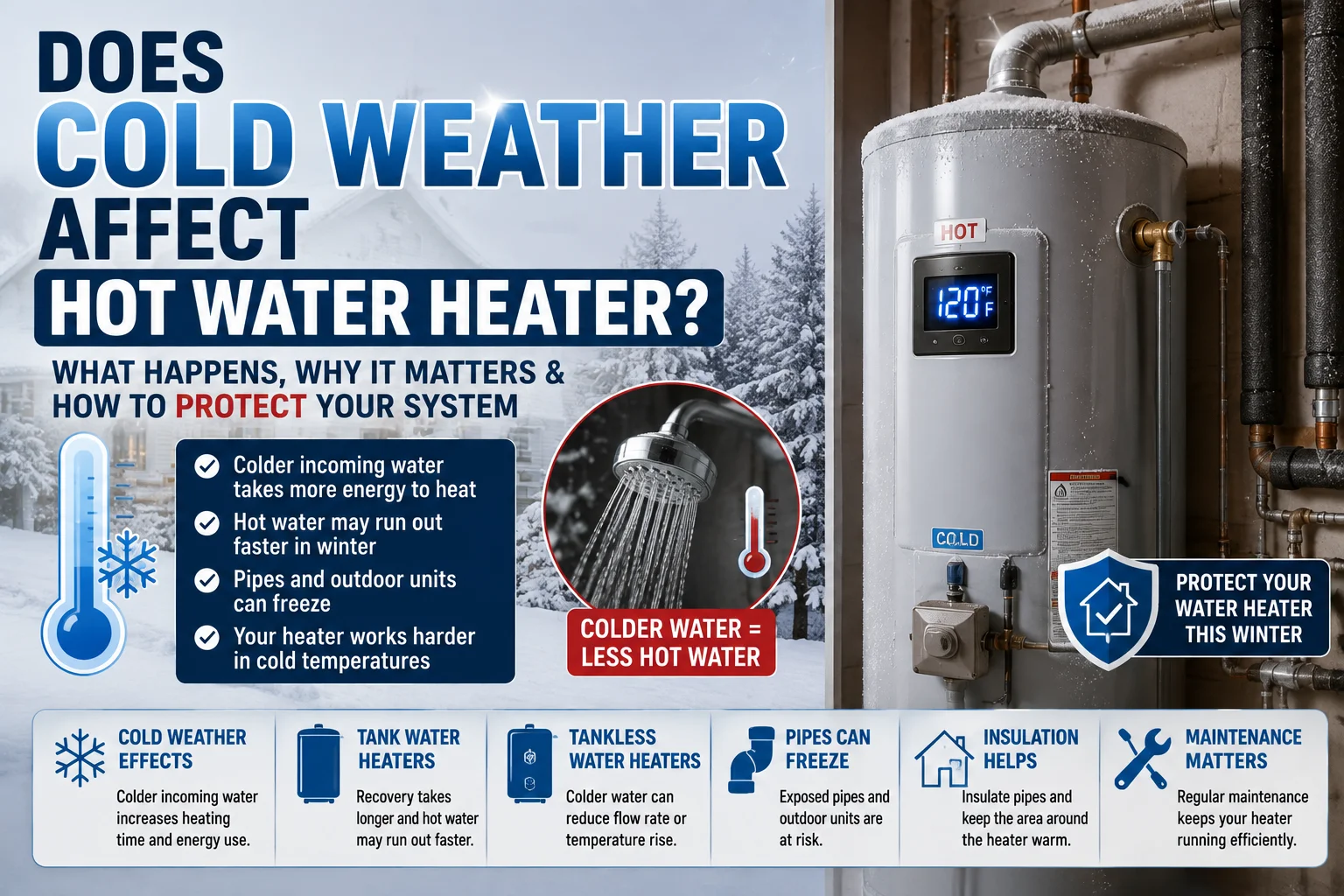
Yes, cold weather can affect your hot water heater — mainly because the water entering it during winter is colder than during warmer months, which means the unit has to work harder and longer to reach the same temperature. How noticeable this is depends on your water heater’s type, its capacity, how much hot water your household uses, how well the tank and pipes are insulated, and where the unit is installed. Separately, extreme cold can create its own risk if pipes or water-heater components are exposed to freezing temperatures — that’s a different problem from normal seasonal performance, and it’s worth understanding the difference before assuming something is broken.
Does Cold Weather Affect a Hot Water Heater?
Every water heater follows the same basic process: cold water enters the unit, the unit raises its temperature, and hot water is delivered to your fixtures. When the incoming water is colder — as it typically is in winter, since groundwater temperature drops with the season — the heater has a bigger temperature gap to close before the water reaches your desired setting.
That larger gap can show up as longer heating time, more energy use during heating cycles, and reduced hot-water recovery, meaning it takes longer for the tank to catch back up to full temperature after use. In some situations, this also means stored hot water gets used up faster than expected during periods of heavy demand, like back-to-back showers. None of this means the water heater is malfunctioning — it’s often just doing more work to overcome colder starting conditions.
Why Does Hot Water Run Out Faster in Winter?
The tank’s capacity hasn’t changed, and your household’s habits may not have changed much either — but the heating requirement per gallon has gone up because incoming water is colder. If several people take showers close together, the heater has less time to recover between uses, and colder incoming water makes that recovery gap more noticeable than it would be in summer.
It’s also common for winter demand to genuinely increase — people often take longer or hotter showers in cold weather, which adds real additional load on top of the seasonal temperature effect. This combination, rather than a single cause, is usually why “running out of hot water” feels like more of a problem in winter. It doesn’t automatically mean the water heater has failed; it may simply be reaching the edge of its normal capacity under harder conditions.
How Cold Weather Affects Different Types of Water Heaters
| Water Heater Type | How Cold Weather Can Affect It | Main Winter Concern |
|---|---|---|
| Traditional tank water heater | Colder incoming water increases heating and recovery demand | Recovery time |
| Tankless water heater | Colder incoming water increases the required temperature rise | Flow rate and temperature stability |
| Heat pump water heater | Cold conditions can affect efficiency depending on model and installation location | Operating conditions |
| Gas water heater | Cold incoming water increases heating demand | Recovery time and venting |
| Electric water heater | Cold incoming water increases heating demand | Recovery time |
| Outdoor tankless unit | Freezing temperatures create freeze-protection concerns | Frozen components or piping |
Manufacturer specifications vary significantly between models, so treat this table as general context rather than a guarantee of how your specific unit behaves.
Does Cold Weather Affect Tankless Water Heaters?
Tankless systems heat water as it flows through the unit rather than storing a tank of pre-heated water. The U.S. Department of Energy explains that tankless units are rated by the maximum temperature rise they can produce at a given flow rate — colder incoming water means a bigger temperature rise is needed to hit the same output temperature, which can reduce the maximum flow rate the unit can support while still delivering water at your desired setting.
Outdoor tankless units deserve separate attention. Navien’s own guidance explains that tankless water heaters carry a higher freezing risk than tank-style units precisely because they don’t store a reserve of already-heated water. Many modern units include built-in freeze protection, but that protection typically depends on the unit staying connected to power — Navien specifically warns not to unplug an outdoor unit during cold weather, since the internal freeze-protection function requires electricity to run. Freeze protection also depends on proper installation, gas supply where applicable, and following the manufacturer’s specific requirements. Don’t assume built-in freeze protection makes an outdoor unit immune to freezing — always follow the manufacturer’s installation and freeze-protection instructions for your specific model. Regardless of the season, sediment and mineral scale can also affect a tankless unit’s performance; see our guide on how to clean a tankless water heater if descaling is overdue.
Does Cold Weather Affect Traditional Tank Water Heaters?
Storage-tank systems respond to cold weather a bit differently. Colder incoming water still means longer recovery time and more energy used per heating cycle, but a well-insulated tank can hold onto stored heat reasonably well between uses. Standby heat loss — the gradual loss of heat from stored water sitting in the tank — happens year-round, but it’s more noticeable relative to a colder starting point in winter. Pipe insulation matters here too: even a well-performing water heater can deliver noticeably cooler water at the fixture if the hot-water pipes running through unconditioned spaces lose heat along the way.
Can Cold Weather Cause a Water Heater to Freeze?
The greatest freezing risk generally isn’t the water heater’s main tank itself, but exposed pipes and components — outdoor installations, unconditioned spaces, garages, crawl spaces, and any plumbing exposed to sustained freezing temperatures. Water expands as it freezes, and that expansion can crack pipes, fittings, and other plumbing components.
If you suspect a frozen pipe, don’t use an open flame to thaw it — this is a serious fire and safety hazard. Safe thawing methods generally involve gentle, controlled heat sources and patience, following manufacturer and local guidance, or calling a professional if you’re not confident handling it yourself.
Why Is My Water Heater Taking Longer to Heat in Winter?
A few explanations are worth considering, and they’re not mutually exclusive:
Colder incoming water is the most straightforward seasonal factor and applies to essentially every water heater to some degree.
Higher household demand — more showers, longer showers — can expose recovery limitations that weren’t obvious during lower-demand months.
Poor insulation, either around the tank or along exposed hot-water pipes, can let heat escape before it reaches the fixture.
Aging or undersized equipment that was barely keeping up before may show its limits more clearly once winter adds extra strain.
An actual mechanical problem is also possible if performance has changed dramatically rather than gradually. This could involve the heating element, burner, thermostat, gas supply, controls, sediment buildup, or another model-specific component — but without inspecting the unit, it’s not possible to pinpoint which one from a description alone.
Does Cold Weather Increase Water Heater Energy Use?
Generally, yes — colder incoming water requires more energy to reach the same target temperature, all else being equal. How much this affects your actual bill depends on several factors together: incoming water temperature, your thermostat setting, household demand, tank insulation, pipe insulation, the water heater’s overall efficiency, and the system type. Because these factors vary so much by household, region, and equipment, it’s not accurate to attach one universal percentage increase to “winter energy use” — actual impact varies considerably from home to home.
Can Cold Weather Cause Low Hot Water Pressure?
This is worth separating clearly: cold weather itself does not automatically cause low water pressure. Temperature and pressure are different things. If hot-water flow specifically feels weak in winter, possible causes include plumbing restrictions, a partially frozen pipe restricting flow, a clogged or restricted faucet or showerhead, a restriction on the water heater side, a valve problem, or a broader supply issue. If only hot water has low flow while cold water is normal, that points toward the water heater or the hot-water-side plumbing specifically, rather than a whole-house pressure problem. If it’s specifically your shower that feels weak, our guide on how to increase the water pressure in your shower covers fixture-level troubleshooting in more depth, and if multiple fixtures seem affected, why is my water pressure suddenly low walks through the broader whole-house diagnostic process.
How to Protect Your Water Heater During Cold Weather
- Insulate exposed hot-water pipes, especially any running through unheated spaces.
- Protect vulnerable plumbing in garages, crawl spaces, and other cold-prone areas.
- Keep required power available for any freeze-protection systems your unit depends on.
- Follow the manufacturer’s specific freeze-protection instructions for your model.
- Maintain proper ventilation for gas-fired systems — never block combustion-air openings or exhaust vents.
- Avoid unnecessary outdoor exposure for components not rated for it.
- Keep mechanical spaces reasonably protected from drafts and extreme cold.
- Inspect for leaks before severe cold weather arrives, since existing leaks can worsen with freeze-thaw cycles.
- Schedule routine maintenance when appropriate for your system type.
Never cover a gas water heater’s combustion air openings or vents, place flammable materials nearby, or use insulation methods that violate the manufacturer’s required clearances — these create fire and carbon monoxide risks that are far more dangerous than the cold weather itself.
What to Do if Your Water Heater Is Installed Outside
Outdoor installations need extra attention before cold weather arrives. Confirm whether your specific model is actually rated for outdoor use, what freeze protection the manufacturer provides and under what conditions it works, what backup protection (like a battery backup for power outages) may be needed, whether electrical power must remain continuously available for the unit’s freeze-protection function, and whether exposed water lines need additional insulation or heat tape. Manufacturer instructions take priority here over general advice, since freeze-protection design varies significantly between brands and models.
Signs Cold Weather Is Revealing a Real Water Heater Problem
Watch for: no hot water at all, water suddenly becoming much colder than normal rather than gradually cooler, repeated error codes, unusual noises, a burner that isn’t operating correctly, a tripped electrical breaker, a leaking tank, leaking connections, frozen or visibly damaged pipes, or repeated shutdowns.
If you smell gas, leave the area immediately and contact your gas utility’s emergency line or local emergency services according to local guidance. Do not attempt to troubleshoot a gas appliance yourself in this situation.
Simple Winter Troubleshooting Checklist
- Check whether the cold water temperature entering your home has noticeably changed.
- Determine whether the issue affects all hot-water fixtures or just one.
- Check whether household demand has been unusually high recently.
- Inspect any accessible pipes for obvious signs of freezing or damage.
- Check the water heater’s display for error codes, if it has one.
- Confirm power availability for electric systems and any freeze-protection features.
- Verify manufacturer-required freeze protection is active for outdoor units.
- Look for any signs of leaking.
- Never block vents or combustion-air openings while inspecting.
- Call a qualified professional if the problem persists after these checks.
When Should You Call a Plumber?
Professional help is appropriate when there’s no hot water at all, the unit repeatedly shuts down, error codes keep appearing, pipes may be frozen or damaged, the water heater is leaking, the system is making unusual noises, hot water performance has changed significantly and suddenly, an outdoor tankless system shows signs of freezing, a gas appliance seems unsafe in any way, or basic troubleshooting hasn’t resolved the issue.
Frequently Asked Questions
1. Does cold weather affect a hot water heater?
Yes. Colder incoming water requires more energy and time to heat, which can mean longer recovery times and reduced available hot water during winter — this is a normal seasonal effect, not necessarily a malfunction.
2. Why does my hot water run out faster in winter?
Colder incoming water takes longer to reheat, so the tank recovers more slowly between uses. Combined with potentially higher winter demand — longer or more frequent showers — this can make hot water feel like it runs out faster.
3. Does cold weather affect tankless water heaters?
Yes. Colder incoming water requires a bigger temperature rise, which can reduce the maximum flow rate the unit can support at your desired temperature. Outdoor tankless units also carry additional freeze-protection considerations.
4. Can a water heater freeze in cold weather?
The tank itself is less commonly the issue — exposed pipes and components, especially in unconditioned spaces or outdoor installations, carry the greatest freezing risk. Water expands when it freezes, which can damage plumbing.
5. Why does my water heater take longer to heat in winter?
Colder incoming water is the main factor, but higher household demand, poor pipe or tank insulation, aging equipment, or an actual mechanical problem can all contribute or compound the effect.
6. Does cold weather increase water heater energy use?
Generally yes, since more energy is needed to heat colder water to the same target temperature. The actual increase varies by household, equipment, and region, so there’s no single universal percentage that applies to everyone.
7. Can cold weather cause low hot water pressure?
Not directly — temperature and pressure are different things. If hot water flow specifically feels weak, look at plumbing restrictions, partially frozen pipes, fixture-side issues, or a water heater-side restriction rather than assuming cold weather alone is the cause.
8. How do I protect my water heater in winter?
Insulate exposed hot-water pipes, protect vulnerable plumbing in cold areas, keep power available for any freeze-protection systems, follow your manufacturer’s specific instructions, and never block combustion-air openings or vents on gas units.
9. Can outdoor tankless water heaters freeze?
Yes, and they carry a higher freezing risk than tank-style units since they don’t store already-heated water. Built-in freeze protection typically requires continuous power, so losing electricity during a freeze can leave the unit vulnerable.
10. When should I call a plumber for winter water heater problems?
Call a plumber if there’s no hot water, the unit shows error codes or shuts down repeatedly, you suspect frozen or damaged pipes, there’s a leak, or performance has changed suddenly and significantly rather than gradually.
Conclusion
Cold weather can genuinely affect hot-water performance, mainly because incoming water is colder and requires more energy and time to heat. Both tank and tankless systems can show this effect, though in somewhat different ways, and outdoor installations carry additional freeze-protection considerations that indoor units don’t face. None of this automatically means your water heater is malfunctioning — normal seasonal strain looks different from an actual fault. Pay attention to sudden changes, error codes, leaks, unusual noises, or freezing, and treat those as signs to call a professional rather than something to wait out.