If your tankless water heater has started taking longer to deliver hot water, the temperature seems to drift up and down mid-shower, or you’ve noticed a low, popping sound coming from the unit, mineral scale is often the culprit. Inside the heat exchanger — the coiled metal passage where your water actually gets heated — calcium and magnesium can build up over time and quietly rob the system of performance. For Temecula homeowners, that’s usually a sign it’s time to clean the unit rather than replace it.
This guide walks through exactly how to clean, flush, and descale a tankless water heater, what tools you’ll need, how often the job should be done, and how to tell the difference between a job you can handle yourself and one that calls for a professional.
What Is Tankless Water Heater Descaling?
“Descaling” refers to removing mineral scale — hardened deposits of calcium and magnesium — from inside a tankless water heater’s heat exchanger. As water flows through the unit and gets heated, dissolved minerals in the water can precipitate out and stick to the internal surfaces, similar to the way a kettle develops a chalky white coating over time.
A few related terms get used interchangeably, but they mean slightly different things:
- Cleaning is the general term for maintaining the unit — descaling, filter cleaning, and inspection combined.
- Flushing means running fluid (either a cleaning solution or plain water) through the system to move debris and buildup out.
- Descaling specifically refers to using an acidic solution to dissolve mineral scale, followed by a clean-water flush to rinse it out.
In practice, a full tankless water heater cleaning includes both descaling and flushing, plus a check of the inlet filter and connections.
Why Does a Tankless Water Heater Need Cleaning?
Tankless units heat water on demand by passing it through a narrow heat exchanger at high speed. That design is efficient, but it also means even a thin layer of scale can meaningfully affect performance, because it insulates the heat exchanger and slightly narrows the water passage. Over time this can lead to:
- Reduced water flow through the unit
- Less efficient heat transfer, meaning the burner or heating element works harder for the same result
- Temperature fluctuations during use
- Increased strain on internal components
- A shorter operating life if buildup is left unaddressed
How quickly this happens depends on several factors:
- Water hardness in your area
- Household hot-water usage (more use means more mineral exposure)
- The specific water heater model and its heat exchanger design
- Manufacturer maintenance recommendations
- Whether a water softener or filtration system is already in place
This applies to tankless units throughout the region, including homes in Temecula. Water hardness varies by property and water source, so rather than assuming a fixed hardness level, it’s worth checking your own water utility’s water quality report or having your water tested if you’re unsure.
Signs Your Tankless Water Heater Needs Cleaning
None of these symptoms guarantees that scale is the cause — several can point to other issues — but they’re worth paying attention to:
- Noticeably reduced hot-water flow
- Water temperature that fluctuates or “hunts” during use
- Longer wait times for hot water to reach the tap
- Popping, rumbling, or knocking sounds from the unit
- Error codes related to flow or overheating
- Visible mineral deposits around fittings or the inlet filter
- The unit shutting down mid-use
- Generally inconsistent hot water performance
If you’re seeing more than one of these signs at once, that’s a stronger indicator that a cleaning is due.
How Often Should You Clean a Tankless Water Heater?
Most manufacturers recommend descaling a tankless water heater once a year, though homes with harder water or heavier hot-water use may need it more often — sometimes every six to nine months. Homes with a water softener installed, or naturally soft water, can sometimes go longer between cleanings.
There isn’t one universal interval that fits every household, because the right schedule depends on:
- How hard your water is
- How much hot water your household uses
- The manufacturer’s specific recommendation for your model
- Whether you already have water treatment equipment installed
- Whether you’re noticing early warning signs of buildup
The safest approach is to follow the maintenance interval listed in your unit’s owner’s manual, and adjust it based on how the system is actually performing.
What You Need to Clean a Tankless Water Heater
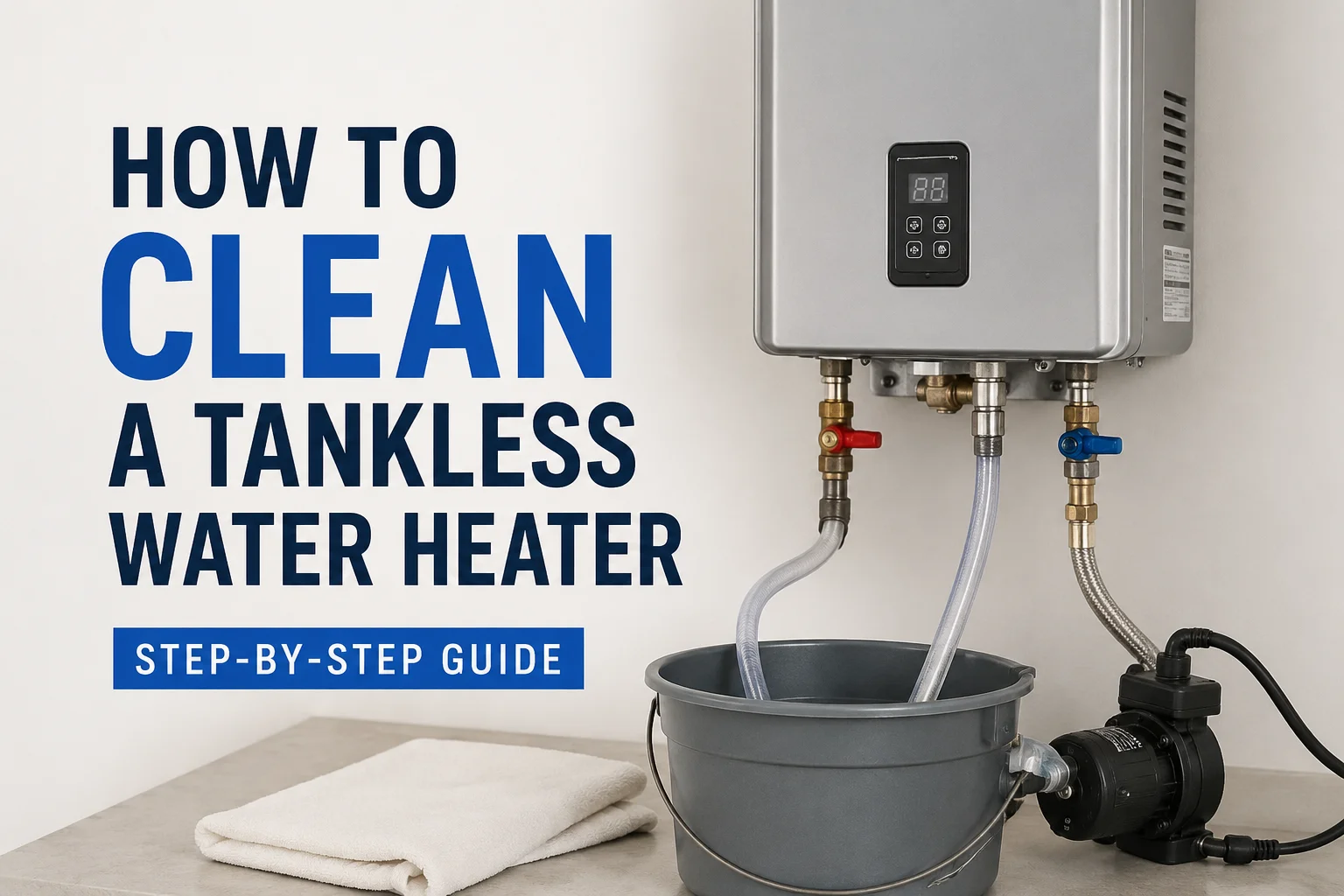
Most DIY descaling kits include everything below, or you can assemble the pieces individually.
| Item | What It’s For |
|---|---|
| Submersible pump | Circulates the descaling solution through the heat exchanger |
| Two flush hoses | Connect the pump and bucket to the unit’s service valves |
| Descaling solution | Dissolves mineral scale (manufacturer-approved solution or food-grade white vinegar, depending on your unit) |
| 5-gallon bucket | Holds the solution while it’s circulated |
| Adjustable wrench | Opens and closes fittings and service valve caps |
| Towels | Catches drips and spills during hose connection |
| Gloves | Protects skin from the descaling solution |
| Safety glasses | Protects eyes from splashes |
The exact equipment can vary depending on your water heater’s brand and how it was installed, so it’s worth checking your owner’s manual before you buy a kit.
Safety Before You Start Cleaning
Before touching any valves, take these steps:
- Turn off the water heater according to the manufacturer’s shutdown instructions
- Close the appropriate water isolation valves
- Turn off electrical power at the breaker for electric units, or where required for gas units
- Shut off the gas supply on gas-fired units
- Let the unit cool before working on it
- Wear gloves and safety glasses
It’s important to draw a clear line here: routine descaling and filter cleaning are water-side maintenance tasks that many homeowners can safely perform. Gas line work, electrical repairs, venting issues, and anything involving the combustion chamber are a different category entirely. Those should be left to a licensed technician, and homeowners shouldn’t attempt to disassemble those components.
How to Clean a Tankless Water Heater: Step-by-Step
Step 1: Turn Off the Water Heater
Follow your manufacturer’s shutdown sequence — this typically means powering down the unit, then shutting off gas or electrical supply as applicable. Give the system a few minutes to cool.
Step 2: Close the Water Isolation Valves
Most tankless units have hot and cold isolation valves near the unit, often with built-in service ports. Close both valves to stop water from flowing through the heat exchanger. Valve placement and design vary between installations, so locate yours before proceeding.
Step 3: Connect the Flush Hoses
Attach one hose to the cold water service port and the other to the hot water service port. Run the free ends of both hoses into your bucket. Place the submersible pump in the bucket as well, connected to the hose feeding the cold water port.
Step 4: Prepare the Descaling Solution
Fill the bucket with a manufacturer-approved descaling solution, or food-grade white vinegar if your manufacturer permits it — check your owner’s manual first. Avoid mixing different chemicals or substituting household cleaners; some can damage internal components or react unpredictably.
Step 5: Circulate the Solution
Open both service valves and turn on the pump. The solution will circulate through the heat exchanger, working to dissolve mineral scale as it flows. Circulation time varies by manufacturer and how much buildup is present, so follow the instructions that came with your descaling solution and your water heater’s manual rather than a fixed number.
Step 6: Flush With Clean Water
Once circulation is complete, disconnect the pump and run clean water through the system for several minutes. This step matters — it clears out the descaling solution along with any loosened scale and debris, preventing residue from reaching your household plumbing.
Step 7: Restore Normal Water Flow
Close the service valves, remove the hoses, and cap the service ports. Slowly open the hot and cold isolation valves and check every connection for leaks before moving on.
Step 8: Restart and Test the Unit
Restore power and gas per the manufacturer’s instructions, then run a hot water tap. Check for:
- Steady water temperature
- Normal hot-water flow
- Any lingering error codes
- Leaks at the connections you worked on
- Unusual sounds during operation
How to Flush a Tankless Water Heater
Flushing is the part of the process where fluid — either the descaling solution or clean water — is actively moved through the unit. You’ll flush twice during a full cleaning: once with the descaling solution to loosen scale, and again with clean water to rinse it out. The clean-water flush is what actually removes the dissolved minerals and prevents residue from settling back into the heat exchanger, so it shouldn’t be shortened or skipped.
How to Descale a Tankless Water Heater
Descaling addresses the mineral deposits themselves. Scale tends to form wherever water moves slowly or heats up — which is exactly what happens inside the heat exchanger. As the acidic descaling solution circulates, it breaks down calcium and magnesium deposits so they can be flushed out with clean water afterward. Proper rinsing afterward matters as much as the descaling step itself; leftover solution left inside the unit can affect water quality or, over time, contribute to corrosion. Always follow your specific manufacturer’s descaling instructions, since circulation times, approved solutions, and valve configurations differ between brands.
Tankless Water Heater Maintenance Beyond Descaling
Descaling is the most talked-about maintenance task, but it’s not the only one. A complete maintenance routine also includes:
- Cleaning the inlet water filter
- Checking all connections for leaks
- Inspecting venting on units where it’s accessible
- Checking condensate lines and components on condensing units
- Reviewing any stored error codes
- Following the manufacturer’s full maintenance checklist
Skipping these secondary checks is a common reason homeowners keep running into the same problems even after descaling.
How to Clean the Tankless Water Heater Filter
Most tankless units have an inlet filter or screen that catches sediment before it reaches the heat exchanger. A clogged filter can restrict water flow in a way that mimics scale buildup. Generally, cleaning it involves:
- Shutting off the water supply
- Removing the filter housing (location varies by model)
- Rinsing the screen under clean water to remove debris
- Reinstalling it securely before restoring water flow
Because filter housings differ between manufacturers, check your owner’s manual for the exact removal process for your unit.
Common Tankless Water Heater Cleaning Mistakes
- Using an unapproved chemical instead of a manufacturer-recommended solution
- Mixing different cleaning chemicals together
- Skipping or rushing the final clean-water flush
- Ignoring manufacturer-specific instructions in favor of generic advice
- Forgetting to check connections for leaks after reassembly
- Neglecting the inlet filter entirely
- Using excessive force on valves or fittings
- Assuming every model has the same valve layout
- Attempting gas or electrical repairs without the proper qualifications
Can You Clean a Tankless Water Heater Yourself?
For many homeowners, yes — routine descaling and filter cleaning are manageable DIY tasks if the unit has accessible service valves and you’re comfortable following the manufacturer’s steps carefully.
That said, professional help is the better call when:
- There are no accessible service valves for flushing
- You’re unsure how your specific system was installed
- The unit is showing persistent error codes even after cleaning
- You suspect a gas-related issue
- There’s any electrical problem
- You notice a water leak
- The heat exchanger itself may be damaged
- Buildup appears severe or the unit has gone a long time without maintenance
- The system keeps shutting down repeatedly
If a tankless water heater in your Temecula home continues showing performance problems after a routine cleaning, that’s usually a sign the issue goes deeper than scale and warrants a professional diagnosis rather than another cleaning cycle.
When Should a Temecula Homeowner Call a Professional?
A short local note: professional water heater service in Temecula is worth considering when cleaning doesn’t resolve the symptoms, when the unit is leaking, when error codes persist, or when you suspect a gas or electrical issue rather than simple scale buildup. A qualified technician can also confirm whether the heat exchanger itself has sustained damage — something that isn’t always obvious from the outside. For homeowners who’d rather not deal with the hoses, pump, and valve setup themselves, tankless water heater service in Temecula is also a reasonable option for routine annual maintenance.
Does Cleaning Improve Tankless Water Heater Performance?
Removing mineral scale can help restore heat transfer, water flow, and more consistent heating performance — but cleaning isn’t a fix for every issue. Problems like a failing sensor, a venting obstruction, or a wiring fault can produce symptoms that look similar to scale buildup. If performance doesn’t improve noticeably after a proper cleaning, it’s worth having the unit inspected rather than repeating the descaling process.
What Happens If You Never Clean a Tankless Water Heater?
Left unaddressed, mineral scale tends to accumulate gradually rather than all at once. Over time this can lead to reduced heat transfer, restricted water flow, more frequent error codes, and added strain on internal components. It doesn’t necessarily mean the unit will fail outright, but consistently skipping maintenance does increase the chances of running into avoidable problems and shortens the practical service life of the system.
Tankless Water Heater Maintenance Checklist
| Maintenance Task | Why It Matters | Recommended Frequency |
|---|---|---|
| Descaling/flushing | Removes mineral buildup from the heat exchanger | Follow manufacturer guidance and local water conditions |
| Inlet filter cleaning | Maintains proper water flow | Check periodically, clean as needed |
| Leak inspection | Catches problems before they worsen | Every time you perform maintenance |
| Error-code review | Flags issues that need attention | As they occur |
| Vent inspection | Supports safe, proper operation | Per manufacturer guidance |
| Professional inspection | Identifies deeper or hidden issues | As recommended by your manufacturer or technician |
Tankless Water Heater Maintenance in Temecula
For homeowners in Temecula, the fundamentals of tankless water heater care don’t change — but a few local factors are worth keeping in mind. Water conditions can vary from property to property, and harder water can accelerate scale formation inside the heat exchanger, so it’s worth paying attention to how your unit performs over time rather than assuming a one-size-fits-all schedule. Following your manufacturer’s recommended maintenance interval, watching for early changes in water flow or temperature, and addressing small issues before they become bigger ones all go a long way toward keeping a tankless system reliable in a Temecula home.
How Much Does Tankless Water Heater Cleaning Cost?
Cost varies based on several factors rather than a single flat rate: the water heater’s model, how accessible the service valves are, how much mineral buildup has accumulated, labor time, the cleaning solution used, and whether any additional issues are discovered during service. If you’re getting professional water heater service in Temecula, it’s reasonable to ask for a written estimate before work begins so you know what’s included.
How Long Does Tankless Water Heater Cleaning Take?
A straightforward descaling and flush often takes roughly one to two hours from setup to restart, but the actual time depends on the unit type, how the system was installed, how much scale has built up, how accessible the service valves are, and whether additional maintenance tasks (like filter cleaning) are done at the same time. Rather than expecting an exact timeframe, plan for a couple of hours if you’re doing it yourself for the first time.
How to Prevent Mineral Buildup
- Stick to a regular maintenance schedule
- Consider water filtration if sediment is a recurring issue
- Consider a water softener if your water is notably hard
- Monitor your local water hardness if you’re unsure
- Clean the inlet filter periodically
- Follow your manufacturer’s specific recommendations
- Address reduced water flow early rather than waiting
Not every home needs a water softener — it depends on your specific water conditions, so it’s worth testing your water or checking your utility’s water quality report before investing in equipment.
Frequently Asked Questions
How do I clean a tankless water heater?
Cleaning involves shutting off the unit, connecting a pump and hoses to the service valves, circulating a descaling solution through the heat exchanger, then flushing with clean water and restoring normal operation. The full process is outlined step-by-step above.
How often should I clean a tankless water heater?
Most manufacturers recommend annual descaling, though homes with harder water or heavier usage may need it more often. Check your owner’s manual for the specific interval recommended for your model.
How do I flush a tankless water heater?
Flushing means running fluid through the unit’s service valves using a pump — first the descaling solution, then clean water to rinse it out. Both steps are necessary for a complete cleaning.
How do you descale a tankless water heater?
Descaling uses an acidic solution circulated through the heat exchanger to dissolve mineral deposits, followed by a thorough clean-water flush. Manufacturer instructions should guide the specific solution and circulation time.
What can I use to descale a tankless water heater?
Many manufacturers approve food-grade white vinegar, while others recommend a specific commercial descaling product. Check your owner’s manual before choosing a solution, since not every chemical is safe for every unit.
Can I clean my tankless water heater myself?
Often, yes, if your unit has accessible service valves and you follow the manufacturer’s instructions carefully. If you’re unsure about your installation, seeing persistent error codes, or dealing with gas, electrical, or leak issues, a professional is the safer choice.
What happens if I don’t descale my tankless water heater?
Scale tends to build up gradually, reducing heat transfer and water flow over time and increasing strain on the system. It doesn’t guarantee failure, but it does raise the risk of avoidable problems.
How long does a tankless water heater flush take?
A typical descaling and flush takes roughly one to two hours, though this varies by unit, installation, and how much buildup is present.
Does vinegar clean a tankless water heater?
White vinegar is a commonly used descaling agent for many tankless units, but not all manufacturers approve it. Confirm with your owner’s manual before using it.
How do I know if my tankless water heater needs cleaning?
Watch for reduced hot-water flow, temperature fluctuations, longer wait times for hot water, unusual noises, or error codes. Any combination of these is a good reason to check the maintenance schedule.
Does hard water affect a tankless water heater?
Yes — harder water contains more dissolved minerals, which can accelerate scale formation inside the heat exchanger. Homes with harder water often need more frequent descaling.
How often should a tankless water heater be serviced?
Beyond annual descaling, most manufacturers recommend periodic filter cleaning, leak checks, and inspection of venting and condensate components as part of routine service.
Can a dirty tankless water heater cause low water pressure?
A clogged inlet filter or scale-restricted heat exchanger can reduce hot-water flow, which can feel similar to low water pressure. It’s worth checking both the filter and the heat exchanger if you notice this symptom.
When should I call a water heater professional in Temecula?
If cleaning doesn’t resolve the issue, the unit is leaking, error codes persist, or you suspect a gas or electrical problem, it’s time to bring in professional water heater service in Temecula rather than continue troubleshooting on your own.
How often should tankless water heaters in Temecula be cleaned?
The same general guidance applies locally: follow your manufacturer’s recommended interval, typically annually, and adjust based on your household’s water conditions and usage. If you’re unsure about your local water hardness, checking your water utility’s report or having your water tested can help set the right schedule.
Conclusion
Tankless water heaters are efficient, but they still need regular attention. Mineral scale builds up gradually inside the heat exchanger, and left unchecked, it can chip away at water flow, heating performance, and the system’s overall lifespan. A proper cleaning — descaling followed by a thorough clean-water flush, plus a check of the inlet filter and connections — is something many homeowners can do themselves with the right tools and by following their manufacturer’s instructions closely.
That said, cleaning isn’t a fix for everything. If your tankless water heater in Temecula is still showing low flow, temperature swings, leaks, or error codes after routine maintenance, that’s usually a sign the underlying issue needs a professional look rather than another cleaning cycle. A qualified technician can diagnose whether you’re dealing with scale, a failing component, or something else entirely — and get your hot water back to normal.