
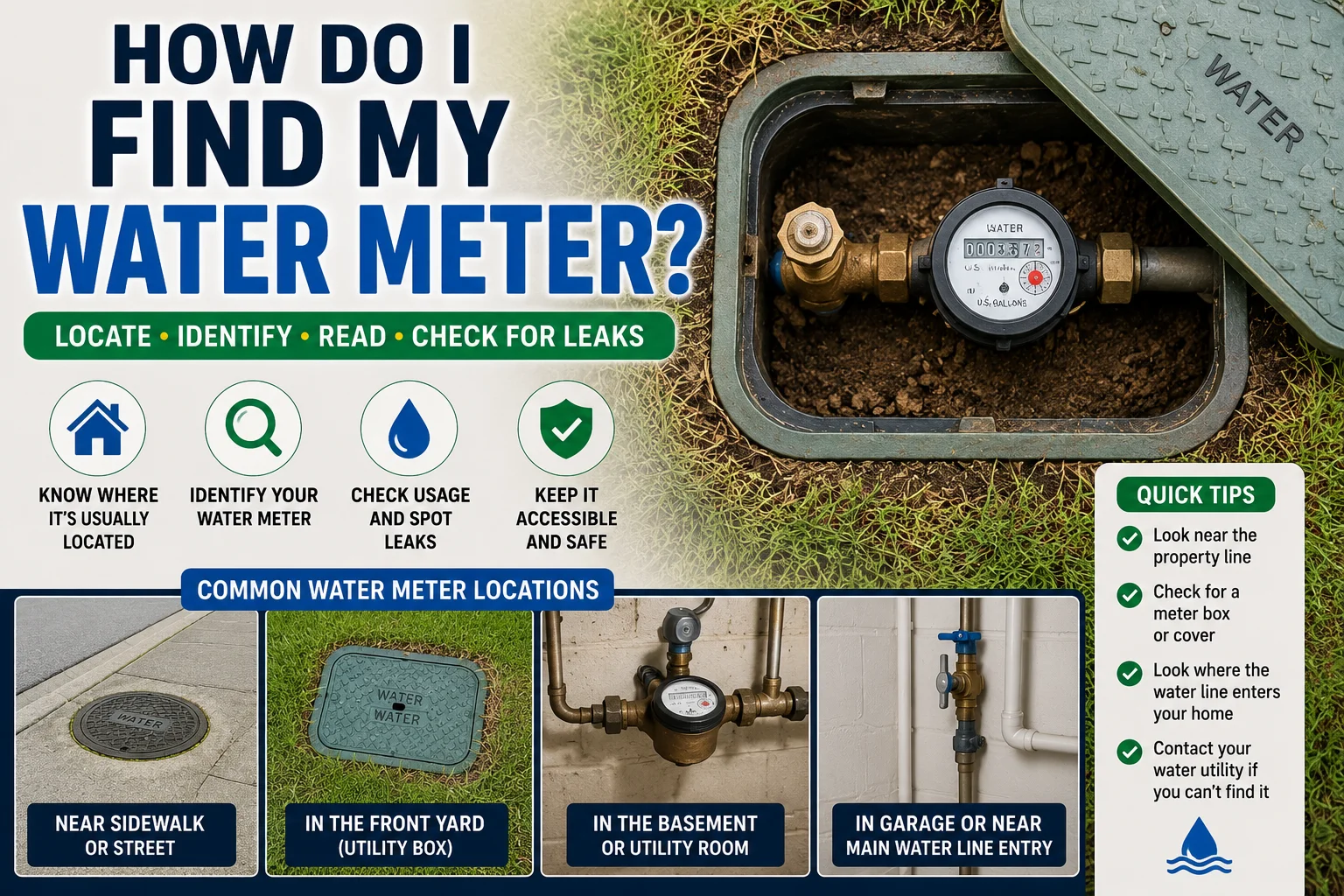
If you’re asking “how do I find my water meter,” the short answer is: check near the property line first, usually in a small box near the sidewalk or street, since that’s the most common location for residential water meters. Some homes have the meter installed elsewhere, including inside the house. The exact spot depends on your local water utility, your property’s layout, and sometimes the age of the home. The easiest approach is to check the most likely spots based on how your home was built, then look for a labeled meter box or the meter itself. This guide walks through where to look, how to identify what you’ve found, and what to do if you still can’t locate it.
Where Is My Water Meter Usually Located?
Water meter placement isn’t universal. It depends heavily on your local utility’s standard practices, so it helps to check a few common locations.
Near the Sidewalk or Street
Many utilities place residential water meters near the property boundary, close to the sidewalk or street. Look for a small rectangular or round cover, often plastic or concrete, sometimes marked “Water” or with a utility logo. Not every meter box is labeled, so don’t rule it out just because you don’t see obvious markings.
In the Front Yard
Some water meters are installed within the front lawn or a landscaped area rather than right at the sidewalk. Look for a small access cover that may be slightly raised or flush with the ground, typically located along the path the water service line would take from the street to the house. Avoid digging randomly if you can’t spot a cover; a visual search is usually enough.
Near the Property Line
In many cases, the meter sits closer to the street than to the house itself, near where your property meets the public right-of-way. The exact distance and placement vary by city and utility, so this is more of a general starting point than a fixed rule.
Inside the House
Some homes, particularly in colder climates or specific municipalities, have an indoor water meter instead of an outdoor one. Common indoor locations include:
- Basement
- Utility room
- Mechanical room
- Garage
- Crawl-space access area
- Near where the main water line enters the house
Whether your meter is indoors or outdoors depends on local utility practices and how the home was constructed, so check both possibilities if you’re not sure.
Apartment, Condo, or Multi-Unit Property
In apartments, condos, and other multi-unit properties, individual meters are often grouped together in a shared utility room, basement, or exterior utility area. Access may be controlled by building management or the utility provider rather than by individual residents, so you may need to ask your property manager if you can’t find a unit-specific meter on your own.
What Does a Water Meter Look Like?
Residential water meters vary in appearance depending on age and manufacturer, but most share a few common features:
- A round or rectangular body
- Either a digital display or a mechanical dial with numbers
- A number readout used for billing
- A flow indicator on some models, such as a small spinning dial or triangle
- Pipe connections where water enters and exits the meter
- A shutoff valve nearby on some installations
Don’t assume every meter looks identical. Older mechanical meters often have a simple dial face, while newer digital meters may show a straightforward number display, sometimes with additional icons for leak detection or usage alerts.
How to Find Your Water Meter Step by Step
Step 1: Check Your Water Bill
Some utility bills or online account portals include a meter number or basic service location details. This won’t always include a precise map, but it can be a helpful starting point.
Step 2: Check Near the Sidewalk or Street
Walk the edge of your property near the street and look for a small ground-level box or cover, which is the most common meter location for many utilities.
Step 3: Check the Front Yard
If you don’t see anything near the sidewalk, scan the front lawn or landscaped areas for a similar access cover, especially along a line between the street and your home’s main water entry point.
Step 4: Find Where the Main Water Line Enters the Home
Look for the visible point where your main water supply line enters the house, often in a basement, crawl space, or utility area. This can give you a clue about which direction the service line runs toward the street or meter, without needing to dig anywhere.
Step 5: Check the Basement, Garage, or Utility Area
If your home may have an indoor meter, check basements, garages, mechanical rooms, and utility closets near where plumbing lines are grouped together.
Step 6: Contact Your Water Utility
If you still can’t locate the meter, your local water utility is usually the most reliable source for confirming its exact location. Have your property address ready, along with your account information and meter number if you know it. Every utility has its own contact process, so check your bill or the utility’s website for the correct number to call.
How Do I Know If I Found My Water Meter?
Once you’ve located a likely candidate, check for these signs to confirm it’s actually the water meter:
- It’s connected to the home’s incoming water service line
- It displays a numerical reading
- It has a dial or digital screen
- It sits inside a recognizable meter box or housing
- It has visible plumbing connections entering and leaving it
It’s easy to confuse a water meter with other nearby components, so it helps to know the difference between a meter, a shutoff valve, a pressure regulator, and a separate irrigation meter if your property has one.
Water Meter vs Main Water Shutoff
These two components are often near each other but serve different purposes.
| Component | Main Purpose |
|---|---|
| Water meter | Measures water consumption |
| Main shutoff valve | Stops water flow to the property/home |
| Pressure regulator | Controls incoming water pressure |
| Irrigation meter | Measures irrigation water where separately installed |
A shutoff valve may be located right next to the meter, but its exact position varies by property, so don’t assume the two are always side by side.
How to Access Your Water Meter
For outdoor meters:
- Only remove a cover that’s clearly designed to be homeowner-accessible.
- Keep the surrounding area clear of leaves, soil buildup, and debris so you can check it easily.
- Don’t force a stuck or rusted cover; contact your utility instead.
- Don’t attempt to enter a utility vault or below-ground vault space.
- Avoid damaging any utility-owned equipment while inspecting the area.
For indoor meters:
- Keep the surrounding area clear and accessible.
- Avoid moving or modifying plumbing just to get a better view of the meter.
If a cover is locked, stuck, or appears to be utility-restricted, contact your water provider rather than trying to force access.
Can I Find My Water Meter Without Digging?
In most cases, yes. Water meter boxes are typically installed at or near ground level specifically so they can be accessed without digging. If you can’t spot the box visually, safe next steps include:
- Checking your utility’s website or account portal for service information
- Contacting your water provider directly
- Looking carefully along the property boundary near the street
- Looking for small utility markings or flags in the yard, if present
Avoid digging around buried utility infrastructure, since underground water lines and other utilities can be damaged, and some digging near utility lines may require you to contact a local utility locating service first.
How to Read a Water Meter
Reading a water meter depends on the type installed.
Mechanical Meters
Older mechanical meters typically use a rotating dial or a series of numbered dials, similar to an odometer, showing cumulative water usage.
Digital Meters
Digital meters usually display a straightforward number readout on a small screen, and some newer models cycle through additional information like flow rate or possible leak alerts.
Flow Indicator
Many meters include a small flow indicator, such as a spinning triangle or star-shaped dial, which moves whenever water is passing through the meter, even in small amounts.
Keep in mind that your utility’s billing calculation may work differently than the raw number shown on the meter, so contact your provider if you have questions about how your bill is calculated.
How to Use Your Water Meter to Check for a Leak
Your water meter can help you get a basic sense of whether water is running somewhere in your home when it shouldn’t be:
- Turn off all faucets and water-using appliances.
- Confirm that no one else in the home is using water.
- Locate and observe the meter.
- Watch to see if the reading changes or the flow indicator moves.
- If it looks like water is flowing while everything is off, investigate further.
Keep in mind that some equipment uses water intermittently, including toilets with a slow fill cycle, water softeners during a regeneration cycle, irrigation systems, and ice makers. A moving meter doesn’t automatically mean there’s a major leak, but persistent movement with everything off is worth investigating further, whether that means checking fixtures yourself or calling a plumber.
Where Is the Water Meter Shutoff Valve?
Shutoff arrangements vary by property and utility. You may find:
- A valve located right at or near the meter
- A separate main shutoff valve inside the home
- A utility-side shutoff, which is generally not meant to be operated by homeowners
- A homeowner-side shutoff valve, where applicable
Don’t attempt to operate a utility-owned valve unless your local provider specifically allows it. In most cases, if you need to shut off water to your home for plumbing work, your home’s main shutoff valve is the more appropriate and accessible option compared to utility-side equipment near the meter.
Why Can’t I Find My Water Meter?
If you’ve searched and still can’t locate your meter, a few possibilities could explain why:
- The meter is buried or covered by soil buildup
- Landscaping has grown over the meter box
- The meter is located inside the home rather than outside
- The property shares a meter with a neighboring unit
- The meter sits within a utility easement you haven’t checked
- The meter box itself is damaged or missing
- The home has an unusual plumbing layout
- The meter has been relocated at some point
- The property has a separate irrigation meter that’s being confused with the main meter
Your local water utility can confirm the official meter location on file for your property, which is often the fastest way to resolve ongoing confusion.
What If My Water Meter Box Is Buried or Damaged?
If you find that your meter box is buried, cracked, or otherwise inaccessible:
- Don’t dig randomly around the suspected area.
- Avoid actions that could damage the meter or the underground service line.
- Contact your water utility, since they typically own and maintain the meter itself.
- A plumber can help with plumbing issues on your side of the meter, but the utility generally controls the meter and its box.
Understanding this distinction can save you time, since a plumber usually can’t legally or practically service utility-owned equipment.
When Should You Call a Plumber?
Consider calling a plumber if:
- You’ve found the meter but can’t locate your home’s main shutoff valve
- There’s a leak near the meter on your side of the property
- Your main shutoff valve is stuck or won’t turn
- The water service line appears visibly damaged
- Plumbing near the meter is leaking
- You need changes made to your home’s plumbing
- You suspect a water pressure problem
For anything involving the utility-owned meter itself, contact your water provider instead. If a suspected leak near a fixture, like a leaking garbage disposal connection, turns out to be unrelated to the meter reading, a plumber can help pinpoint the actual source.
Frequently Asked Questions
How do I find my water meter?
Start by checking near the sidewalk or street, since that’s the most common location for residential meters. If you don’t see a meter box there, check your front yard, then consider whether your home might have an indoor meter in the basement, garage, or utility area.
Where is a water meter usually located?
Most residential water meters are located near the property line, often in a small box close to the sidewalk or street. However, some homes have meters in the front yard, and others have indoor meters, so location can vary by utility and property.
Is the water meter usually inside or outside?
It depends on your local utility and how your home was built. Outdoor meters near the street or yard are common in many areas, while some homes, especially in certain regions or climates, have indoor meters instead.
What does a residential water meter look like?
Most meters have a round or rectangular body with either a digital display or a mechanical dial showing a number reading. Many also include a small flow indicator that moves when water passes through the meter.
How do I find my water meter if there is no meter box in my yard?
Check for an indoor meter in your basement, garage, or utility room. If you still can’t find it, contact your local water utility, which can confirm the exact registered location for your property.
Is the water shutoff valve next to the water meter?
Sometimes, but not always. A shutoff valve may be located near the meter, but many homes also have a separate main shutoff valve inside the house, which is often more practical for homeowners to use.
Can I use my water meter to check for a leak?
Yes. Turn off all faucets and water-using appliances, then watch the meter to see if the reading or flow indicator still moves. Keep in mind that some appliances use water intermittently, which can affect the result.
Can I open my water meter box?
You can typically open a homeowner-accessible cover to check the meter, but avoid forcing a stuck or locked cover, and never attempt to enter a utility vault or damage utility-owned equipment.
Who do I call if I cannot find my water meter?
Contact your local water utility. They maintain records of your meter’s official location and can guide you to it, especially if it’s buried, damaged, or in an unusual spot.
How do I know if I found the correct water meter?
Confirm that it’s connected to your home’s incoming water line, has a numerical reading or dial, and sits inside a recognizable meter housing. If you’re unsure, comparing it against your utility’s account information can help confirm it’s the right one.
Conclusion
Most residential water meters are located near the property line, often in a small box close to the sidewalk or street, though some homes have meters in the front yard or indoors. The exact location depends on your local utility and how your property was built. Start by checking the most common outdoor spots, then look indoors if needed, and always look for a labeled or identifiable meter box rather than digging blindly. If you still can’t find your meter or the box is damaged or inaccessible, contact your local water utility for help. A plumber can assist with shutoff valves and plumbing issues on your side of the connection.