
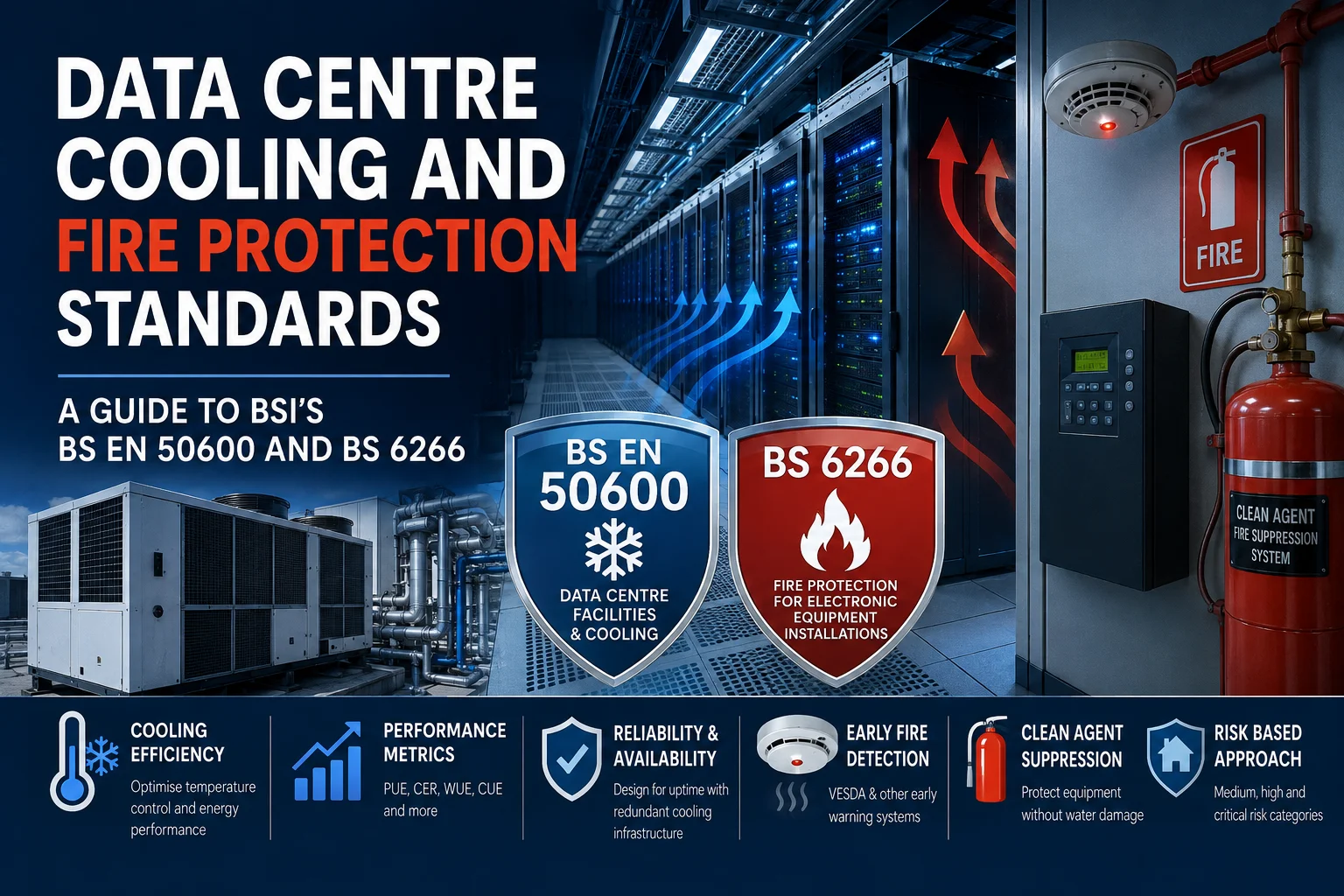
Data centre operators juggling uptime targets, energy efficiency goals, and insurance requirements eventually run into the same two standards bodies’ worth of documents: the BS EN 50600 series covering facility design and cooling performance, and BS 6266 governing fire protection for electronic equipment installations. Both are published by BSI, the British Standards Institution, and both matter for very different — but connected — reasons. Here’s what each actually covers.
BS EN 50600: The Core Data Centre Facilities Standard
BS EN 50600 is the UK-adopted version of the European standard for data centre facilities and infrastructure, published gradually since 2012 across multiple parts. It’s maintained by BSI as the UK implementation of the CENELEC EN 50600 series and is widely referenced in data centre tenders and design specifications across Europe. The series is broad by design, covering building construction, power distribution, cabling, security systems, and — most relevant here — cooling and environmental control.
The series is structured in layers:
- Part 1 lays out general concepts and definitions used across the rest of the series.
- Part 2 (in several sub-parts) covers specific facility elements — building construction (2-1), power supply and distribution (2-2), environmental control (2-3), telecommunications cabling (2-4), and security systems (2-5).
- Part 3 addresses data centre management and operational processes.
- Part 4 (in multiple sub-parts) defines key performance indicators, including the well-known Power Usage Effectiveness (PUE) metric alongside less-familiar ones like Cooling Efficiency Ratio (Part 4-7), Carbon Usage Effectiveness (Part 4-8), and Water Usage Effectiveness (Part 4-9).
Where Cooling Fits Into BS EN 50600
Cooling shows up in two distinct places within the series, and it’s worth understanding the difference.
BS EN 50600-2-3 (Environmental Control) sets requirements for the systems that actually maintain temperature, humidity, and air quality inside the facility — the physical infrastructure decisions around things like computer room air conditioning (CRAC) units, containment strategies, and coolant flow management.
BS EN 50600-4-7 (Cooling Efficiency Ratio) operates at a different level entirely. Rather than specifying how cooling should be built, it defines a KPI — the Cooling Efficiency Ratio, or CER — used to measure how efficiently a facility is using energy specifically to control temperature within its data centre spaces. This sits alongside PUE, WUE, and CUE as one of several efficiency metrics operators are increasingly expected to report and benchmark against.
The series also assigns availability classes that apply to cooling supply alongside power supply and cabling, meaning a facility’s cooling redundancy design is directly tied to which availability class it’s targeting under the standard — a consideration that affects everything from N+1 CRAC configurations to chilled water loop redundancy.
BS 6266: Fire Protection for Electronic Equipment Installations
Separate from the EN 50600 series, BS 6266:2011 is BSI’s code of practice specifically for fire protection in spaces containing electronic equipment — explicitly including computer rooms, internet hosting centres, switching centres, and data centres. It supersedes the 2002 and original 1992 editions and remains the current version, though it’s listed as under review.
BS 6266 categorizes electronic equipment installations by risk level — medium, high, and critical — and provides recommendations covering both the equipment itself and the surrounding areas, including adjacent spaces that could contribute to or be affected by a fire event. It draws on and cross-references several related BSI and EN documents, including:
- BS 5306-0, the guide for selection, use, and application of fixed firefighting systems and other fire equipment
- BS EN 1047-1, covering fire resistance testing for secure storage units like data cabinets
- BS EN 1363-1 and BS EN 1364-1, general fire resistance test standards for building elements
In practice, BS 6266 compliance shapes decisions around detection systems (typically very early smoke detection apparatus, or VESDA-type systems, in high-risk data halls), fixed suppression systems (commonly clean-agent gaseous suppression rather than water-based systems, given the equipment risk), and fire-rated separation between critical and non-critical zones.
How the Two Standards Interact
Cooling and fire protection aren’t isolated disciplines in a data centre — airflow design under BS EN 50600-2-3 directly affects how a fire or smoke event behaves and how quickly a BS 6266-compliant detection or suppression system responds. Hot aisle/cold aisle containment, raised floor plenums used for cooling distribution, and pressurization strategies all influence smoke movement and suppression agent concentration. This is one reason facilities teams and fire safety consultants are increasingly expected to coordinate design decisions across both standards rather than treating them as separate checklists.
Frequently Asked Questions
What BSI standard covers data centre cooling? BS EN 50600-2-3 covers environmental control, including cooling infrastructure requirements, while BS EN 50600-4-7 defines the Cooling Efficiency Ratio (CER), a KPI used to measure cooling energy efficiency.
What BSI standard covers fire protection in data centres? BS 6266:2011, “Fire protection for electronic equipment installations — Code of practice,” is the relevant BSI standard. It explicitly covers computer rooms, internet hosting centres, and data centres.
Is BS EN 50600 mandatory for UK data centres? BS EN 50600 is not typically a legal requirement on its own, but it’s widely referenced in tenders, design specifications, and third-party certification schemes such as Trusted Site Infrastructure (TSI), making it a de facto industry benchmark.
What risk categories does BS 6266 use? BS 6266 categorizes electronic equipment installations as medium, high, or critical risk, with recommendations scaled accordingly for detection, suppression, and fire-rated separation.
Does BS EN 50600 replace national fire codes? No. BS EN 50600 addresses facility design, performance, and efficiency; it does not replace fire safety legislation or codes such as those referenced in BS 6266 and related fire resistance standards. Both are typically applied together in a compliant data centre design.
What is the Cooling Efficiency Ratio (CER)? CER is a key performance indicator defined in BS EN 50600-4-7 that quantifies how efficiently a data centre uses energy specifically to control the temperature of its spaces, similar in structure to the more widely known Power Usage Effectiveness (PUE) metric.
For facilities teams building or auditing a data centre, the practical takeaway is that BS EN 50600 and BS 6266 answer two different questions — how efficiently and reliably the space is cooled, and how safely it’s protected if something goes wrong — and both need a seat at the same design table.