
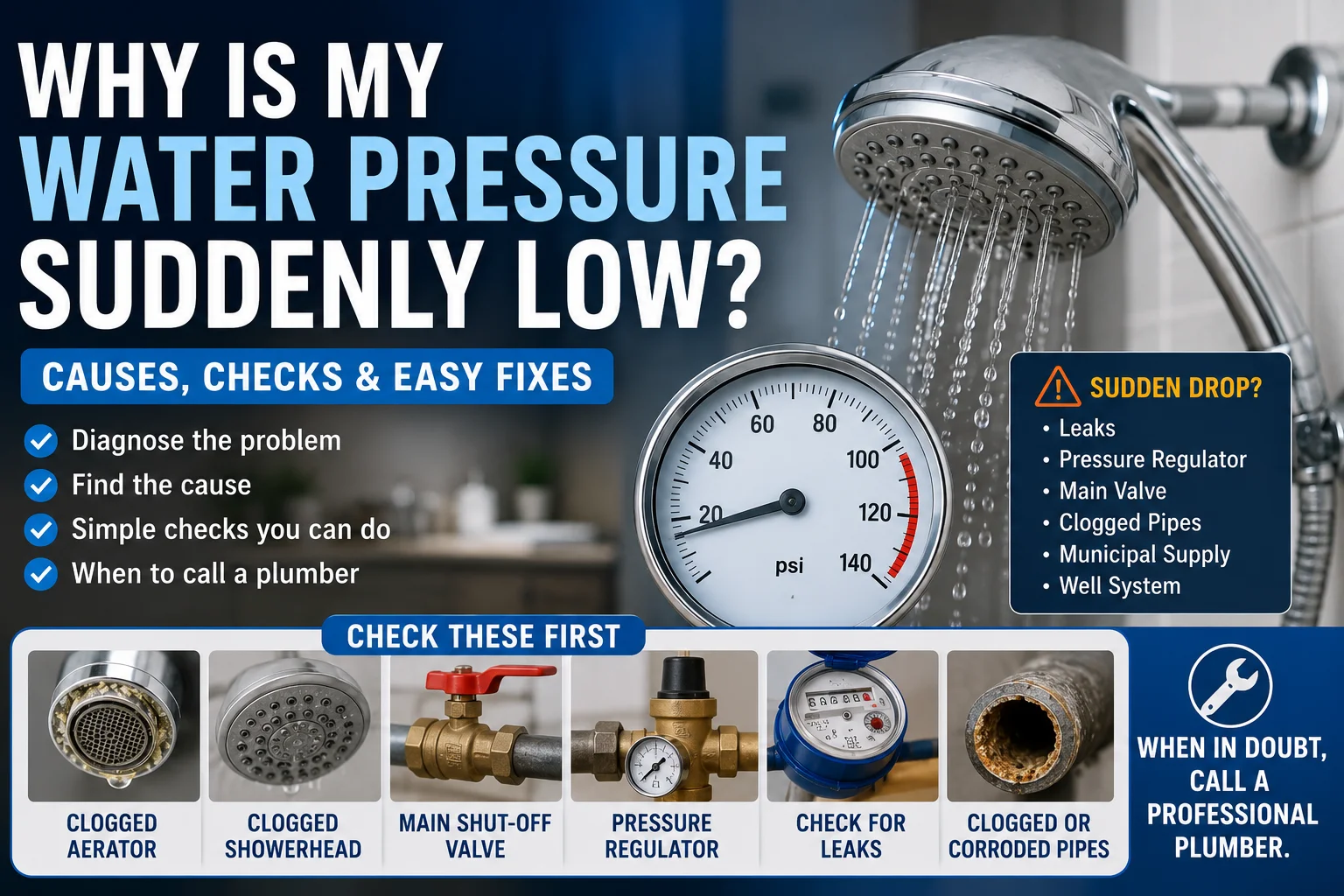
Why is my water pressure suddenly low? The most common causes are a partially closed main shutoff valve, a failing pressure regulator, a water leak, a municipal supply issue, a well-system problem, a clogged pipe, a fixture-specific restriction, or recent plumbing work that disturbed something in the system. The fastest way to narrow this down is to figure out whether the drop affects one fixture, several fixtures, or the entire house — that single distinction points you toward the right cause faster than guessing at parts to replace.
What Does Sudden Low Water Pressure Mean?
It helps to separate two related ideas. Water pressure is the force pushing water through your plumbing, measured in psi. Water flow is how much water actually comes out of a fixture, measured in gallons per minute. A clogged faucet aerator or showerhead can reduce flow at that one fixture without your home’s actual water pressure having dropped at all. Keeping this distinction in mind prevents chasing a whole-house problem when the real issue is one clogged screen.
First Check: Is the Low Pressure Affecting the Whole House?
Test a few fixtures around the house: the kitchen faucet, a bathroom sink, the shower, the bathtub, and an outdoor faucet if you have one.
If only one fixture has low pressure, look at the aerator, the showerhead, the faucet cartridge, a local shutoff valve, or the supply line feeding that specific fixture.
If several fixtures have low pressure, consider the main shutoff, a pressure regulator, a broader plumbing restriction, the water supply itself, a leak, or — for well homes — the well system.
If every fixture suddenly has very low pressure, think bigger: the main water supply, a municipal issue, a failing pressure regulator, a significant leak, or a well pump or main valve problem.
Why Is My Water Pressure Suddenly Low?
| Possible Cause | Typical Clue | What to Check |
|---|---|---|
| Partially closed main valve | Whole house affected | Main shutoff |
| Pressure regulator issue | Pressure low throughout home | Professional inspection |
| Water leak | Pressure drops with unexplained water use | Check for leaks |
| Municipal supply issue | Neighbors affected too | Contact water utility |
| Clogged fixture | One faucet/shower affected | Aerator/showerhead |
| Clogged pipe | One or several fixtures affected | Plumbing inspection |
| Well-system problem | Pressure fluctuates | Well equipment |
| Recent plumbing work | Problem started afterward | Check affected area |
| Frozen pipe | Cold weather plus no flow | Professional help |
| Failed valve | Sudden restriction | Inspect valve |
These symptoms can overlap, so treat this table as a starting point for investigation rather than a definitive diagnosis.
Check the Main Water Shutoff Valve
The main shutoff valve controls all water entering your home, so if it’s only partially open, it can restrict pressure throughout the entire house. Visually inspect it — modern ball valves typically use a lever-style handle that should be parallel to the pipe when fully open, while older gate valves use a wheel that should be turned as far as it will go.
Don’t force a valve that feels stuck. Older valves can fail internally when forced, sometimes turning a simple check into an emergency. If the valve won’t move, leaks when touched, or looks damaged or corroded, that’s a job for a plumber rather than more force.
Could a Water Leak Cause Sudden Low Water Pressure?
A significant leak can reduce the water actually reaching your fixtures and cause a real pressure drop. Warning signs include unexpectedly high water usage, a water meter that keeps moving when nothing is running, wet or damp areas indoors or outdoors, the sound of running water when no fixtures are on, stained walls or ceilings, unexplained puddles, or soft, soggy ground outside near buried supply lines. If you’re not sure where your meter is located to check it, our guide on how to find your water meter can help.
A small leak at a single fixture usually won’t cause a noticeable whole-house pressure drop, but a major leak in a supply line can. If you suspect a significant leak, shut off the main water supply if it’s safe to do so and contact a plumber — don’t wait to see if it resolves on its own.
Check Whether Your Neighbors Have the Same Problem
If nearby homes are also experiencing low pressure, the source is likely outside your property. Water-main work, utility maintenance, a main break, a temporary supply restriction, or a broader municipal pressure issue can all affect an entire area at once. Contact your local water utility to confirm whether there’s a known issue in your area — they can usually tell you quickly whether the problem is on their end or yours.
Could a Pressure Regulator Be the Problem?
Many homes have a pressure-reducing valve (PRV) installed where the water line enters the house, which regulates incoming municipal pressure down to a safer, more consistent level for household plumbing. EPA WaterSense recommends keeping incoming service pressure at 60 psi or lower for efficient, code-compliant performance, and a properly functioning PRV is usually what keeps pressure in that range.
A failing regulator can cause low pressure, pressure that fluctuates noticeably, pressure that changes throughout the day, or reduced flow at multiple fixtures simultaneously. This isn’t a component to diagnose or adjust yourself — regulator settings need to stay within safe, code-compliant limits, and incorrect adjustment can create bigger problems. If a failing regulator is suspected, have it professionally inspected.
What If You Have a Private Well?
Well systems work differently from municipal supply and involve their own components: a well pump, a pressure tank, and a pressure switch that controls when the pump turns on and off. Sudden low pressure in a well home can point to pump problems, a failing pressure tank, a malfunctioning pressure switch, pump short-cycling, a dropping water level in the well itself, or clogged filtration equipment if your system includes one.
Well pressure switches and tanks should not be adjusted by anyone without proper training — incorrect settings can damage the pump or create unsafe pressure conditions. If you suspect a well-system issue, bring in a qualified well or plumbing professional rather than experimenting with the controls.
Check Your Water Filter or Treatment System
Whole-house filters, water softeners, and other treatment equipment can restrict flow if a filter cartridge is clogged, the equipment is malfunctioning, a bypass valve is in the wrong position, or sediment has built up inside the unit. Maintenance intervals vary by equipment type and manufacturer, so check your system’s specific instructions rather than assuming a generic schedule applies.
Could a Clogged Pipe Cause Sudden Low Water Pressure?
Timing is a useful clue here. Gradual pressure decline over months or years often points to mineral deposits, corrosion, sediment buildup, or aging galvanized piping narrowing from the inside. A sudden restriction, on the other hand, is more likely tied to recent plumbing work, a water-main repair nearby, a disturbed section of pipe, a failed valve, or debris that entered the system during other work. Serious internal pipe restrictions generally require professional inspection to diagnose accurately — this isn’t something you can confirm by eye.
Why Is My Shower Pressure Suddenly Low?
If your shower specifically feels weak, check the showerhead for clogs, inspect the spray nozzles for mineral buildup, look at any flow-control components, and consider whether the shower cartridge might be worn or stuck. If the kitchen faucet and other fixtures in the house have normal pressure, the problem is likely isolated to that one shower rather than the home’s actual water pressure — don’t assume a whole-house issue just because one fixture feels weak. Our guide on how to increase the water pressure in your shower walks through the full fixture-specific diagnostic process in more detail.
Why Is My Faucet Pressure Suddenly Low?
The usual suspects are a clogged aerator, debris trapped inside the fixture, a worn cartridge, a partially closed supply valve under the sink, or a restricted supply line. Compare that faucet with others in the house — if it’s the only one affected, the fix is almost always local to that fixture rather than something upstream. If it’s the kitchen faucet specifically, our companion guide on no water pressure in the kitchen sink covers the same diagnostic steps in more depth.
Could Recent Plumbing Work Cause Low Water Pressure?
Pressure problems sometimes appear right after water-main work, a faucet replacement, a water heater replacement, pipe repairs, a valve replacement, or a broader renovation. Common explanations include debris that entered the system during the work, a valve that wasn’t fully reopened afterward, an unintentional supply restriction, an incorrect connection, or sediment that got disturbed and settled somewhere new. If the problem started immediately after specific work was done, contact the plumber who performed it — they may be able to identify and fix the cause quickly.
Step-by-Step: What to Do When Water Pressure Suddenly Drops
- Test several fixtures to determine whether the issue is local or whole-house.
- Check hot and cold water separately to see whether one side is specifically affected.
- Check the main shutoff valve to confirm it hasn’t been partially closed.
- Check for obvious leaks, both visible plumbing and water-use indicators like the meter.
- Check filters and treatment equipment, following the manufacturer’s instructions.
- Ask neighbors or check utility updates to rule out an external cause.
- Consider a pressure-regulator or well-system problem, without making adjustments yourself unless you’re qualified to do so.
- Call a plumber when the problem persists, describing exactly what you observed and when it started.
How to Measure Water Pressure at Home
A simple water-pressure gauge, available at most hardware stores, can be threaded onto an outdoor spigot or a washing-machine connection to get a static pressure reading. Testing at a consistent, appropriate connection point matters, since readings can vary depending on where and when you test.
A single reading doesn’t explain every flow problem on its own — a normal static pressure reading doesn’t rule out a clogged fixture, and a low reading doesn’t automatically point to one specific cause. As a general reference point, EPA WaterSense’s guidance for water-efficient homes targets a service pressure at or below 60 psi, and many plumbing codes cap maximum static pressure at 80 psi. What counts as “normal” for your specific home can still depend on your plumbing system, elevation, and local requirements, so use these figures as general context rather than a strict pass/fail test.
Sudden Low Water Pressure vs. Gradual Low Water Pressure
| Sudden Drop | Gradual Decline |
|---|---|
| Main valve issue | Pipe corrosion |
| Utility problem | Mineral buildup |
| Leak | Aging plumbing |
| Regulator failure | Clogged filter |
| Recent plumbing work | Increasing sediment |
| Well equipment problem | Developing valve restriction |
Timing is a helpful clue, but it doesn’t prove the cause on its own — treat it as one more data point alongside the fixture-vs-whole-house test.
Common Mistakes to Avoid
- Replacing a faucet before checking the main supply and shutoff valve
- Assuming the water company is automatically responsible without checking
- Ignoring a visible leak because it seems minor
- Forcing an old, stuck shutoff valve
- Adjusting a pressure regulator without understanding the system
- Ignoring water filters and treatment equipment as a possible cause
- Assuming low flow at one fixture always means low household pressure
- Replacing expensive plumbing components before diagnosing the actual cause
- Ignoring a sudden pressure change instead of investigating it promptly
Each of these mistakes tends to waste time, money, or both — and some can create new problems on top of the original one.
When Is Sudden Low Water Pressure an Emergency?
Treat these situations as urgent: rapidly dropping pressure, a visible burst pipe, water actively flooding part of the home, water coming from walls or ceilings, a major outdoor water leak, concerns about water contamination, a suspected burst frozen pipe, or a complete loss of water combined with visible plumbing damage. In any of these cases, shut off the main water supply if it can be done safely and contact a qualified plumber right away — don’t attempt repairs on pressurized systems or buried lines yourself.
When Should I Call a Plumber?
Bring in a professional when the entire house has low pressure, the main shutoff is stuck, a pressure regulator is suspected, an underground leak seems likely, pipes may be severely restricted, a well system is involved, pressure fluctuates significantly without explanation, a leak is present, the problem began right after complex plumbing work, or basic troubleshooting hasn’t resolved the issue.
Frequently Asked Questions
1. Why is my water pressure suddenly low?
Common causes include a partially closed main valve, a failing pressure regulator, a water leak, a municipal supply issue, a well-system problem, or a fixture-specific restriction. Testing multiple fixtures helps narrow down which of these is most likely.
2. Why is my water pressure low throughout the whole house?
Whole-house low pressure usually points to something upstream of individual fixtures — the main shutoff valve, a pressure regulator, a significant leak, or a municipal or well-system issue — rather than a single clogged faucet.
3. Can a water leak cause low water pressure?
Yes, especially a significant leak in a supply line. Smaller fixture leaks are less likely to cause a noticeable whole-house pressure drop, but a major leak can meaningfully reduce the water reaching your fixtures.
4. Can a partially closed main valve cause low pressure?
Yes. Even a valve that’s most of the way open can restrict flow throughout the entire home. Visually check that it’s fully open, but don’t force it if it feels stuck or damaged.
5. Can a pressure regulator cause sudden low water pressure?
Yes, a failing pressure-reducing valve can cause low or fluctuating pressure throughout the home. This isn’t something to diagnose or adjust yourself — have it professionally inspected if you suspect it’s the cause.
6. Why is my shower pressure suddenly low?
If other fixtures in the house are unaffected, the problem is likely isolated to the shower itself — check the showerhead, spray nozzles, flow-control components, and cartridge before assuming a whole-house issue.
7. Why is only one faucet affected?
A single affected faucet usually points to something local: a clogged aerator, debris in the fixture, a worn cartridge, or a partially closed supply valve specific to that fixture.
8. Can a clogged water filter reduce pressure?
Yes. Whole-house filters and treatment systems can restrict flow if the cartridge is clogged, sediment has built up, or a bypass valve is positioned incorrectly. Check your system’s specific maintenance instructions.
9. Why is my water pressure low after plumbing work?
Recent work can introduce debris, leave a valve not fully reopened, disturb sediment, or create an unintentional restriction. If the problem started right after specific work, contact the plumber who did it.
10. When should I call a plumber for sudden low water pressure?
Call a plumber if the whole house is affected, a valve is stuck, a regulator or well system is suspected, you notice a leak, or basic troubleshooting doesn’t resolve the problem. These situations typically go beyond simple fixture maintenance.
Conclusion
Diagnosing sudden low water pressure starts with one key question: is it affecting one fixture, several fixtures, or the entire house? From there, check the main shutoff valve, look for signs of a leak, inspect filters and treatment equipment, consider whether a municipal issue is affecting your area, and think about pressure-regulator or well-system problems if the whole house is involved. If the issue started right after plumbing work, that’s a strong clue worth following up on directly with the plumber involved. Call a professional when the problem touches the main water supply, involves a significant leak, or requires working with pressure equipment or hidden plumbing. A sudden drop deserves a diagnosis, not just an attempt to force more pressure through the system.