
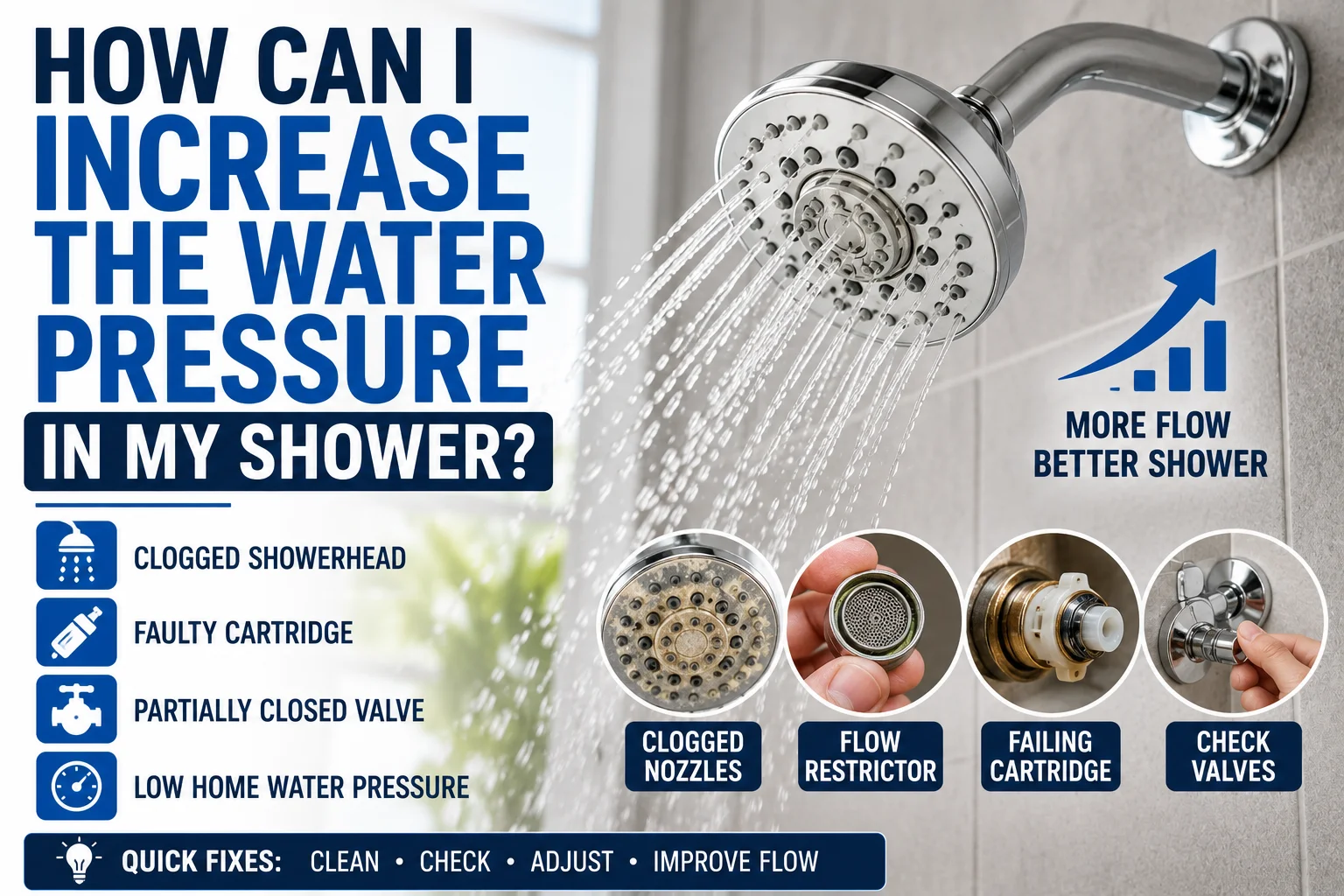
If you’re asking how can I increase the water pressure in my shower, the fastest path is figuring out whether the real problem is your home’s water pressure or just the flow coming out of the showerhead — these are two different things with two different fixes. Common causes of weak shower performance include a clogged showerhead, mineral buildup, a partially closed valve, a built-in flow restriction, a faulty shower cartridge, or genuinely low water pressure throughout the house. Before buying a new showerhead or trying to “boost” your plumbing pressure, it’s worth diagnosing exactly where the restriction is happening. That one step can save you money and prevent unnecessary repairs.
Is Your Shower Actually Low Pressure or Just Low Flow?
These two terms get used interchangeably, but they’re not the same thing, and the difference matters for fixing the problem.
Water pressure is the force pushing water through your home’s pipes, measured in psi (pounds per square inch). It’s set by your municipal supply or well system and is generally consistent throughout the house.
Water flow is how much water actually comes out of a fixture over time, measured in gallons per minute (gpm). Flow can be reduced at a single fixture — by a clogged showerhead, a restrictor, or a bad valve — even when the home’s underlying pressure is perfectly normal.
Here’s a simple test: turn on the shower, then check another faucet in the house while it’s running. If other fixtures have strong flow and only the shower feels weak, the problem is very likely local to that fixture, not your home’s water pressure. If everything in the house feels weak, that points toward a whole-house issue instead. This distinction alone can save you from replacing an expensive valve when the real fix is a five-minute showerhead cleaning.
Why Is My Shower Pressure So Low?
| Possible Cause | What You May Notice | What to Check |
|---|---|---|
| Clogged showerhead | Weak, uneven spray pattern | Clean the showerhead |
| Mineral buildup | Restricted or sideways spray | Inspect the nozzles |
| Partially closed valve | Reduced flow overall | Check accessible valves |
| Faulty cartridge | Flow or temperature problems | Inspect the cartridge |
| Flow restriction | Consistently limited flow | Check the fixture’s rated flow |
| Whole-house low pressure | Multiple fixtures affected | Check the main supply |
| Pressure regulator issue | Low pressure throughout home | Professional inspection |
| Well-system issue | Pressure cycles or drops | Professional system check |
No single symptom automatically confirms one cause — this table is a starting point for narrowing things down, not a diagnosis on its own.
Check the Showerhead First
The showerhead is the easiest place to start because it’s usually the simplest fix. Mineral deposits, sediment, and general debris commonly build up inside the spray holes and internal passages over time, gradually restricting flow even though nothing is technically “broken.”
To check it safely:
- Turn off the shower.
- Remove the showerhead if it’s practical to do so.
- Inspect the inlet screen and spray nozzles for visible buildup or debris.
- Clean it according to the manufacturer’s instructions for your specific model.
- Rinse thoroughly.
- Reinstall and test the flow.
Some showerheads have delicate finishes or plastic components that can be damaged by harsh scrubbing or abrasive tools — stick to gentle cleaning methods rather than forcing debris out with metal picks or aggressive scrubbing. If you’re doing broader bathroom maintenance at the same time, our guide to types of shower drains and how to remove them covers the other common fixture in the same space.
Clean Mineral Buildup From the Showerhead
Hard water leaves calcium and mineral scale behind, and it accumulates fastest inside the tiny spray openings where water is constantly evaporating and depositing minerals. Over months or years, this buildup can meaningfully choke down flow.
Cleaning methods depend on the showerhead’s material and finish, so check the manufacturer’s instructions before assuming a method is safe for your specific fixture. Vinegar soaking is a common approach for compatible showerheads, but it isn’t universally safe — some finishes and materials can be damaged by prolonged exposure to acidic solutions. Avoid soaking longer than the manufacturer recommends, and don’t assume every fixture on the market handles vinegar the same way.
Check the Shower Valve
A shower valve that’s only partially open restricts flow even though water is still technically getting through. If your shower has an accessible shutoff or service stop, confirm it’s fully open. Some homes also have a main valve serving the bathroom or the whole house that could be involved.
If a valve feels stuck, don’t force it. Older valves can fail internally when forced, sometimes turning an easy fix into an emergency repair. If a valve looks corroded, leaks when touched, or won’t turn smoothly, that’s a sign to call a plumber rather than push harder. If you’re planning a valve replacement or remodel, our guide to standard height for a shower valve covers where valves are typically positioned.
Check the Shower Cartridge
Many modern shower faucets use an internal cartridge to control flow and temperature. According to Moen’s own troubleshooting guidance, the cartridge is the most common reason for low flow in a shower. A worn, clogged, or damaged cartridge can cause weak overall flow, temperature swings, uneven hot/cold balance, or dripping.
Cartridge design varies significantly by manufacturer and even by model line within the same brand — a Moen Posi-Temp cartridge isn’t interchangeable with a Moentrol cartridge, for example. Identify your exact faucet model before attempting to remove or replace a cartridge, and follow that manufacturer’s specific instructions rather than a generic procedure.
Could the Shower Flow Restrictor Be Limiting Flow?
Many modern showerheads include a built-in flow-control device designed to limit water use while maintaining a satisfying spray. In the U.S., federal law caps standard showerhead flow at 2.5 gallons per minute (gpm), and EPA WaterSense-certified showerheads are independently certified to use no more than 2.0 gpm while still meeting performance criteria for spray force and coverage.
If your shower feels weak, it’s worth checking whether the showerhead’s rated flow is simply on the lower end of what’s allowed, rather than assuming something is broken. Removing or defeating a flow-control device isn’t a safe or appropriate fix — these components are part of the fixture’s design and, in many cases, part of complying with water-efficiency requirements. If you want stronger-feeling performance, look at a properly rated replacement showerhead engineered for better spray characteristics within the allowed flow range, rather than trying to bypass the restrictor on your current one.
Try a Showerhead Designed for Better Spray Performance
Some showerheads are engineered to feel more forceful at the same flow rate through spray pattern design, nozzle configuration, and how the water is distributed across the spray face. Aerating showerheads mix air into the stream for a fuller-feeling spray, while laminar-flow designs separate water into individual streams — different approaches, same underlying flow limit.
It’s important to understand what these designs actually do: they change how a given amount of water feels coming out of the fixture. They do not increase your home’s actual plumbing pressure. A showerhead cannot create pressure that doesn’t exist in your supply line — it can only work more efficiently with the pressure and flow already available to it. If your home genuinely has low pressure throughout, a new showerhead may improve the shower experience somewhat, but it won’t solve an underlying whole-house pressure problem.
Check Whether Other Fixtures Have Low Pressure
Test the bathroom sink, the kitchen faucet, another shower if you have one, and an outdoor faucet if applicable.
If only one shower is affected, focus on that fixture: the showerhead, the valve, the cartridge, or a local restriction specific to that line.
If multiple fixtures are affected, the cause is more likely broader — the main shutoff valve, a pressure regulator, the water supply itself, a well system, or whole-house plumbing.
This single check is often the deciding factor in whether you need a plumber or just a cleaning kit. Our companion guide on no water pressure in the kitchen sink walks through the same fixture-vs-whole-house diagnostic logic for a different part of the house, if you’re testing multiple faucets at once.
Check the Main Water Shutoff Valve
A main shutoff valve that’s only partially open can restrict flow to the entire house, not just the shower. Visually check whether the valve appears to be turned fully open. Don’t force a valve that feels stuck — old valves can fail internally, and a professional replacement is safer than risking a break that leaves you without water entirely.
Could a Pressure Regulator Cause Low Shower Pressure?
Many homes have a pressure-reducing valve (PRV) that regulates incoming water pressure from the street. If this regulator is malfunctioning, it can cause low pressure throughout the home, noticeable pressure changes, or multiple fixtures being affected at once.
This is not a component to adjust yourself. Pressure settings need to stay within safe, code-compliant limits, and incorrect adjustment can create bigger problems than the one you started with. If a failing regulator is suspected, have it professionally inspected rather than attempting to tune it on your own.
What If You Have a Well?
Private well systems work differently from municipal water supplies and involve their own set of components: a pressure tank, a well pump, and a pressure switch that controls when the pump cycles on and off. Symptoms like pressure that drops gradually, cycles noticeably, or feels inconsistent can point to a well-system issue rather than anything in your shower itself.
Well pressure switches and tanks should not be adjusted by inexperienced homeowners — incorrect settings can damage the pump or create unsafe pressure conditions. If you suspect a well-system problem, get a professional diagnosis rather than experimenting with the controls.
Can a Water Heater Cause Low Shower Pressure?
It depends on which side is affected. If only the hot water feels weak, the cause may involve hot-water plumbing, the shower cartridge, a restriction on the water heater’s outlet side, or a partially closed hot-side valve. If both hot and cold water are weak, the water heater is much less likely to be the direct cause, since cold water typically bypasses it entirely. Don’t assume the water heater is at fault just because hot water is involved — confirm cold water is normal first. If your water heater is due for maintenance regardless, see our guide on how to clean a tankless water heater for the descaling process most units eventually need.
How Can I Increase the Water Pressure in My Shower? Step-by-Step
- Test another fixture to determine whether the issue is local to the shower or affects the whole house.
- Test hot and cold separately to see whether one side is specifically affected.
- Inspect and clean the showerhead, checking for mineral buildup and debris.
- Check accessible valves to confirm none are partially closed.
- Inspect the shower cartridge, following manufacturer-specific guidance for your model.
- Check household pressure if multiple fixtures are affected, rather than continuing to focus on the shower alone.
- Consider a better-performing, properly rated showerhead matched to your available pressure and flow.
- Call a professional for supply-side, regulator, well, hidden-pipe, or complex valve problems.
What NOT to Do When Trying to Increase Shower Pressure
- Don’t remove or defeat a showerhead’s flow-control device.
- Don’t attempt to push household pressure beyond safe limits.
- Don’t force a stuck valve of any kind.
- Don’t start replacing expensive components at random without diagnosing the actual cause first.
- Don’t adjust well pressure switches or tanks without proper expertise.
- Don’t adjust a pressure regulator without fully understanding the system.
- Don’t use cleaning chemicals that aren’t compatible with your fixture’s finish or material.
- Don’t cut into pipes before you’ve actually identified where the restriction is.
The goal is restoring proper flow to your shower — not increasing pressure at any cost, and definitely not at the cost of safety or a working plumbing system.
When Should You Call a Plumber?
Bring in a professional if water pressure is low throughout the entire house, the main valve is stuck, a pressure regulator is suspected, a well system shows pressure problems, the shower valve is buried behind a finished wall, the cartridge can’t be safely removed, you suspect a hidden leak, pipes may be clogged or corroded, pressure changes dramatically without explanation, or pressure suddenly drops throughout the house.
Frequently Asked Questions
1. How can I increase the water pressure in my shower?
Start by cleaning the showerhead, checking that valves are fully open, and inspecting the cartridge. If those don’t help and other fixtures are also weak, the issue is likely whole-house pressure, which calls for professional evaluation.
2. Why is my shower pressure suddenly low?
A sudden drop often points to a clogged showerhead, a stuck cartridge, or a partially closed valve. If it happened everywhere in the house at once, check the main shutoff and consider whether a pressure regulator issue is involved.
3. Can a clogged showerhead cause low water pressure? It can cause low flow at that fixture specifically, even when your home’s actual water pressure is normal. Mineral buildup and debris inside the spray holes are among the most common causes of a weak-feeling shower.
4. How do I clean a showerhead to improve water flow?
Remove it if practical, inspect the nozzles and inlet screen, and clean it according to the manufacturer’s instructions — often involving a compatible soak and gentle scrubbing. Rinse thoroughly before reinstalling and testing.
5. Can a flow restrictor cause weak shower pressure?
A built-in flow restrictor limits flow by design, which can feel like weak pressure even though the fixture is working normally. Removing it isn’t a safe fix — consider a properly rated showerhead engineered for a stronger-feeling spray instead.
6. Why is my shower weak but the kitchen faucet is strong?
This points to a fixture-specific problem rather than a whole-house issue — most likely the showerhead, the shower valve, or the cartridge, rather than your home’s actual water pressure.
7. Why is only the hot water pressure low in my shower?
This can involve hot-water plumbing, the cartridge, or a restriction specific to the hot side, including a partially closed valve. If cold water is normal, the water heater is a possible but not automatic explanation.
8. Can a pressure regulator cause low shower pressure?
Yes, a failing pressure-reducing valve can cause low pressure throughout the home, not just the shower. This isn’t something to adjust yourself — have it professionally inspected if you suspect it’s the cause.
9. Can a water heater cause low shower pressure?
It can, but only for the hot side. If both hot and cold water are weak, the water heater is unlikely to be the direct cause, since cold water generally doesn’t pass through it.
10. When should I call a plumber for low shower pressure?
Call a plumber if the whole house is affected, a valve is stuck, a regulator or well system is suspected, the valve is hidden behind a wall, or you notice a leak. These situations go beyond simple fixture maintenance.
Conclusion
The most effective way to answer “how can I increase the water pressure in my shower” is to diagnose the restriction before changing anything. Determine whether the problem affects just one shower or the whole home, test hot and cold separately, clean the showerhead, check accessible valves, and inspect the cartridge if the problem points that way. If multiple fixtures are affected, look at the home’s broader pressure system instead of the shower itself. Call a plumber for regulator, well, main-supply, hidden-pipe, or complex valve problems. The best fix isn’t blindly increasing pressure — it’s finding out exactly what’s restricting flow and addressing that specific cause.