
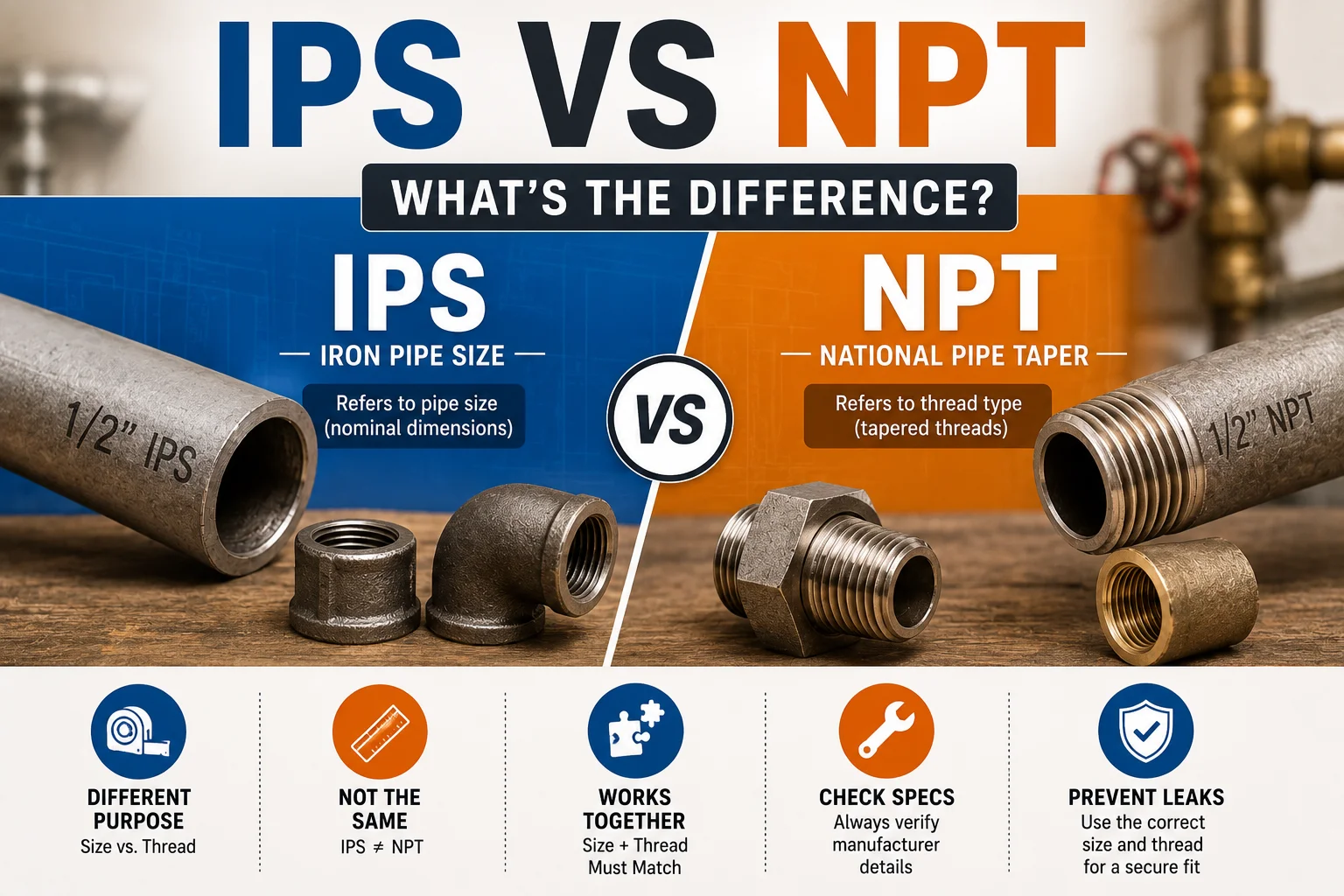
IPS and NPT show up together constantly on pipes, fittings, valves, and product listings, which makes them easy to mix up — but they don’t describe the same thing. IPS stands for Iron Pipe Size, a sizing and dimensional convention for pipe and fittings. NPT stands for National Pipe Taper, a specific tapered thread standard widely used in North American plumbing. A single fitting can involve both: a nominal pipe size (its IPS designation) and a thread standard (NPT) that lets it screw into a matching connection. Understanding that distinction makes it much easier to pick fittings that actually go together.
IPS vs NPT: Quick Answer
| Feature | IPS | NPT |
|---|---|---|
| Full meaning | Iron Pipe Size | National Pipe Taper |
| Primary purpose | Pipe sizing/dimensional terminology | Thread standard |
| Describes | Nominal pipe size/system | Thread form |
| Used with fittings | Yes | Yes |
| Same thing? | No | No |
| Can appear together? | Yes | Yes |
Not every IPS-labeled product automatically has NPT threads — some IPS-sized pipe is non-threaded and joined by welding, clamps, or solvent cement instead. Always check the specific product’s specifications rather than assuming based on the IPS label alone.
What Does IPS Mean in Plumbing?
IPS stands for Iron Pipe Size, a traditional sizing system tied to nominal pipe dimensions. It’s been used since the 1800s and still shows up on iron, steel, brass, and PVC plumbing components today.
“Nominal” size is a standardized designation, not a literal measurement of the pipe’s actual outside diameter. A pipe labeled 1/2-inch, 3/4-inch, 1-inch, or 2-inch IPS doesn’t necessarily measure exactly that at any single dimension — the nominal number is a naming convention, not a precise physical measurement. That’s why guessing a pipe’s size just by eyeballing its diameter can lead to the wrong fitting.
What Is NPT?
NPT stands for National Pipe Taper (also called National Pipe Thread Taper), a U.S. standard for tapered threads used on threaded pipes and fittings, first standardized in the 1860s and still the most common pipe thread standard in North American plumbing, HVAC, and hydraulic systems.
The “taper” part matters: unlike straight threads on a bolt, NPT threads gradually narrow along their length. As a male and female NPT connection are threaded together, that taper causes the threads to compress against each other, helping form a tight mechanical fit. Threads alone don’t always guarantee a perfect seal, though — appropriate thread sealant, such as PTFE tape or pipe joint compound, is typically used depending on the application and the manufacturer’s instructions. If you’re unsure which to use, our guide on Teflon tape vs. pipe dope breaks down when each is appropriate.
Is IPS the Same as NPT?
No, IPS and NPT are not exactly the same thing. IPS primarily describes a pipe’s nominal size and dimensional system, while NPT identifies a specific thread standard. They aren’t competing alternatives — they answer two different questions about a connection.
That’s exactly why the two terms often show up together in product descriptions. A fitting might be listed by its nominal pipe size (an IPS designation) along with whether it has male or female threads and whether those threads follow the NPT standard. Seeing both terms on the same product isn’t a contradiction; it’s just two different specifications being listed side by side.
Why Are IPS and NPT Sometimes Used Interchangeably?
Homeowners often run into confusing terminology online, partly because plumbing language has evolved unevenly over the decades. Older plumbing terminology and some manufacturer descriptions use “IPS” loosely to describe threaded pipe or threaded connections in general — not strictly the sizing system it technically refers to.
Terms like Iron Pipe Size, Iron Pipe Thread, Male Iron Pipe, Female Iron Pipe, and NPT can all appear in related contexts, sometimes describing overlapping ideas depending on who wrote the product listing. These terms are not always used consistently, and they are not always interchangeable in a technical sense. When you’re unsure exactly what a listing means, the safest move is to confirm the meaning directly from the product’s specification sheet rather than assuming based on common usage.
IPS vs NPT Fittings
When comparing fittings, you’ll run into IPS-sized fittings, NPT-threaded fittings, male and female threaded connections, adapters, valves, couplings, and nipples. It’s tempting to assume that matching the nominal size is enough to guarantee a fit, but that’s not the whole picture.
A proper connection needs all of the following to line up:
- A compatible thread standard (not just a similar-looking one)
- The correct male/female configuration
- Appropriate material for the application
- The correct pressure or application rating for the intended use
Two fittings can share the same nominal size and still fail to connect properly if any of these don’t match.
IPS vs NPT: Male and Female Connections
Two more terms that come up constantly alongside NPT are MIP and FIP:
- MIP (Male Iron Pipe): commonly used to describe the male, externally threaded side of a pipe-threaded connection.
- FIP (Female Iron Pipe): commonly used to describe the female, internally threaded side of a pipe-threaded connection.
In everyday plumbing terminology, NPT typically describes the thread standard itself, while MIP and FIP describe which side of the connection — male or female — you’re dealing with. In practice, an FIP fitting is generally sized to accept a matching NPT male thread. That said, manufacturers don’t always label products with perfectly consistent terminology, so it’s worth double-checking a product’s listed specifications rather than assuming based on the abbreviation alone.
IPS vs NPT vs MIP vs FIP
| Term | What It Generally Describes |
|---|---|
| IPS | Iron Pipe Size — a nominal pipe sizing system |
| NPT | National Pipe Taper — a tapered thread standard |
| MIP | Male iron pipe — the male threaded side of a connection |
| FIP | Female iron pipe — the female threaded side of a connection |
| NPS | National Pipe Straight, or more generally “Nominal Pipe Size” depending on context |
Note that NPS itself is used two different ways in the plumbing world: as its own straight-thread standard, and, informally, as shorthand for “nominal pipe size” in general. Context and the specific product documentation matter here more than the abbreviation alone.
Can IPS and NPT Be Used Together?
Yes, in the sense that a single fitting commonly has both an IPS-based nominal size and NPT threads — that’s a completely normal and common combination. What you shouldn’t assume is that “IPS fitting” and “NPT fitting” are automatically interchangeable labels for the same thing.
Before treating two products as compatible, verify the size, the thread standard, the male/female configuration, the material, and the intended application against the actual product specifications. A quick label check now is much easier than discovering a mismatch after you’ve already cut pipe or applied thread sealant.
How Do You Identify an IPS or NPT Connection?
Step 1: Check the product label. Look for markings like NPT, MIP, FIP, a nominal size, or a manufacturer model number.
Step 2: Check the manufacturer’s specifications. This is far more reliable than guessing based on how a fitting looks.
Step 3: Identify male or female threads. Male threads are external (on the outside of the fitting); female threads are internal (inside a fitting or opening).
Step 4: Determine the nominal size. Don’t rely on outside diameter alone — nominal size is a designation, not a direct measurement.
Step 5: Confirm the thread standard. Visually similar threads can still belong to different standards and fail to mate correctly, especially when comparing NPT to other tapered or straight thread systems.
How Are IPS Pipe Sizes Measured?
IPS sizing is based on a nominal size designation rather than a single, simple measurement. Related dimensions include the outside diameter, the inside diameter, wall thickness, and schedule (a designation related to wall thickness and pressure rating). The nominal size doesn’t necessarily equal the pipe’s actual measured diameter at any given point — it’s a standardized label that has stayed consistent even as manufacturing details have changed over time. Because exact dimensions vary by pipe type, material, and schedule, always confirm measurements against the manufacturer’s specifications rather than a general chart when precision matters.
How Are NPT Threads Identified?
Identifying NPT threads generally involves checking the nominal size, confirming the threads are tapered rather than straight, determining male vs. female configuration, and — most reliably — checking manufacturer documentation. Thread identification can be genuinely difficult by eye, since different thread standards can look similar at a glance despite not being compatible. Don’t assume a connection is NPT just because it appears tapered or looks similar to another fitting you’ve used before.
Are IPS and NPT Interchangeable?
Not automatically. IPS is a sizing term, and NPT is a thread standard — they answer different questions, and product terminology isn’t always applied consistently across manufacturers. Two fittings can share the same nominal size and still fail to connect properly if their thread standards don’t actually match. When precision matters, treat “same nominal size” as a starting point for checking compatibility, not proof of it.
IPS vs NPT for Water Lines
Homeowners are likely to encounter both terms on water heaters, shutoff valves, filters, pumps, water softeners, faucets, and pipe adapters. In each case, the fitting needs to match the pipe, valve, and appliance connection it’s being paired with — not just in nominal size, but in thread type and male/female configuration too. Not all water system connections use NPT threads; some use compression fittings, push-to-connect fittings, or other joining methods entirely, so it’s worth confirming what type of connection your specific fixture actually requires. If you’re working near a dielectric union or similar transition fitting, matching thread type is especially important since these connections often sit at points where different pipe materials meet.
IPS vs NPT for Gas Lines
Gas piping requires components specifically approved for gas service, along with compliance with applicable local codes and requirements. A fitting’s thread designation alone — even if it’s genuinely NPT — does not by itself prove the product is rated or approved for gas use. The product needs to be specifically rated for that application.
This isn’t a place for guesswork or DIY shortcuts. If you’re unsure whether existing gas piping or fittings are appropriate, or if a gas line connection needs to be added, modified, or repaired, professional installation is strongly recommended.
Common Mistakes When Choosing IPS or NPT Fittings
- Assuming IPS and NPT are identical or interchangeable terms
- Matching only the nominal size and stopping there
- Ignoring whether the connection is male or female
- Assuming visually similar threads are automatically compatible
- Mixing NPT with a different thread standard that happens to look alike
- Guessing pipe size from outside diameter instead of checking the designation
- Skipping the manufacturer’s specifications
- Using the wrong adapter for a transition between systems
- Choosing a material not rated for the application
- Forgetting to check the pressure or application rating
Each of these can lead to leaks, stripped threads, or connections that won’t seal, even when they appear to “fit” at first glance.
IPS vs NPT: Which One Should I Choose?
This isn’t really a choice between two competing products — IPS and NPT describe different aspects of the same connection. A practical approach:
- Identify the required pipe or fitting size.
- Identify the thread standard the application calls for.
- Determine whether you need a male or female connection.
- Check the manufacturer’s specifications for the exact product.
- Select a fitting that matches on all of the above.
In many residential applications, NPT will be the correct thread standard, while IPS describes the nominal pipe size the connection is built around. Treating them as complementary specifications, rather than competing options, makes the selection process much clearer.
When Should You Call a Plumber?
Consider professional help when threads are damaged or stripped, existing fittings are corroded and difficult to remove, the thread standard on an existing connection is unclear, a fitting won’t connect properly despite matching the labeled size, a water heater connection needs modification, gas piping is involved in any way, a hidden connection appears to be leaking, you’re unsure about compatibility between two components, or a pipe needs to be cut or reconfigured. Getting an accurate identification before you buy replacement parts — rather than after a failed connection — saves time, materials, and frustration. If you also need to turn off the water supply before working on a connection, do that first regardless of who ends up doing the repair.
Frequently Asked Questions
What does IPS mean in plumbing?
IPS stands for Iron Pipe Size, a nominal sizing and dimensional system used for pipes and fittings. It’s a sizing convention, not a thread type, and the nominal size doesn’t always match a pipe’s exact measured diameter.
What does NPT mean?
NPT stands for National Pipe Taper, a U.S. standard for tapered pipe threads. NPT threads compress together as they’re tightened, helping create a leak-resistant connection, often with the help of thread sealant.
Is IPS the same as NPT?
No. IPS describes pipe size and dimensional terminology, while NPT describes a specific thread standard. A single fitting can have both an IPS nominal size and NPT threads at the same time — they’re complementary specs, not competing ones.
Can IPS and NPT fittings be used together?
Yes, in the sense that many fittings combine an IPS nominal size with NPT threads. But “IPS fitting” and “NPT fitting” aren’t automatically interchangeable labels — always verify size, thread standard, and configuration before assuming compatibility.
Is IPS a thread type?
Not primarily. IPS is fundamentally a sizing and dimensional system. Some IPS-labeled pipe is threaded and some isn’t, so the label alone doesn’t tell you the thread type — check the specific product’s documentation.
What is the difference between IPS and MIP?
IPS refers to pipe sizing terminology, while MIP (Male Iron Pipe) specifically describes the male, externally threaded side of a pipe connection. MIP threads are commonly sized to match NPT standards.
What is the difference between NPT and FIP?
NPT is the thread standard itself, while FIP (Female Iron Pipe) describes the female, internally threaded side of a connection. An FIP fitting is generally sized to accept a matching NPT male thread.
How do I identify an NPT fitting?
Check the product label and manufacturer specifications for “NPT,” confirm the threads are tapered rather than straight, and determine whether it’s male or female. Visual inspection alone isn’t always reliable since other thread standards can look similar.
Are IPS and NPT interchangeable?
Not automatically. They describe different things — size versus thread standard — and terminology varies by manufacturer. Always confirm size, thread type, and male/female configuration rather than assuming compatibility from the nominal size alone.
How do I know what pipe fitting size I need?
Check the existing pipe or fitting’s label or documentation, measure carefully rather than guessing from appearance, and compare against manufacturer specifications. When in doubt, bring the old fitting to a supplier or consult a plumber for confirmation.
Conclusion
IPS and NPT are related plumbing terms, but they describe different things: IPS generally refers to Iron Pipe Size, a nominal sizing and dimensional system, while NPT refers to the National Pipe Taper thread standard used to connect threaded fittings. A single fitting can have both — a nominal pipe size and NPT threads — which is why the two terms so often appear together. Before buying or connecting fittings, match the nominal size, the thread standard, the male/female configuration, the material, and the application rating rather than assuming compatibility from just one of these factors.