
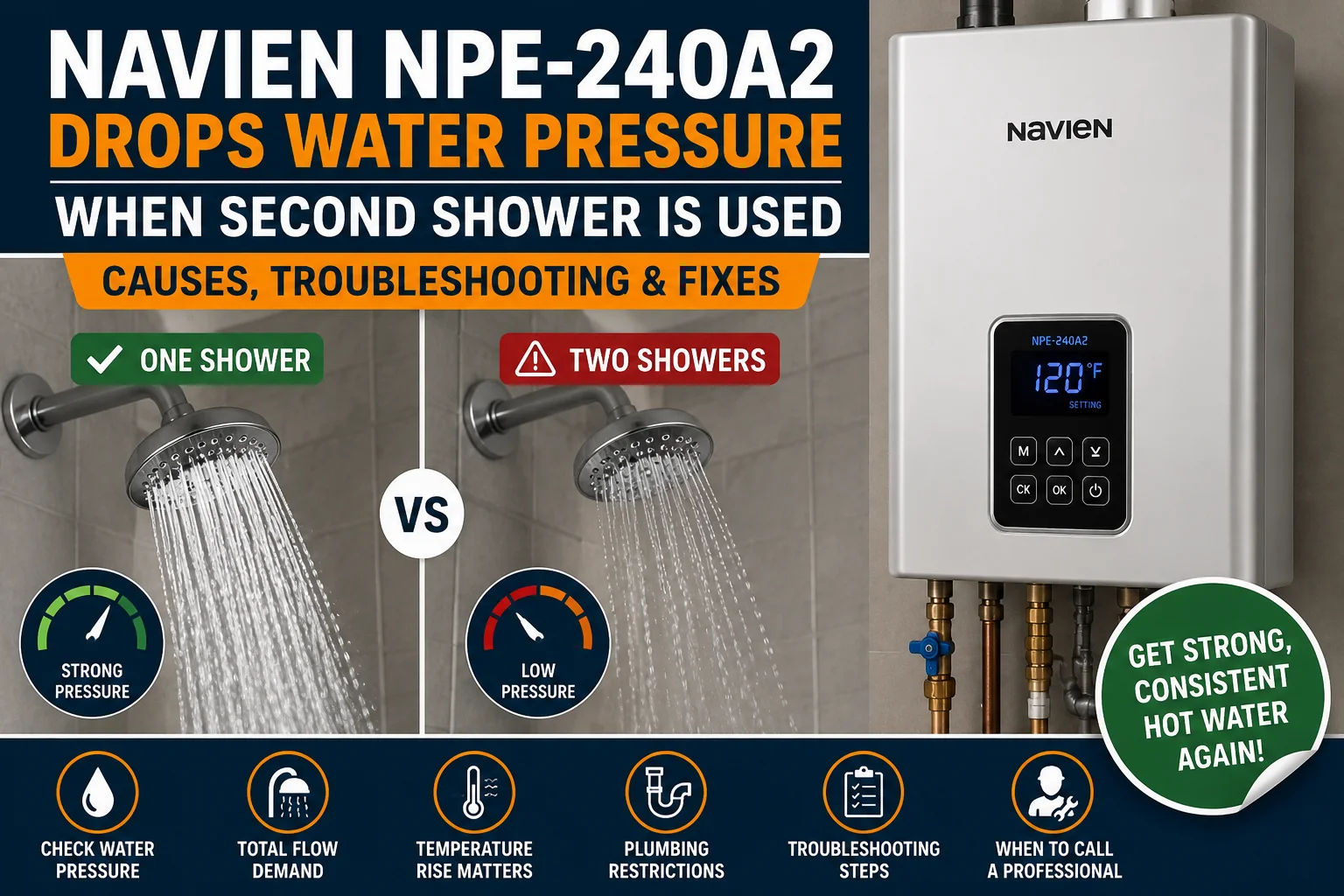
If your Navien NPE-240A2 handles one shower just fine but the water noticeably weakens the moment a second shower turns on, you’re dealing with a common — and usually explainable — situation. It doesn’t automatically mean your tankless water heater is failing. In many cases, what feels like a pressure drop is actually the system responding to increased demand. This guide walks through how to tell whether the real issue is water pressure, flow capacity, temperature rise, or something in your home’s plumbing, and what you can safely check before calling a professional.
Why Does Water Pressure Drop When the Second Shower Starts?
Every shower draws a certain number of gallons per minute (GPM). When a second shower starts, total household demand roughly doubles, and every part of the system — supply, plumbing, and water heater — has to keep up.
Possible limits anywhere in that chain include: limited incoming water supply, high total demand from two fixtures, undersized or older plumbing, a poorly set pressure-reducing valve, a partially closed supply valve, clogged aerators or filters, or the water heater’s own flow capacity at the current temperature setting.
The NPE-240A2 is only one link in that chain, so it’s worth ruling out the others before assuming the heater is the limiting factor.
Is It Really Low Water Pressure or Reduced Water Flow?
These two terms get used interchangeably, but they describe different things, and mixing them up can send troubleshooting in the wrong direction.
Water pressure is the force behind the water, measured in PSI (pounds per square inch) — what pushes water through your pipes and fixtures.
Water flow rate is the volume of water moving through the system, measured in GPM (gallons per minute). Flow rate depends on both pressure and how much is being demanded by open fixtures at once.
Here’s why the distinction matters: if your home has genuinely low water pressure, you’ll usually notice weak flow even with a single fixture running. But if one shower runs strong and only weakens once a second fixture opens, that typically signals a flow-capacity limitation under higher demand, not a true pressure problem. Watch for these patterns:
- Strong flow with one shower, weaker with two — points to a flow/capacity issue under demand
- Weak flow even with just one fixture — points more toward an actual pressure problem
- Flow that recovers immediately when the second shower is turned off — confirms it’s demand-related, not a leak or failure
- Temperature drops along with flow — can indicate the heater working near its capacity limit at the current temperature rise
Can the Navien NPE-240A2 Handle Two Showers at Once?
According to Navien’s published specifications, the NPE-240A2 delivers up to 11.2 GPM at a 35°F temperature rise, 8.7 GPM at a 45°F rise, and 5.6 GPM at a 67°F rise. It has a gas input range of 13,300–199,900 BTU/hr and a rated inlet water pressure range of roughly 15–150 PSI, per published product specifications.
That doesn’t translate to a simple yes-or-no on two showers, though. Whether two showers run comfortably together depends on showerhead GPM (standard heads often run 1.5–2.5 GPM), how cold your incoming water is, your temperature setpoint, total combined demand from all fixtures in use, your plumbing’s size and condition, and whether the installation includes mixing valves or a recirculation setup.
As an example only: with relatively warm incoming water and just a 35°F rise, the unit’s 11.2 GPM capacity likely covers two standard showers comfortably. With cold incoming water requiring a 67°F rise, capacity drops to 5.6 GPM — still enough for two low-flow showers, but tighter with higher-flow fixtures. This illustrates how temperature rise affects capacity; it isn’t a guarantee for your specific setup.
Common Reasons Your Second Shower Has Weak Water Flow
High Demand and Low Incoming Pressure
Two showers running at once can use nearly double the water of one. If your plumbing, water heater, or incoming supply is already near its limit with a single shower, adding a second pushes it past what it can comfortably deliver — and if your home’s incoming pressure is already marginal, this is where that limitation shows up first.
Plumbing and Showerhead Restrictions
Partially closed shutoff valves, clogged inline filters, mineral buildup in older pipes, a poorly adjusted pressure-reducing valve, or a clogged, mineral-scaled showerhead can all restrict flow — and the effect often becomes more noticeable under higher demand.
Temperature Rise and Hot-Water Demand
The colder your incoming water, the higher the temperature rise needed to reach your target temperature — and the lower the unit’s maximum flow capacity becomes at that rise. This is normal tankless behavior, not a malfunction.
Recirculation or System Configuration
The NPE-240A2 includes a built-in recirculation pump and buffer tank as part of its ComfortFlow system. If your installation uses this system or an external recirculation loop, an incorrectly configured setup could affect performance — but this should be evaluated by your installer, not assumed.
How to Troubleshoot a Navien NPE-240A2 When Two Showers Are Running
- Test one shower alone and note how strong the flow and temperature feel.
- Turn on the second shower and observe exactly what changes — flow, temperature, or both — and in which shower.
- Check other fixtures, like a kitchen faucet, while two showers run, to see whether the whole house is affected or just the showers.
- Check showerhead flow for visible blockage or mineral buildup you can safely clean.
- Check accessible supply valves to confirm they’re fully open. Don’t dismantle valves or plumbing components you’re not familiar with.
- Consider your incoming water pressure. A plumber can measure both static pressure (no water running) and flowing pressure (under demand) to see whether your home’s supply is the limiting factor.
- Check the Navien unit for error codes. A code can point to a separate appliance issue, though many flow/demand situations won’t trigger any code — no code doesn’t rule out a real limitation.
How Temperature Rise Affects NPE-240A2 Performance
Temperature rise is simply: desired hot-water temperature minus incoming cold-water temperature. The colder your incoming water — common in winter or with well water — the more the unit has to raise the temperature to reach your setpoint, and the lower its maximum flow rate becomes at that setting. This is a basic characteristic of how tankless heaters work, not a sign of a problem, and it doesn’t reduce your home’s actual water pressure — it limits how much hot water the unit can produce per minute at that temperature.
What If the Water Pressure Drops Throughout the House?
If pressure drops noticeably with any two fixtures running — hot or cold, anywhere in the house — that points toward a broader plumbing or supply issue rather than the water heater specifically. Worth investigating: the main water supply line, a whole-house pressure-reducing valve, the main shutoff valve, a clogged whole-house filter, general pipe condition and sizing, well system output (if applicable), or municipal supply conditions in your area. Pinpointing the exact cause usually requires hands-on testing rather than guesswork.
When Should You Call a Professional?
Bring in a licensed plumber or Navien-qualified technician if:
- Two fixtures can’t maintain adequate flow even after basic checks
- Pressure drops significantly throughout the home, not just at the showers
- The problem happens even with a single shower running
- Hot water temperature becomes unstable or fluctuates
- The Navien unit displays an error code
- You suspect a plumbing restriction you can’t access or diagnose
- The recirculation setup may need professional evaluation
A professional can measure actual pressure and flow rather than relying on how things feel, and pinpoint whether the limitation comes from the heater, the plumbing, the incoming supply, or fixture demand.
Frequently Asked Questions
Why does my Navien NPE-240A2 lose pressure when I use two showers?
it’s often a flow-capacity response to increased demand rather than an actual pressure problem — though home plumbing or incoming supply limitations can also be involved.
Can an NPE-240A2 run two showers at the same time?
Often, yes, but it depends on showerhead flow rates, incoming water temperature, and your plumbing — there’s no universal guarantee for every installation.
Is low water pressure the same as low water flow?
No. Pressure (PSI) is the force behind the water; flow (GPM) is the volume moving through the system. A home can have adequate pressure but still show reduced flow under high demand.
Why does my second shower get weaker when the first shower is running? Total demand has increased, and if the water heater, plumbing, or supply is near its limit, the added draw is where it becomes noticeable.
Can low incoming water pressure affect a tankless water heater?
Yes. Tankless units need adequate incoming pressure and flow to operate properly, so a marginal home supply can limit performance regardless of the heater’s own capacity.
How can I test whether the problem is my Navien or my plumbing?
Compare flow at a non-shower fixture during high demand, check for error codes, and have a plumber measure static versus flowing pressure to isolate the source.
A weaker second shower often points to normal flow-capacity limits under higher demand rather than a failure of your Navien NPE-240A2. Because pressure and flow are different things, it’s worth diagnosing them separately before assuming the heater is at fault. The unit’s actual capacity depends heavily on temperature rise and your specific plumbing setup, so if basic checks don’t explain what you’re seeing, a professional evaluation can measure the real numbers and identify where the limitation is coming from.