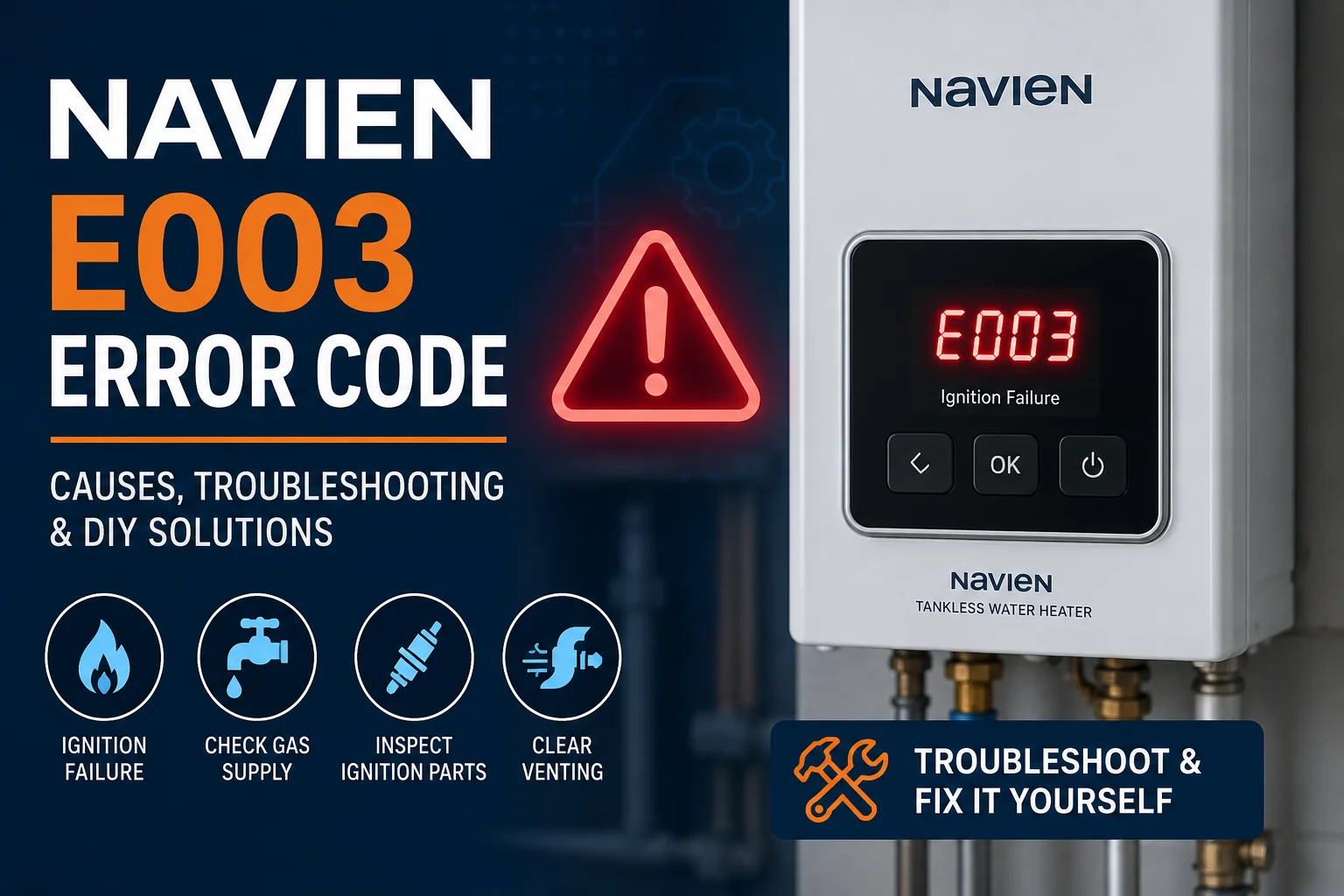
If your Navien tankless water heater is showing E003, it means the unit tried to light the burner and couldn’t confirm a flame. This is an ignition failure code, and it’s the reason your home suddenly lost hot water. The exact cause varies by model and situation, but it almost always traces back to gas supply, ignition components, flame sensing, venting, or electrical power — and in this guide, we’ll walk through each one so you can figure out what’s likely going on before a technician arrives.
What Does Navien E003 Error Code Mean?
When you turn on a hot water tap, your Navien unit runs through an ignition sequence: it purges air from the combustion chamber, opens the gas valve, fires the igniter, and then checks whether a flame actually caught. That last step matters — the unit doesn’t just assume ignition worked. A component called a flame rod (or flame sensor) has to detect and confirm a stable flame within a few seconds.
If the unit can’t confirm that flame within its allowed number of attempts, it stops trying and locks out, displaying E003. This shutdown is a safety feature. Rather than continuing to release gas without a confirmed flame, the unit halts the process. That’s why E003 almost always means no hot water — the burner never successfully lit, so there’s no heat being added to the water passing through the unit.
Because ignition depends on several systems working together (gas, air, spark, and sensing), E003 doesn’t point to one single problem. It just tells you that ignition didn’t succeed. Figuring out why is the real troubleshooting task.
What Causes Navien E003?
Gas supply problems
Ignition needs a steady, adequate flow of gas the moment the igniter fires. A few things can interrupt that:
- Closed or partially closed gas valve. If the manual shutoff valve leading to the unit isn’t fully open, gas flow can be restricted enough to prevent ignition.
- Interrupted supply. If the gas was shut off recently — for maintenance, an appliance install, or a utility issue — and not fully restored, the unit won’t have gas to ignite.
- Insufficient gas pressure. Even with the valve open, pressure that’s too low (due to line sizing, regulator issues, or high demand from other appliances) can prevent a stable flame from establishing.
- Recent gas line work. Plumbing or gas line work elsewhere in the home can sometimes introduce air into the lines or leave a valve not fully reopened, both of which can trigger ignition failure the next time the heater runs.
- Empty propane tank, for homes running on propane instead of natural gas.
Ignition component problems
The igniter is what creates the spark (or hot surface) needed to light the gas. If it’s worn, corroded, or covered in soot or debris, it may not generate a strong enough ignition source. Over time, ignition components can also loosen from vibration or degrade from repeated heat cycles, weakening their ability to reliably start combustion.
Flame-sensing problems
Even if the burner does light, the unit still has to detect that flame to continue running. The flame rod senses this through a small electrical signal that only flows when it’s in contact with an active flame. If the flame rod is coated with residue, corroded, or has a damaged or loose wire connection, the control board may not receive that confirmation signal — and it will shut down and post E003 even if the burner briefly lit.
Venting or combustion-air problems
Gas combustion needs a proper balance of fuel and air, plus a clear path for exhaust. If the air intake is blocked (commonly by insects, debris, or a clogged filter) or the vent termination outside is obstructed, the unit may not get the airflow it needs to ignite and sustain combustion safely. Many Navien units are designed to detect abnormal venting conditions and will prevent ignition rather than risk incomplete combustion.
Electrical or wiring problems
The entire ignition sequence — gas valve, igniter, and flame sensor — is controlled electronically. Problems with the unit’s power supply, a loose or corroded ground connection, or damaged wiring between the control board and ignition components can interrupt the sequence at any point, resulting in the same E003 code even though the underlying issue is electrical rather than gas-related.
Gas valve or internal control problems
In some cases, the internal gas valve itself or the control board managing the ignition sequence can be the source of the fault. These are technician-level components — diagnosing and repairing them requires specialized tools and training, and they shouldn’t be opened, tested, or adjusted by a homeowner.
How to Troubleshoot Navien E003
Work through these steps in order. Start with what’s easiest and safest to check, and stop immediately if you smell gas (see the safety note below).
Step 1: Check whether the unit has power
Confirm the water heater’s display is lit or responsive. Check that it’s plugged in (if applicable) and that the circuit breaker supplying it hasn’t tripped. A unit with no power, or intermittent power, can’t complete an ignition sequence at all.
Step 2: Check the gas supply
Look at the manual gas shutoff valve near the unit. On most valves, the handle should be parallel to the pipe when open and perpendicular when closed. If it looks even partially closed, that alone could explain E003. Don’t attempt to test or adjust gas pressure yourself — that’s a technician-level task covered later in this guide.
Step 3: Check other gas appliances
Try your stove, furnace, or another gas appliance in the home. If they’re also not working, the problem likely lies with your home’s gas supply rather than the water heater itself, and you may need to contact your gas utility rather than a water heater technician.
Step 4: Check the vent and air intake from the outside
Walk outside and look at where the unit vents to the exterior. Check for obvious blockages — leaves, snow, ice, a bird’s nest, or debris caught in the vent cap or intake screen. Don’t remove venting components or reach inside the vent pipe; just look for anything obstructing it from the outside.
Step 5: Reset the Navien unit according to the manufacturer’s instructions
Follow the reset procedure listed in your unit’s manual (this is usually done through the front panel or a dedicated reset button). A reset can clear a one-time fault and let the unit try ignition again, but it doesn’t fix whatever caused the failure in the first place. Don’t rely on unplugging the unit for an arbitrary amount of time as a fix — follow the documented reset steps for your specific model.
Step 6: Observe whether E003 returns
After a reset, pay attention to whether the error comes back — and how quickly. This is one of the most useful pieces of information for figuring out what’s actually wrong, which is why it gets its own section below.
Navien E003 Keeps Coming Back — What Does It Mean?
How E003 behaves over time tells you a lot:
- A single occurrence, then normal operation often points to a temporary condition — a brief gas interruption, a momentary power blip, or a one-off ignition miss.
- Occasional E003, no clear pattern can suggest a marginal issue, such as a flame sensor that’s slightly dirty or a gas pressure fluctuation under certain demand conditions.
- E003 every single time you try for hot water points to a persistent problem — likely gas supply, a failed or badly fouled ignition component, or a wiring fault — and won’t resolve with repeated resets.
- E003 that started right after gas-line work strongly suggests the gas supply itself, such as a valve not being fully reopened or air trapped in the line.
- E003 with no other symptoms narrows things toward ignition or flame-sensing components rather than a broader system issue.
- E003 alongside unusual noises, other error codes, or burning smells should be treated as more serious and reviewed by a technician promptly.
If E003 is recurring, resist the urge to just keep resetting the unit. A reset doesn’t diagnose or repair anything — it only tells the unit to try again. Repeated ignition failures should be professionally diagnosed rather than repeatedly cleared.
Why Does My Navien Have E003 But Work After a Reset?
This is one of the most common follow-up questions, and it makes sense why it’s confusing. A reset can clear the fault condition in the unit’s control logic and give it another chance to run through the ignition sequence successfully. If the original issue was marginal or intermittent — a brief pressure dip, a momentary bad connection, dust that got knocked loose — the next attempt may succeed.
But a successful reset doesn’t mean the underlying cause is gone. If it was a flame sensor with slight buildup or a connection that’s starting to corrode, that condition is still there and can easily cause the same failure again. Working after a reset is a sign the unit is on the edge of failing, not a sign it’s fixed.
Can You Fix Navien E003 Yourself?
Some checks are genuinely safe for a homeowner to do. Others involve gas pressure, internal components, or live electrical testing and should be left to a licensed technician.
| Check/Repair | Homeowner Safe? | Usually Requires Technician? |
|---|---|---|
| Check power | Yes | No |
| Check external gas shutoff position | Yes | No |
| Check obvious external vent obstruction | Yes | No |
| Reset according to manual | Yes | No |
| Gas pressure testing | No | Yes |
| Gas valve adjustment | No | Yes |
| Internal ignition-component repair | No | Yes |
| Combustion testing | No | Yes |
Anything involving opening the unit’s cabinet, testing or adjusting gas pressure, working on internal wiring, or handling the gas valve requires the training, tools, and manufacturer procedures a licensed technician has. Attempting these without that background isn’t just a warranty risk — it’s a genuine safety risk with a gas-burning appliance.
How a Technician Diagnoses Navien E003
A qualified technician approaches E003 methodically, rather than swapping parts at random. Here’s generally what that process involves and why:
- Reviewing error history. Many Navien units log previous error codes, which helps a technician see whether E003 has occurred before, alongside other codes, or in a specific pattern.
- Checking gas supply and pressure. Using proper test equipment, a technician verifies that gas pressure meets the unit’s specifications during ignition and while firing — something that can’t be confirmed by eye.
- Inspecting the ignition sequence. They observe how the unit behaves when it calls for heat, watching for a weak spark, delayed gas valve opening, or other timing issues.
- Testing ignition components. The igniter is checked for proper resistance and spark strength, since a weakened igniter may spark but not reliably light the burner.
- Testing flame-sensing components. The flame rod is inspected and tested to confirm it can properly detect a flame once one is established.
- Evaluating venting and combustion air. A technician checks that the vent and intake are unobstructed and functioning as designed, since improper venting can prevent safe ignition even when gas and ignition components are fine.
- Checking wiring and electrical connections. Connections to the igniter, flame rod, gas valve, and control board are inspected for corrosion, looseness, or damage.
- Testing the gas valve and control board. If the above checks don’t explain the failure, the technician moves to testing the internal gas valve operation and control board function, which can require specialized diagnostic tools.
This step-by-step approach is why a technician can identify the actual cause instead of guessing — and why the same E003 code can have very different fixes depending on the unit.
When Should You Call a Professional?
Call a licensed technician if:
- E003 keeps returning, even after a proper reset
- The unit won’t ignite at all
- You’ve completed the safe homeowner checks above and still have no hot water
- Other gas appliances in the home are also affected
- The issue started right after gas-line work
- You notice visible damage to the unit or its venting
- You’re not comfortable performing any of the checks above
- The problem appears to involve internal components
- Gas pressure or combustion needs to be tested
If you ever smell gas near the unit or anywhere in your home, leave the area immediately, do not operate any switches or the water heater, and contact your gas utility or local emergency services from a safe location before doing anything else. Don’t attempt to troubleshoot the heater in this situation.
How to Prevent Future Navien E003 Errors
You can’t guarantee E003 will never happen, but a few habits reduce the odds:
- Follow Navien’s maintenance schedule for your specific model, found in the installation and service manual.
- Keep the air intake and vent termination clear of debris, snow, ice, insects, and vegetation.
- Schedule professional inspections when recommended, especially for combustion and gas pressure checks that homeowners can’t perform themselves.
- Address recurring ignition problems early instead of relying on repeated resets — a small issue caught early is usually a smaller repair.
- Keep a record of error codes and when they occur. This history is genuinely useful to a technician and can speed up diagnosis.
Frequently Asked Questions About Navien E003
What does E003 mean on a Navien tankless water heater?
It means the unit attempted to ignite the burner but couldn’t confirm a flame within its allowed attempts, so it shut down as a safety measure.
Is Navien E003 an ignition failure?
Yes. E003 is specifically an ignition failure code, not a general error — it always relates to the unit’s inability to establish or confirm flame.
Why does my Navien show E003 but work after a reset?
A reset clears the fault and lets the unit try again, and a marginal issue may succeed on the next attempt. This doesn’t mean the underlying cause is resolved — it can easily fail again.
Can low gas pressure cause E003?
Yes. Insufficient gas pressure during ignition can prevent a stable flame from forming, triggering E003. Testing gas pressure should only be done by a licensed technician.
Can a blocked vent cause Navien E003?
Yes. Blocked venting or combustion air intake can interfere with the airflow needed for safe ignition, which can result in E003.
Can I fix Navien E003 myself?
You can safely check power, confirm the gas valve is open, look for obvious external vent blockages, and perform a manual reset. Anything involving gas pressure, internal components, or wiring should be handled by a technician.
Why does my Navien E003 keep coming back?
Recurring E003 usually means there’s a persistent issue — with gas supply, an ignition component, flame sensing, or wiring — that a reset can’t resolve. It needs professional diagnosis.
Does E003 mean I need a new water heater?
Not usually. E003 is a diagnostic code, not a verdict on the unit’s overall condition. Most causes are repairable once a technician identifies the specific issue.
Should I call a plumber or HVAC technician for E003?
Either can be appropriate, since tankless water heater service overlaps both trades — what matters most is that whoever you call has specific experience servicing Navien units and gas appliances.
Can recent gas-line work cause an ignition problem?
Yes. Work on gas lines elsewhere in the home can sometimes affect supply or introduce air into the lines, which can lead to ignition failure the next time the water heater runs.
Final Takeaway
Navien E003 means the unit tried to ignite and couldn’t confirm a flame, so it shut itself down for safety. The most common causes fall into a handful of categories: gas supply, ignition components, flame sensing, venting, and electrical connections. Homeowners can safely check power, confirm the gas valve is open, look for obvious external vent blockages, and perform a proper reset — but gas pressure testing, internal ignition-component repair, and combustion testing require a licensed technician. If E003 keeps coming back, don’t keep resetting the unit and hoping it resolves on its own; a recurring ignition failure needs a proper diagnosis to find and fix the actual cause.