
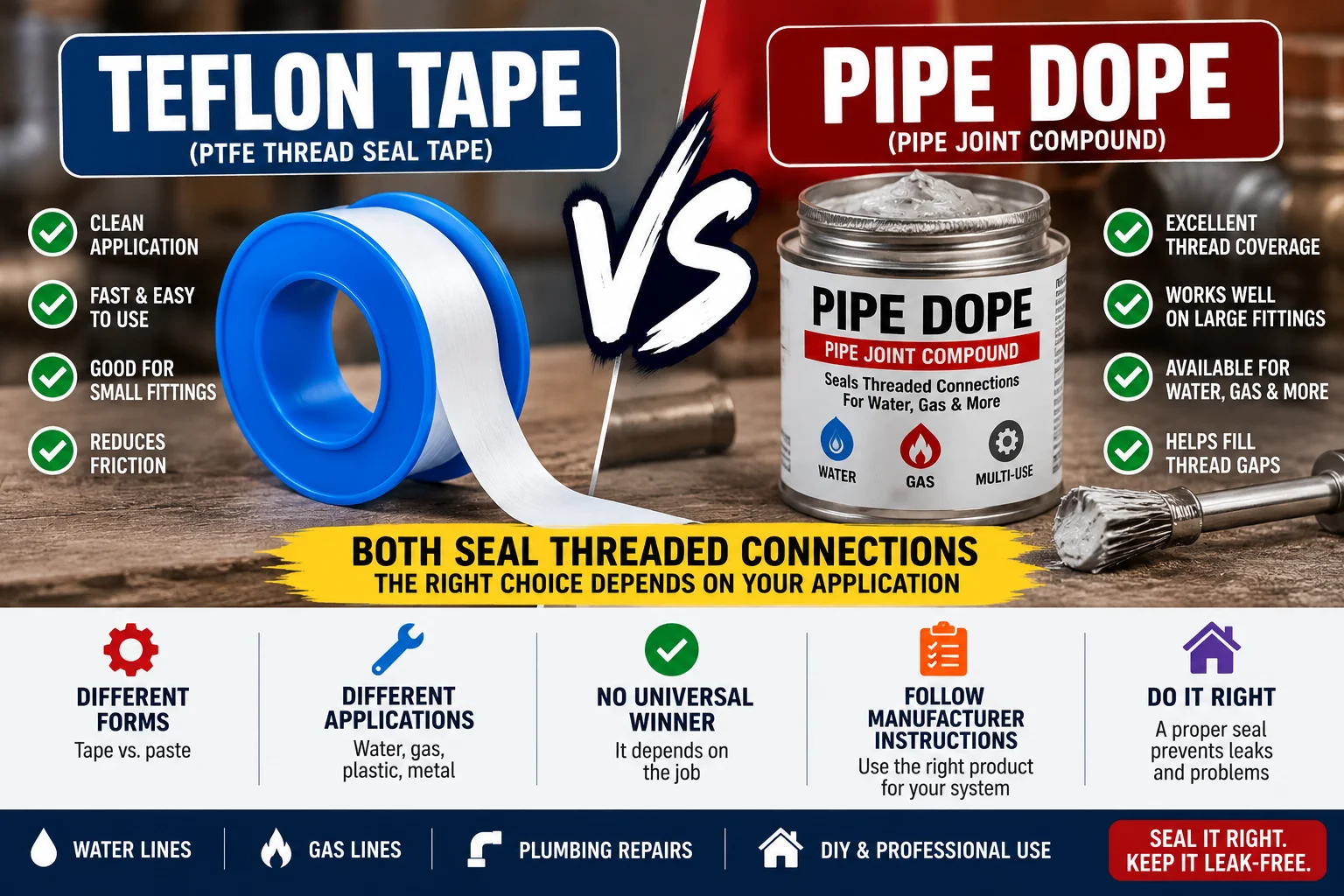
Teflon tape vs pipe dope is one of the most common questions homeowners ask when sealing a threaded pipe connection, and the honest answer is that neither product wins in every situation. Teflon/PTFE tape and pipe dope both help seal threaded joints, but they work differently and suit different jobs. The right choice depends on the thread type, pipe material, fitting size, pressure, temperature, the fluid or gas involved, and what the manufacturer actually recommends for that specific connection. This guide compares both products so you can pick the right one for your project instead of guessing.
Teflon Tape vs Pipe Dope: Quick Answer
Teflon/PTFE tape is a thin tape wrapped around compatible male pipe threads before assembly. Pipe dope, also called pipe joint compound, is a paste or liquid sealant brushed onto the threads instead. Both can help create a leak-free threaded connection, but neither is automatically the better choice for every job.
| Feature | Teflon Tape | Pipe Dope |
|---|---|---|
| Form | PTFE tape | Paste/liquid compound |
| Application | Wrapped around threads | Brushed/applied to threads |
| Cleanliness | Generally cleaner | Can be messier |
| Application speed | Fast | Usually slower |
| Cure time | Generally none | Depends on formula |
| Large fittings | May be less convenient | Often useful |
| High-pressure applications | Depends on tape rating | Depends on product rating |
| Gas applications | Only use appropriately rated tape | Only use appropriately rated compound |
| Best choice | Depends on application | Depends on application |
Treat this table as a general starting point rather than a specification sheet — always check the label and documentation for the exact product you’re using.
What Is Teflon Tape?
“Teflon” is a trademark name, and the product most people call Teflon tape is technically PTFE thread-seal tape (polytetrafluoroethylene). It’s a thin, flexible tape that gets wrapped around the male threads of a compatible fitting before it’s screwed into place. As the connection is tightened, the tape helps seal small gaps in the threads and also acts as a lubricant, making the fitting easier to turn and helping prevent galling on some metal-to-metal connections. Not every fitting is designed for tape, so it’s worth confirming that the connection actually seals on the threads before applying it. Threaded fittings, including the male threads found on MIP fittings, are a common example of connections where tape or dope is typically appropriate.
What Is Pipe Dope?
Pipe dope is a common name for pipe joint compound, a paste or liquid thread sealant applied directly to the threads with a brush or applicator. Unlike tape, pipe dope isn’t one single universal formula. Different products are designed for different applications, including specific pipe materials, temperature ranges, chemicals, or fluid types. The compound works by filling small gaps between mating threads as the connection is tightened. Because formulations vary so much, it’s important to check the label of the specific product you’re using rather than assuming any pipe dope works for any job.
How Does Teflon Tape Work?
PTFE tape helps seal a threaded connection through a fairly simple process:
- Machined threads almost always contain tiny imperfections or gaps.
- PTFE tape conforms to the shape of the thread profile as it’s compressed.
- The tape helps fill those small potential leak paths.
- It also provides lubrication, making assembly smoother.
- When properly applied and tightened, this creates a more reliable seal.
Tape is not designed to compensate for damaged, stripped, or badly worn threads. If a fitting’s threads are already compromised, adding more tape usually won’t solve the underlying problem.
How Does Pipe Dope Work?
Pipe joint compound follows a similar general principle, with a few differences:
- The compound is applied to the compatible threaded surface.
- It fills small spaces within the thread profile.
- Tightening draws the threaded surfaces together.
- The compound helps create a seal across that contact area.
- Some products may require a specific set or cure time before the connection should be pressurized.
Not every pipe dope requires curing time; this varies by formula and manufacturer, so check the specific product’s instructions rather than assuming a universal wait time.
Teflon Tape vs Pipe Dope: Main Differences
Application
Tape is wrapped by hand around the threads. Pipe dope is brushed or applied as a coating. Each requires a different technique to apply correctly.
Mess
Tape is generally a cleaner option since it doesn’t drip or require cleanup afterward. Pipe dope can be messier, especially if too much is applied.
Ease of Use
Many homeowners find tape easier for smaller DIY jobs, though it still requires correct wrapping direction and amount. Pipe dope can offer broader thread coverage but takes a bit more care to apply evenly.
Gap Filling
Pipe dope can provide fuller coverage across the entire threaded surface, which is one reason it’s often favored on certain metal fittings and larger connections.
Disassembly
Both products can affect how easily a fitting comes apart later. Correct application matters for both; too much of either product can make future disassembly more difficult.
Cure Time
Tape generally doesn’t require curing. Some pipe dope formulas do have a specified set time before the connection should be used under pressure, while others don’t. Check the product label.
Storage
PTFE tape generally has a long shelf life under normal storage conditions. Pipe joint compounds can have product-specific storage requirements and shelf-life limits, so check the container for guidance rather than assuming indefinite storage.
When Should You Use Teflon Tape?
PTFE tape is often a practical choice for:
- Small household threaded fittings
- Water-line connections where the tape is rated for that use
- DIY plumbing projects where a clean, quick application is preferred
- Connections where the fitting manufacturer specifically recommends tape
When selecting tape, consider its density, thickness, chemical compatibility, temperature rating, pressure rating, and the fluid being carried. Standard white tape isn’t automatically appropriate for every application; some jobs call for a thicker or specially rated tape.
When Should You Use Pipe Dope?
Pipe joint compound is often preferred for:
- Larger threaded fittings
- Certain metal-to-metal threaded connections
- Applications where fuller coverage across the threads is useful
- Systems where the manufacturer specifically calls for a compound
- Certain demanding applications, when the specific product is rated for that use
Since pipe dope isn’t a single universal product, always check the label and technical documentation for the exact compound you’re using before applying it to a specific system.
Can You Use Teflon Tape and Pipe Dope Together?
Some plumbers do use both tape and pipe joint compound on certain connections, but combining them isn’t always necessary and isn’t automatically better. If you’re considering this approach, the specific products need to be approved for combined use with each other and with your pipe material. A common method on suitable applications involves wrapping PTFE tape first, then adding a thin, compatible layer of pipe dope over it. Even so, always follow the manufacturer’s instructions for both products rather than combining them without checking compatibility first.
Teflon Tape vs Pipe Dope for Water Lines
For residential water connections, consider:
- Whether the sealant is rated for potable (drinking) water use, when that applies
- The system’s operating pressure
- Water temperature
- Pipe material, such as copper, steel, or PVC
- Fitting size
- The manufacturer’s specific instructions for that fitting
Neither product is automatically better for every water-line connection. A fitting behind a water heater, for example, may have specific sealant guidance in the manufacturer’s installation manual, so it’s worth checking that documentation before choosing.
Teflon Tape vs Pipe Dope for Gas Lines
Gas-line connections require extra care. Any thread sealant used on natural gas or propane piping must be specifically rated for gas service — this is a safety requirement, not a preference. Not all PTFE tape is rated for gas, and tape color alone doesn’t confirm suitability; always check the product label for a gas rating. The same applies to pipe joint compound: it must be specifically formulated and rated for gas applications, not just general plumbing use.
Local code requirements can also apply to gas-line sealants and installation methods. If you’re not experienced with gas piping, this is an area where professional installation is strongly recommended rather than a DIY attempt.
Teflon Tape vs Pipe Dope for PVC and Plastic Fittings
Plastic fittings require some extra caution:
- Overtightening a plastic fitting can crack it, regardless of which sealant is used.
- Not every pipe dope formula is compatible with every type of plastic; some compounds can degrade certain plastics over time.
- Not every PTFE tape is automatically appropriate for every plastic application without checking compatibility.
- Manufacturer recommendations should always be checked before applying either product to a plastic fitting.
When working on plastic supply lines, drain fittings, or components like shower drain assemblies, confirm the sealant is listed as compatible with that specific plastic material before applying it.
How to Apply Teflon Tape Correctly
Step 1: Clean the threads. Remove any old tape, dope, or debris from the fitting.
Step 2: Confirm compatibility. Make sure the tape is rated for your specific application, whether that’s water, gas, or another use.
Step 3: Start on the correct thread. Many manufacturers recommend leaving the first thread exposed to reduce the chance of tape material entering the system.
Step 4: Wrap in the tightening direction. Wrapping the tape in the same direction the fitting will be tightened helps keep it from unwinding during assembly.
Step 5: Use an appropriate amount. The number of wraps needed depends on the tape’s thickness and density, so follow the manufacturer’s guidance rather than a fixed rule.
Step 6: Smooth the tape. Press it into the threads before threading the connection together.
Avoid using excessive tape. Too much material can prevent the threads from fully engaging, which can actually cause a poor seal rather than a better one.
How to Apply Pipe Dope Correctly
- Clean the threads thoroughly before application.
- Confirm the compound is compatible with your specific application and pipe material.
- Stir the product if the label instructs you to.
- Apply a thin, even coat to the appropriate threaded surface.
- Avoid letting excess compound get pushed into the pipe interior during assembly.
- Assemble the connection and tighten to a snug fit.
- Follow the manufacturer’s instructions regarding any set or cure time before pressurizing the line.
- Check the finished connection carefully for leaks.
Don’t assume a specific cure time applies; some products set quickly while others need longer, so the label is the only reliable source.
Common Mistakes With Teflon Tape and Pipe Dope
- Using the wrong product for the application — a sealant not rated for your specific use (like gas) can create a serious safety issue.
- Wrapping tape in the wrong direction — this can cause it to unravel during tightening.
- Using too much tape — can prevent proper thread engagement.
- Applying excessive pipe dope — extra compound can be pushed into the pipe and cause blockages or contamination.
- Sealing fittings that don’t seal on their threads — some fittings rely on an O-ring or gasket instead, and adding sealant there can interfere with the actual seal.
- Using the wrong sealant for gas — always confirm gas-rated products.
- Using incompatible sealant on plastic — can degrade certain plastic materials over time.
- Reusing old tape — tape that’s been removed shouldn’t be reapplied.
- Skipping thread cleaning — old sealant residue can prevent a proper new seal.
- Overtightening — can crack fittings, especially plastic ones, without actually improving the seal.
- Assuming sealant fixes damaged threads — neither product can compensate for stripped or worn threads.
- Combining products without checking compatibility — some combinations aren’t approved for use together.
Do All Threaded Fittings Need Teflon Tape or Pipe Dope?
No. Not every threaded connection is designed to seal on the threads themselves. Some fittings rely on:
- O-rings
- Gaskets
- Flare surfaces
- Compression mechanisms
- Other dedicated sealing surfaces
Adding thread sealant to a connection that’s designed to seal a different way can actually interfere with the intended seal rather than help it. If you’re unsure how a specific fitting is meant to seal, check the manufacturer’s documentation before applying tape or dope.
Which Is Better: Teflon Tape or Pipe Dope?
Choose Teflon Tape When…
You’re working on a smaller fitting, want a clean and fast application, and have a tape that’s specifically rated for your application (water, gas, or otherwise).
Choose Pipe Dope When…
You’re working on a larger fitting, want fuller coverage across the threaded surface, or the manufacturer specifically calls for a compound rated for your application.
Consider Both When…
Some professionals use tape and a compatible pipe dope together on certain larger or more demanding connections, but only when both specific products are confirmed compatible with each other and the manufacturer’s instructions support that approach.
Neither product is universally superior; the right choice comes down to the specific fitting, material, and application in front of you.
When to Call a Plumber
Consider calling a licensed plumber if:
- The work involves gas piping
- A connection keeps leaking after resealing
- The threads are visibly damaged
- The fitting is corroded
- The leak is concealed inside a wall or floor
- The system operates under high pressure
- You’re unsure which sealant is compatible with your fitting
- A plastic fitting is cracked or damaged
- A water heater connection requires more than a routine reseal
Gas-line work in particular should be left to a qualified professional unless you have the training and equipment to do it safely.
Frequently Asked Questions
Is Teflon tape better than pipe dope?
Neither is universally better. Tape is often quicker and cleaner for smaller fittings, while pipe dope can offer fuller thread coverage on larger connections. The right choice depends on the fitting, material, and manufacturer instructions.
Can I use Teflon tape and pipe dope together?
Sometimes, but only when both specific products are confirmed compatible with each other and the fitting. It’s not always necessary, and combining products without checking compatibility isn’t recommended.
Is pipe dope better for water lines?
Not automatically. Both tape and pipe dope can be appropriate for water-line connections, depending on the fitting size, pipe material, and whether the specific product is rated for potable water use.
Is Teflon tape safe for gas lines?
Only if it’s specifically rated for gas service. Not all PTFE tape is gas-rated, and color alone doesn’t confirm suitability. Always check the product label and consider professional installation for gas piping.
How many times should I wrap Teflon tape?
There’s no single universal number. The correct amount depends on the tape’s thickness and density, so follow the manufacturer’s specific guidance for the product you’re using.
Does pipe dope need to dry?
It depends on the formula. Some pipe joint compounds require a set or cure time before the connection is pressurized, while others don’t. Check the manufacturer’s instructions for your specific product.
Can I use pipe dope on PVC?
Only if the specific compound is labeled compatible with PVC or the plastic material involved. Some formulas can degrade certain plastics, so checking compatibility first is important.
Can I use Teflon tape on plastic fittings?
In many cases, yes, but compatibility should still be confirmed for the specific tape and plastic material. Overtightening plastic fittings can also cause cracking regardless of the sealant used.
Can thread sealant fix a leaking fitting?
No. Tape and pipe dope help create a proper seal on compatible threads, but they can’t compensate for damaged, stripped, or incompatible threads. A persistent leak after resealing usually points to a different underlying issue.
Do all threaded fittings need Teflon tape or pipe dope?
No. Some fittings seal using an O-ring, gasket, flare surface, or compression mechanism instead of the threads themselves. Adding sealant to those connections can interfere with the intended seal.
Conclusion
Teflon/PTFE tape and pipe dope are both useful thread-sealing products, but neither one is automatically the better choice for every plumbing job. The right pick depends on the thread type, pipe material, fitting size, pressure, temperature, whether the line carries water, gas, or something else, and what the manufacturer specifically recommends. Using the correct, appropriately rated sealant and applying it properly matters far more than simply choosing one product over the other. When you’re unsure which sealant fits your situation, check the manufacturer’s documentation or ask a licensed plumber before assembling the connection.