
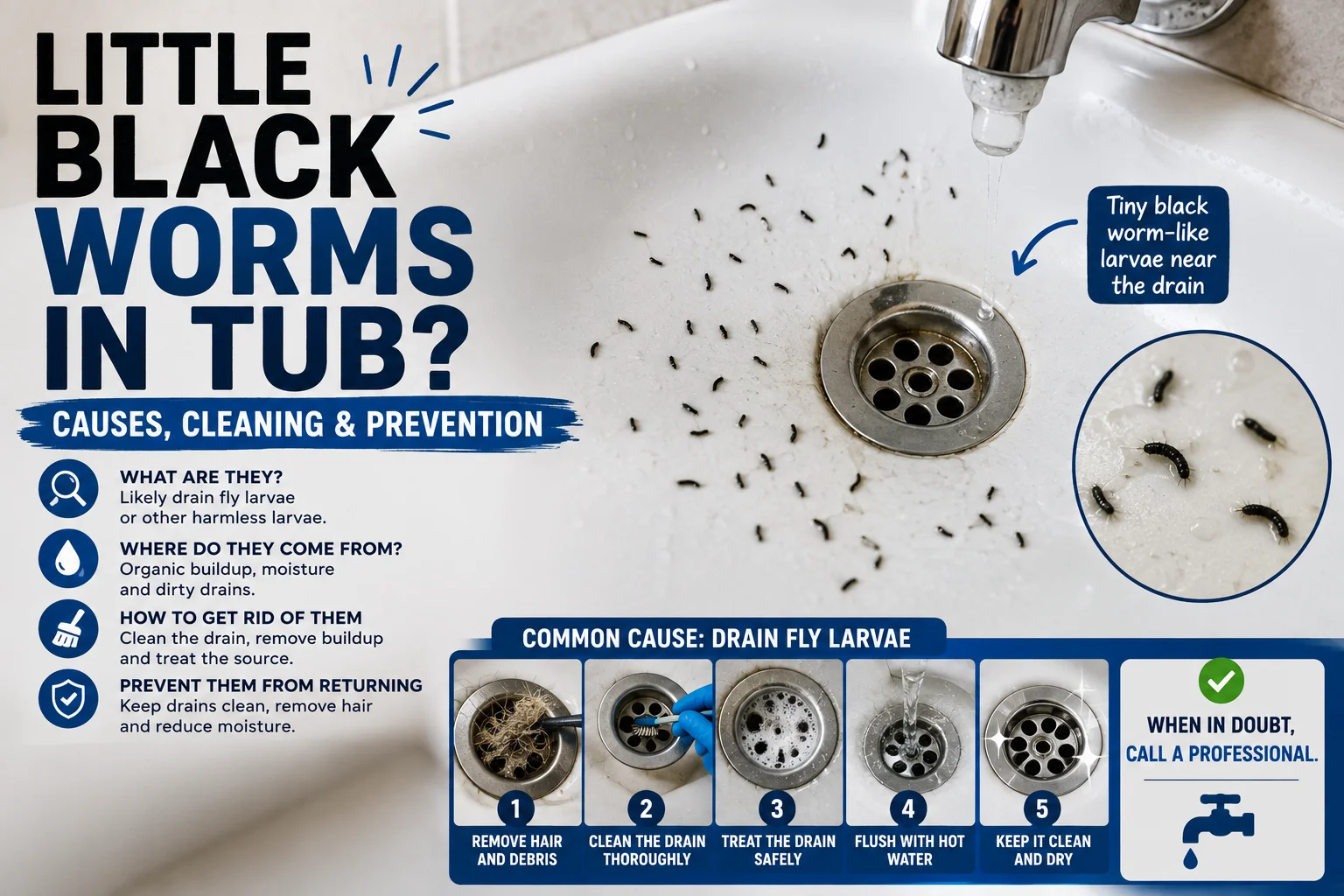
Finding little black worms in your tub is unpleasant, but it usually doesn’t mean your home has a serious infestation. In most cases, “little black worms” is a description rather than a confirmed identification — it could be drain fly larvae, another small organism drawn to moisture, or even debris like hair or biofilm that looks worm-like when wet. The first real step is figuring out where they’re coming from. This article covers what they may be, why they show up, how to identify the likely source, how to clean the tub and drain safely, how to keep them from coming back, and when to call a plumber versus a pest-control professional.
What Are the Little Black Worms in My Tub?
“Little black worms” describes an appearance, not a species — several different things can look similar in a damp bathtub.
Drain fly larvae. Drain flies (also called moth flies) are small, fuzzy, moth-like flies that breed in the slimy organic film that builds up inside drains. According to the University of Maryland Extension, drain fly larvae live in the gelatinous slime coating drains and traps, feeding on the algae, bacteria, and fungi that grow there. Virginia Tech Extension describes the larvae as long, thin, and worm-like — a reasonable match for what many homeowners describe as “little black worms.” If you’re also noticing small fuzzy flies resting on the tub walls or nearby surfaces, drain flies become a more likely explanation.
Other small larvae or worm-like organisms. Other insects can also turn up in damp bathrooms, and not every worm-like organism found near a drain is a drain fly larva. Precise identification usually requires a closer look — sometimes a photo or physical sample examined by an entomologist, extension office, or pest-control professional — rather than a description alone.
Debris that looks like worms. Hair, soap scum, sludge, and biofilm can clump together in ways that look surprisingly worm-like when wet, especially if they shift or move slightly with water flow. Before assuming you’re dealing with a living organism, take a closer look — what appears to be movement is sometimes just water or drainage disturbing debris.
Why Are Little Black Worms Appearing in My Bathtub?
Several conditions tend to show up together where drain fly larvae and similar organisms are found: standing water, moisture that lingers after use, organic buildup from hair and soap residue, dirty or slimy drain surfaces, slow-draining plumbing, biofilm coating the inside of the pipe, and infrequent drain cleaning. UC IPM notes that female moth flies lay eggs in moist, nearly saturated organic matter, and that in homes, bathroom drains are the most common development site.
Not every bathtub with a slightly dirty drain will develop worms or larvae — it typically takes sustained moisture and organic buildup over time, not just occasional soap residue, to create conditions that support them.
Are Little Black Worms in the Tub Dangerous?
The presence of small worm-like organisms doesn’t automatically mean they’re dangerous or parasitic to humans. Drain fly larvae specifically feed on organic material inside the drain rather than on people, pets, or food. That said, when identification isn’t certain, a few sensible precautions are worth taking: wear gloves during cleanup, wash your hands afterward, clean any surfaces the organisms contacted, and keep children and pets away from unknown organisms until you know more. If the organisms are unusual, unusually numerous, or widespread beyond the drain area, professional identification is a reasonable next step. If there’s any sign of sewage contamination, take extra caution and treat it as a plumbing issue requiring professional attention rather than a routine cleaning job.
How to Tell Where the Black Worms Are Coming From
A few observations can help narrow down the source, even without a definitive identification:
Are they concentrated around the drain? This points toward a drain-related source rather than a broader bathroom issue.
Do they appear after the tub has been used? This can offer a clue about how they’re connected to water flow or drain activity.
Are they found on the walls or floor too, not just near the drain? This may suggest a broader moisture or pest issue extending beyond the plumbing itself.
Are they showing up in multiple drains around the house? This could point to a larger moisture or plumbing pattern rather than an isolated problem.
Is the drain slow? Slow drainage is often associated with the kind of organic buildup that supports drain fly larvae and similar organisms.
These clues help you form a reasonable hypothesis, but they don’t prove the exact organism or source on their own — treat them as a starting point for investigation.
Check the Bathtub Drain
You can safely inspect the accessible parts of your drain without dismantling any hidden plumbing:
- Remove the visible drain cover or stopper, if it’s designed to come off.
- Inspect for visible hair and organic buildup.
- Look for sludge or a slimy film (biofilm) coating the inside surfaces.
- Clean the visible debris you can reach.
- Rinse thoroughly.
- Monitor whether the problem returns over the following days.
Don’t attempt to dismantle the P-trap or other hidden plumbing components unless you have the right tools and knowledge — those parts require more care and can be a source of leaks if reassembled incorrectly. Drain cover and stopper designs vary quite a bit between tubs; our guide to types of shower drains and how to remove them covers the common styles and how to safely remove each one.
How to Clean a Bathtub Drain
Step 1: Remove visible hair and debris. Wear gloves and use a drain-cleaning tool, a bent wire, or a similar implement designed for this purpose.
Step 2: Clean the drain opening. Scrub the accessible surfaces you can reach, removing built-up slime or residue.
Step 3: Use an appropriate drain-cleaning product if needed. Choose a product compatible with your specific plumbing (some chemical cleaners aren’t safe for certain pipe materials or older plumbing) and follow the label instructions exactly.
Step 4: Flush according to the product’s instructions. Don’t use excessive water or chemical volume beyond what the label recommends.
Step 5: Clean the tub surface. Follow your tub’s specific surface-care instructions, since some finishes are sensitive to certain cleaners.
Safety note: Never mix bleach with ammonia, vinegar, acids, or other cleaning chemicals — combining these can produce dangerous fumes. Use one product at a time, rinse thoroughly between different products if you need to switch, and always follow the manufacturer’s label.
How to Get Rid of Little Black Worms in the Tub
- Remove any visible organisms.
- Clean the bathtub surface thoroughly.
- Inspect the accessible parts of the drain.
- Remove hair and organic buildup.
- Clean the accessible drain surfaces, including any slimy film.
- Address slow drainage if present.
- Reduce standing water where possible.
- Monitor the drain over the following days and weeks for recurrence.
- If they return, revisit the likely source rather than repeating the same cleaning step.
Simply removing the visible organisms often provides only temporary relief if the underlying organic buildup inside the drain remains untouched — that buildup is the food source and habitat, so addressing it matters more than clearing what’s visible on the surface.
Could Drain Flies Be Responsible?
Drain flies are small, hairy, moth-like flies typically under a quarter-inch long, often gray, brown, or black. Clemson HGIC describes adults as commonly found resting on or near showers and sinks, since they’re weak fliers that don’t travel far from where they developed. If you’re seeing both tiny worm-like larvae and small fuzzy flies around the tub drain, drain flies become a more plausible explanation for both. That combination doesn’t confirm the identification on its own, though — if you’re uncertain, a local extension office or pest-control professional can help confirm what you’re dealing with.
Why Do They Keep Coming Back?
Recurrence usually means the underlying environment that supported them in the first place is still there. Possible reasons include organic buildup still coating the inside of the drain, moisture that hasn’t fully cleared, slow drainage that continues to trap water, a hidden plumbing issue you haven’t identified yet, other drains in the home harboring the same conditions, or a nearby damp area supplying a continuous source. Treating only the visible organisms — wiping them away or using a spray — without addressing the buildup and moisture that support them rarely solves the problem for good.
How to Prevent Little Black Worms From Returning
- Keep drains clean on a regular basis, not just when a problem appears.
- Remove hair from the drain regularly rather than letting it accumulate.
- Avoid letting soap scum and organic buildup collect over time.
- Fix slow drains promptly rather than living with them.
- Address any leaks that keep an area persistently damp.
- Keep bathroom surfaces reasonably dry between uses.
- Improve bathroom ventilation to reduce lingering humidity.
- Check other drains in the home if the problem persists despite cleaning the tub.
- Follow your plumbing and fixture manufacturer’s cleaning recommendations.
Daily harsh chemical treatments aren’t necessary and can be counterproductive — regular mechanical cleaning (physically removing buildup) is generally more effective at removing the organic film that supports larvae than chemicals alone, since larvae can retreat into the deeper layers of slime to avoid surface-level chemical treatments.
Can a Clogged Drain Cause Black Worms?
A clogged or partially blocked drain can create the conditions that support drain fly larvae and similar organisms — mainly by trapping moisture and organic material for longer periods. But it’s worth distinguishing between different kinds of buildup: a hair clog, soap scum, organic sludge, and biofilm are all different things that can combine in a slow drain. The clog itself doesn’t directly create worms — rather, the moisture and organic material that accumulates around and because of the clog can provide a suitable environment for certain organisms to develop.
What If the Tub Drain Smells Bad Too?
A foul or musty odor alongside worm-like organisms often points toward the same organic buildup — hair, soap residue, decaying matter, and biofilm — or another drainage issue like a problem with the drain trap. If the odor persists after a proper cleaning, that’s a sign the problem may go deeper than what’s easily reachable, and a professional inspection is a reasonable next step.
When Should You Call a Plumber?
Plumbing help is appropriate when the drain is persistently slow despite cleaning, the bathtub repeatedly backs up, multiple drains in the home are affected, there’s any sign of sewage backup, a foul odor persists after cleaning, the problem keeps returning despite proper maintenance, you suspect a hidden leak, the drain can’t be safely cleared with accessible tools, or you suspect a damaged or blocked drain line beyond what you can reach.
When Should You Call Pest Control?
Pest control is often the better call when organisms are found throughout the bathroom rather than concentrated at the drain, they appear in locations away from any drain, multiple rooms are affected, there’s evidence of a broader insect infestation, the organism can’t be identified through basic observation, or the moisture and pest conditions clearly extend beyond the plumbing itself. Which professional to call really depends on where the evidence points — a plumbing problem calls for a plumber, while a broader pest issue calls for pest control, and sometimes both are involved.
Common Mistakes to Avoid
- Assuming every black worm you find is automatically a drain fly larva
- Repeatedly pouring harsh chemicals down the drain as a default response
- Mixing cleaning chemicals together
- Treating only the visible organisms while ignoring the buildup that supports them
- Ignoring slow drainage instead of addressing it
- Ignoring persistent moisture in and around the bathroom
- Removing plumbing components you’re not equipped to reassemble
- Using excessive force on a stuck drain cover
- Ignoring signs of sewage contamination
- Assuming a pest problem is always a plumbing problem, or vice versa
Frequently Asked Questions
1. What are the little black worms in my bathtub?
They’re often drain fly larvae, which develop in the organic film coating drains, but they can also be another small organism or even debris like hair or biofilm that looks worm-like when wet. Close observation or professional identification can confirm which.
2. Are little black worms in the tub drain flies?
Possibly. Drain fly larvae are commonly described as small, thin, worm-like organisms, especially when found near the drain alongside tiny fuzzy adult flies. It’s a plausible explanation, not an automatic confirmation.
3. Are black worms in the bathtub dangerous?
Not typically to humans — drain fly larvae feed on organic drain material, not people or pets. Still, wear gloves during cleanup and wash your hands afterward, especially if you’re not certain what you’re dealing with.
4. Why do little black worms keep coming back?
Recurrence usually means the organic buildup and moisture that support them are still present inside the drain. Removing visible organisms without cleaning the underlying buildup rarely solves the problem long-term.
5. Can a dirty bathtub drain cause worms? A dirty, slow, or buildup-coated drain creates the moist, organic-rich environment that certain organisms, including drain fly larvae, need to develop. The dirt itself doesn’t create worms, but it supports the conditions they need.
6. How do I get rid of little black worms in my tub?
Remove visible organisms, clean the tub and accessible drain surfaces thoroughly, address any slow drainage, and monitor for recurrence. If they keep coming back, the underlying buildup likely needs more thorough attention.
7. How do I clean a bathtub drain?
Remove hair and debris, scrub accessible slime and buildup, use a plumbing-compatible drain product if needed following the label, and clean the tub surface according to its specific care instructions. Never mix cleaning chemicals together.
8. Can drain flies have worm-like larvae?
Yes. Extension entomology sources describe drain fly (moth fly) larvae as long, thin, and worm-like, living in the slime layer inside drains and feeding on the organic material there.
9. Should I call a plumber or pest control?
Call a plumber for drainage problems, slow drains, backups, or suspected hidden plumbing issues. Call pest control if organisms appear throughout the bathroom or beyond, or if you can’t identify what you’re dealing with despite basic drain maintenance.
10. How can I prevent black worms from returning?
Keep drains clean, remove hair regularly, fix slow drainage promptly, address leaks, and improve bathroom ventilation. Regular mechanical cleaning of the drain tends to be more effective long-term than occasional chemical treatments.
Conclusion
“Little black worms in tub” is a description, not a confirmed identification — drain fly larvae are one common explanation, especially in damp, organic-rich drains, but other organisms or even debris can look similar. Start by inspecting the drain and the surrounding moisture conditions, then clean accessible buildup safely, being careful never to mix cleaning chemicals. Address slow drainage and any leaks that keep the area persistently damp, since these are usually what allows the problem to return. Call a plumber when the issue centers on drainage or hidden plumbing, and contact pest control when the problem appears broader than what your plumbing can explain.