
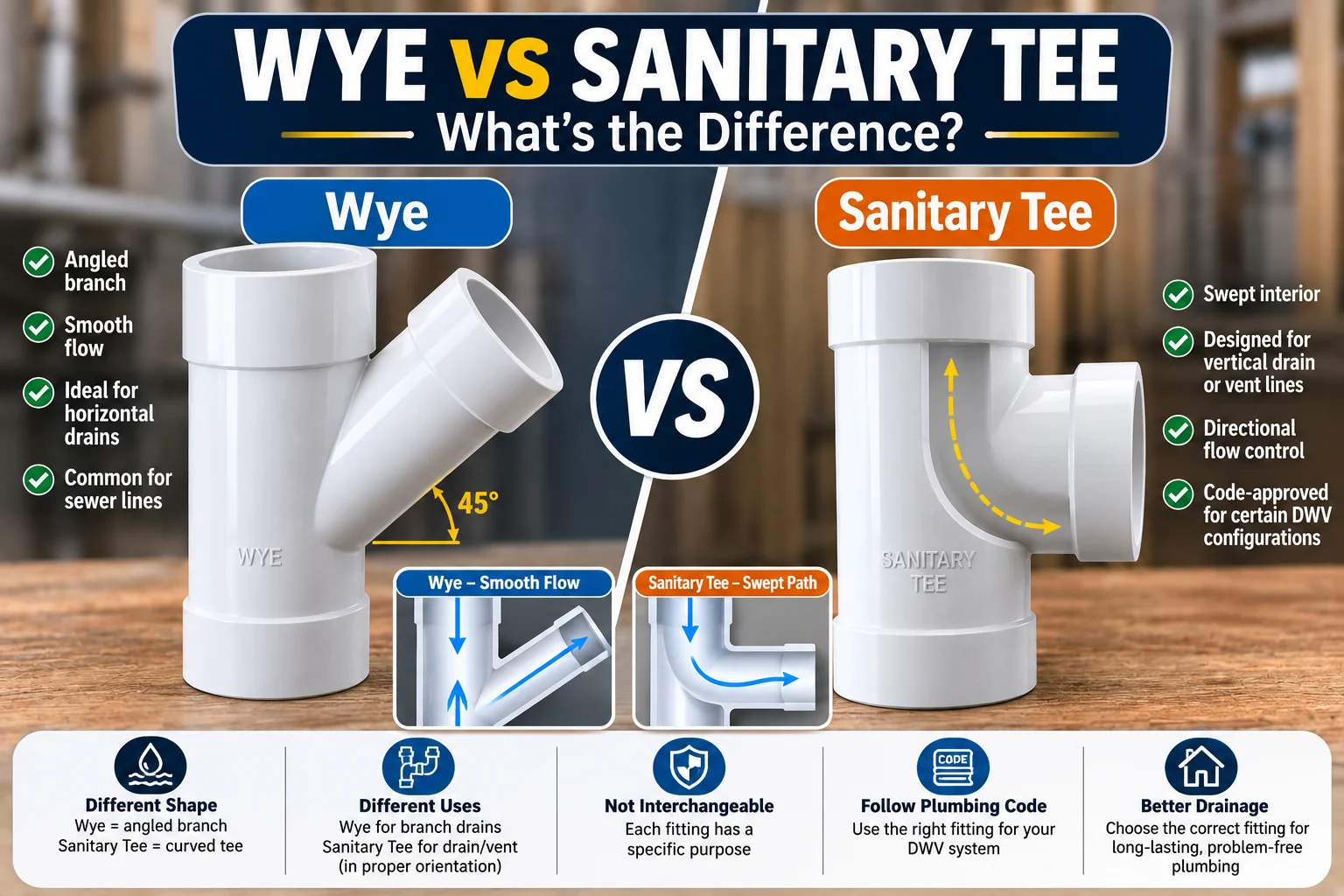
In the wye vs sanitary tee comparison, the biggest difference is the shape of the branch connection and the flow direction it’s built to handle. A wye has an angled branch that eases waste into a main line. A sanitary tee has a curved interior shaped for specific drain-to-vertical and vent transitions. Both are common DWV (drain-waste-vent) fittings, but they are not interchangeable. Using the wrong one can cause poor drainage, improper flow direction, or a code violation. The correct fitting always depends on the exact layout, orientation, and your local plumbing code.
Wye vs Sanitary Tee: Quick Answer
| Feature | Wye | Sanitary Tee |
|---|---|---|
| Branch connection | Angled (typically 45°) | Swept/curved tee |
| Common use | Drainage branch connections | Certain drain-to-vertical/vent configurations |
| Flow direction | Smooth directional merge | Built for a specific drainage/vent transition |
| Horizontal drainage | Commonly used where appropriate | Often restricted, depending on orientation/code |
| Vent applications | Depends on configuration/code | Commonly used in appropriate vent connections |
| Interchangeable? | No | No |
Always confirm the applicable local code before assuming an installation is allowed.
What Is a Wye Fitting?
A plumbing wye (“Y fitting”) connects a branch pipe to a main line at an angle, usually 45 degrees, instead of a sharp 90-degree turn. Think of two roads merging onto a highway at a gentle angle rather than crossing straight over — traffic blends in instead of colliding.
That angled entry is the key feature. It lets waste ease into the main run in roughly the same direction the flow is already moving, which helps keep water, solids, and vent air moving properly. Wyes show up throughout DWV systems wherever a branch drain, vent, or sewer line needs to join a larger line without disrupting flow.
What Is a Sanitary Tee?
A sanitary tee resembles a standard tee — a straight run with a 90-degree side branch — but the inside is different. Instead of a sharp square corner, it has a curved, swept interior on the branch side. That curve is shaped for waste to transition cleanly in specific arrangements, most often where a horizontal branch drain enters a vertical drain or stack.
The swept side also makes sanitary tees useful for certain vent connections, since air can move through the curved opening without the turbulence a square-cornered tee would create.
Main Difference Between a Wye and Sanitary Tee
Shape: A wye has an angled branch, usually 45 degrees. A sanitary tee has a 90-degree branch with a curved, swept interior instead of a square corner.
Flow direction: A wye keeps flow moving with a gentle merge. A sanitary tee is built for a specific transition — commonly horizontal-to-vertical — where the sweep helps waste change direction without a hard stop.
Typical applications: Wyes appear in branch drains, sewer laterals, and combination fittings. Sanitary tees are common at fixture drain connections to a vertical stack and in certain vent arrangements.
Orientation: Both fittings can physically be installed more than one way, but they aren’t approved for the same orientations. A fitting correct standing upright may not be correct on its side.
Code: Model codes like the IPC and UPC set which fitting patterns are permitted for horizontal-to-vertical, vertical-to-horizontal, and horizontal-to-horizontal changes in direction — and these permitted uses differ between a wye and a sanitary tee. Local amendments can change specifics, so the applicable code has the final word. For a closer look at how codes classify fitting connections, see up.codes’ summary of drainage piping and fitting connections.
Wye vs Sanitary Tee for Horizontal Drain Lines
Horizontal drain lines rely on gravity, so the fitting has to guide waste in the direction of flow instead of fighting it. Wyes are commonly used to join a branch drain into a horizontal main because the angled entry lets flow merge smoothly rather than colliding at a sharp angle.
A sanitary tee is generally intended for a horizontal-to-vertical transition, not for joining two horizontal runs, and many jurisdictions restrict using one to connect horizontal-to-horizontal. Before installing either fitting on a horizontal run, verify what your local IPC, UPC, or municipal code allows for that specific configuration.
Wye vs Sanitary Tee for Vertical Drain Connections
Where a branch drain drops into a vertical stack, a sanitary tee is often used because its swept interior is shaped for flow transitioning from horizontal to vertical. A wye can also connect to a vertical line, and combination wye fittings are common at the base of stacks where horizontal and vertical runs meet.
The permitted direction of flow — horizontal-to-vertical versus vertical-to-horizontal — isn’t automatically the same just because the pipes physically connect. Orientation changes what’s allowed, even for the identical fitting.
Wye vs Sanitary Tee for Venting
Vent piping moves air rather than waste, but the fitting still matters because vents tie into the drainage system and must avoid interfering with waste flow or trap seals. Sanitary tees are commonly used in certain vent connections, including where a dry vent rises from a horizontal drain fitting. ASPE’s overview of approved fittings for connecting horizontal branches to vertical stacks walks through why directional fittings matter at these transitions.
A wye may also appear in vent piping depending on the layout. Neither fitting is automatically the correct vent fitting in every case — the fitting’s listing, orientation, pipe arrangement, and applicable code all determine whether a specific installation is acceptable.
Can You Use a Sanitary Tee on Its Side?
This is one of the most common questions homeowners ask, and there’s no blanket answer. A sanitary tee’s curved interior is shaped for a specific change in flow direction. Rotated onto its side, the branch opening no longer functions the way it does standing upright.
Many codes limit a sanitary tee’s use for actual drainage flow to horizontal-to-vertical transitions, meaning it’s generally not intended to accept drainage flow when turned to connect one horizontal run to another. A sanitary tee on its side is sometimes acceptable for a dry vent, where only air — not waste — passes through the branch. Because this depends on the exact configuration, verify the applicable local plumbing code before installing a sanitary tee horizontally.
Can You Use a Wye for Venting?
A wye can be part of a vent configuration in some layouts, but that doesn’t mean every installation is automatically approved. Suitability depends on orientation, the direction of flow it will handle, the overall vent configuration, applicable code, and the fitting’s listing. Don’t assume a wye is correct for venting just because it physically connects — confirm the specific application is permitted first.
Wye vs Sanitary Tee vs Combination Wye and 1/8 Bend
A combination wye and eighth bend (1/8 bend) joins a wye with a 45-degree bend, creating a longer, smoother sweep than a standalone wye. Plumbers commonly use this combination when a line needs to change direction and merge a branch at the same time, without the sharper transition a single wye alone would create.
| Fitting | General Shape | Common Purpose |
|---|---|---|
| Wye | Angled branch | Branch drainage connections |
| Sanitary tee | Swept tee | Certain drain-to-vertical and vent connections |
| Combo wye + 1/8 bend | Wye with sweep | Direction changes and drainage transitions |
Wye vs Sanitary Tee for Sewer Lines
Wyes are commonly encountered in sewer and underground drainage systems because they let a branch line join a main line while preserving gravity-driven flow. The angled connection reduces turbulence at the joint, supporting smoother drainage over a long underground run. Even so, a wye isn’t automatically required for every sewer connection — the correct fitting still depends on the layout, pipe material, and applicable code for underground work in your area.
Wye vs Sanitary Tee for Toilet Drains
A toilet drain is part of the larger DWV system, so the correct fitting depends on more than just “it’s a toilet.” What matters is whether the connection is horizontal or vertical, whether it ties into a branch or a stack, how the fixture is vented, pipe size, and the applicable code. There’s no single fitting that’s always correct for every toilet drain configuration — the layout determines the answer. The same layout-first thinking applies to other fixture drains in the house, like the ones covered in our guide to types of shower drains and how to remove them.
Why Can’t You Use a Regular Tee for Drainage?
A standard tee has a sharp, square 90-degree branch with no interior sweep. That square corner creates turbulence and can catch solids, a problem in a gravity system that depends on smooth, directional flow. Sanitary tees and wyes exist specifically to avoid this — their interiors are shaped to guide flow instead of interrupting it. Standard tees are generally not accepted in DWV drainage applications for this reason, which is the same logic behind avoiding sharp-cornered fittings anywhere solids can collect, including at garbage disposal drain connections.
How to Choose Between a Wye and Sanitary Tee
- Identify the pipe function — drain, waste line, vent, or sewer connection.
- Identify the orientation — horizontal, vertical, or changing direction at that point.
- Identify the flow direction, since fittings are rated for specific directional changes.
- Check the applicable code — IPC, UPC, or a local amendment.
- Check the fitting listing to confirm it’s approved for the intended application.
- Confirm pipe size and material — PVC, ABS, cast iron, etc. If you’re also deciding between pipe schedules for the run itself, see our comparison of SDR 35 vs. Schedule 40.
Common Mistakes When Choosing a Wye or Sanitary Tee
- Treating the two fittings as interchangeable
- Installing a sanitary tee horizontally without checking code
- Installing a fitting backward, reversing intended flow
- Ignoring flow direction when planning the layout
- Using a standard tee for drainage
- Confusing vent and drain applications
- Ignoring fitting orientation after rough-in
- Mixing incompatible pipe materials (see what is a dielectric union for how this is handled on the supply side)
- Choosing a fitting based only on appearance
- Ignoring local code requirements
Each mistake matters because it can compromise drainage, vent performance, or code compliance — sometimes in ways that aren’t obvious until the system is already covered up.
How to Tell a Wye From a Sanitary Tee
Wye: Look for a branch entering the main body at a clear angle, usually 45 degrees, rather than straight across.
Sanitary tee: Look for a 90-degree branch with a visibly curved, swept interior instead of a sharp square corner.
Standard tee: A straight 90-degree branch with no interior sweep — not shaped for drainage use.
Combo fitting: A wye body combined with a visible bend, giving it a longer sweep than a basic wye.
Look at the actual fitting rather than relying solely on a product listing title, since naming conventions vary between suppliers.
Are Wyes and Sanitary Tees Interchangeable?
No, not automatically. Each fitting has different internal geometry built for a different function. A sanitary tee and a wye may fit the same pipe diameter, but that doesn’t make either one the correct choice for a given connection. Physical compatibility isn’t the same as code compliance or proper function — always match the fitting to its intended use, orientation, and the applicable plumbing code.
When Should You Call a Plumber?
Consider professional help for main sewer replacement, new DWV rough-in work, modifications to drain lines hidden in walls or slabs, relocating vent piping, reconfiguring a toilet drain, underground sewer work, layouts with multiple branch connections, structural framing conflicts, or any time you’re unsure which local code applies. A licensed plumber can also pull permits and schedule inspections where required, and can sort out related connection details — like IPS vs. NPT thread differences — that DIYers often overlook.
Frequently Asked Questions
1. What is the difference between a wye and sanitary tee? A wye has an angled branch, usually 45 degrees, for a smooth merge. A sanitary tee has a 90-degree branch with a curved interior, mainly for horizontal-to-vertical drainage transitions and certain vent connections.
2. Can I use a sanitary tee on a horizontal drain? Sometimes, but not for every horizontal application — many codes limit sanitary tees to horizontal-to-vertical drainage transitions. Check your local IPC, UPC, or municipal code before installing one horizontally.
3. Can I use a wye for a vent? A wye can appear in some vent configurations, but suitability depends on orientation, flow direction, layout, and code approval. Don’t assume it’s correct just because it physically fits.
4. Which is better for sewer lines, a wye or sanitary tee? Wyes are more commonly used in sewer and underground connections because their angled branch supports smooth gravity flow. The correct fitting still depends on the specific layout, material, and applicable code.
5. Can a wye replace a sanitary tee? Not automatically. A wye has different geometry and a different intended flow pattern. Whether it can substitute depends on the configuration and whether it’s permitted by the applicable code.
6. Can a sanitary tee replace a wye? Not automatically. Sanitary tees are generally limited to specific directional transitions and may not be approved everywhere a wye is used, especially for joining horizontal branch and main lines.
7. What is a combination wye and 1/8 bend? A single fitting joining a wye with a 45-degree bend, creating a longer, smoother sweep. It’s used when a line needs to change direction and take in a branch at the same time.
8. Why can’t I use a regular tee for a drain? A standard tee has a sharp, square branch with no interior sweep, which can create turbulence and catch solids. Drainage fittings are shaped specifically to avoid that.
9. How do I know which fitting to use? Identify the pipe’s function, orientation, and flow direction, then check the applicable code and the fitting’s listing. The correct choice depends on the full configuration, not just pipe size.
10. Does plumbing code determine whether I can use a wye or sanitary tee? Yes. Model codes like the IPC and UPC set requirements for which fitting patterns are allowed for specific changes in direction, and local jurisdictions can add amendments. Always confirm the applicable code first.
Conclusion
In the wye vs sanitary tee comparison, both are essential DWV fittings that serve different roles. A wye has an angled branch and is commonly used for drainage branch connections, including sewer lines. A sanitary tee has a swept interior and is commonly used for certain drain-to-vertical and vent configurations. They are not automatically interchangeable — orientation and flow direction both affect what’s permitted, and plumbing codes vary by jurisdiction. Always verify the intended use, the fitting’s listing, and your local code before installing either fitting in a drain, waste, or vent system.