
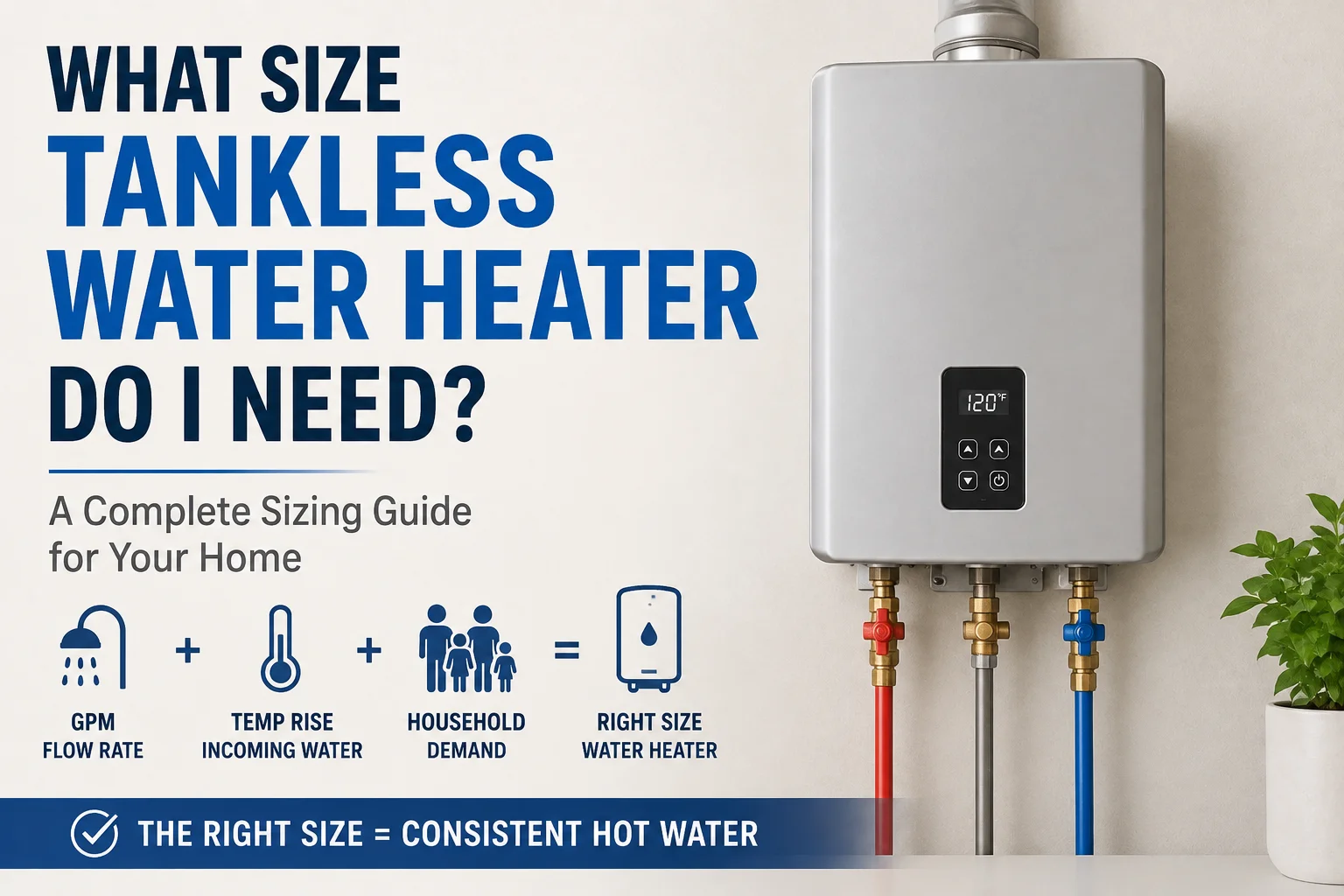
If you’re replacing a traditional tank water heater with a tankless unit, you’ve probably run into a wall of confusing specs — GPM, BTU, temperature rise — with no clear answer to the one question you actually have: what size do I need? Buy too small, and you’ll get lukewarm water the moment two showers run at once. Buy too large, and you’ve paid for capacity your home will never use.
The short answer is that tankless water heater sizing isn’t based on how many people live in your house — it’s based on how much hot water your home uses at the same time, and how much that water needs to be heated. For Temecula homeowners weighing tankless against a traditional tank, understanding that distinction is the difference between a system that performs well for years and one that disappoints on day one.
This guide walks through exactly how sizing works, with practical examples for different household sizes and bathroom counts, so you can make an informed decision — whether you’re buying the unit yourself or getting a quote from an installer.
How Tankless Water Heater Sizing Works
Unlike a tank water heater, which stores a fixed volume of hot water, a tankless unit heats water instantly as it flows through the system. That means it doesn’t have a “capacity” in the traditional sense — instead, it has a maximum flow rate it can heat to a given temperature at any one moment.
Sizing a tankless water heater correctly comes down to two core numbers:
- Flow rate (GPM) — how many gallons per minute of hot water your household needs during peak, simultaneous use
- Temperature rise — how many degrees the unit needs to raise the water temperature, from incoming cold water to your desired hot water temperature
A unit that can’t deliver enough GPM at your required temperature rise will let water run cooler than expected when multiple fixtures are open at once. That’s the entire sizing problem in a nutshell — everything else in this guide builds on those two numbers.
Tankless Water Heater GPM: What Does It Mean?
GPM stands for gallons per minute — the amount of hot water a fixture uses, or a water heater can deliver, in one minute. Every fixture in your home draws a different amount, and actual flow rates vary by fixture design, age, and any low-flow restrictors installed.
| Fixture | Typical Flow Range (GPM) |
|---|---|
| Shower | 1.5–2.5 |
| Bathroom faucet | 0.5–1.5 |
| Kitchen faucet | 1.0–2.0 |
| Bathtub | 2.5–4.0 |
| Dishwasher | 1.0–2.5 |
| Washing machine | 1.5–3.0 |
Older or non-low-flow fixtures can run toward the higher end of these ranges, while WaterSense-labeled showerheads and faucets can come in lower. If you want a precise number for your own home, you can check the label on a fixture (often stamped with its GPM rating) or use a simple bucket test: time how long it takes to fill a one-gallon container, then divide 60 by that number of seconds.
What Is Temperature Rise?
Temperature rise is the difference between your desired hot water temperature and your incoming cold water temperature. The formula is simple:
Temperature rise = Desired hot-water temperature − Incoming cold-water temperature
For example, if your incoming water is 60°F and you want water heated to 120°F at the tap:
120°F − 60°F = 60°F temperature rise
Temperature rise matters because a tankless unit’s flow rate capacity changes depending on how much heating work it has to do. The same unit that can deliver 8 GPM at a 30°F rise might only deliver 5 GPM at a 60°F rise — because it takes more energy to heat the same volume of water through a bigger temperature gap. Incoming water temperature isn’t the same everywhere or all year; it varies by region, season, and water source, so it’s worth confirming rather than assuming a fixed number for your property.
How to Calculate the Tankless Water Heater Size You Need
Step 1: List the Hot-Water Fixtures That Might Run at Once
Think about your household’s actual routine — not every fixture in the house, just the ones that realistically overlap. A shower running while someone starts the dishwasher is common; a shower running at the same time as every faucet in the house usually isn’t.
Step 2: Estimate Their Flow Rates
Using the table above (or your own fixture ratings), add up the GPM for the fixtures you listed.
Step 3: Determine Your Incoming Water Temperature
This depends on your local groundwater and season. If you don’t know it, a plumber or installer can measure it, or you can check with your local water provider.
Step 4: Choose Your Desired Hot-Water Temperature
Most households set hot water somewhere between 100°F and 120°F, though the right setting depends on personal preference and household needs — there’s no single mandatory number.
Step 5: Calculate Required Temperature Rise
Subtract incoming water temperature from your desired temperature, as shown above.
Step 6: Determine Your Required GPM
This is your peak simultaneous demand from Step 2 — the total flow rate the unit needs to supply at once.
Step 7: Compare Against Manufacturer Performance Charts
This step is easy to skip and is where a lot of sizing mistakes happen. Every tankless model has a performance chart showing flow rate at different temperature rises — not just one maximum GPM number. A unit’s advertised “max GPM” is usually measured at a low temperature rise; check its actual GPM output at your required temperature rise before deciding it’s big enough.
Tankless Water Heater Sizing Examples
Example 1: Small Household (1–2 People)
A single shower (2 GPM) plus a bathroom faucet (1 GPM) running at the same time totals about 3 GPM. With a 50°F temperature rise, most mid-size tankless units comfortably handle this load.
Example 2: Medium Household (3–4 People)
A shower (2.5 GPM) plus a kitchen faucet (1.5 GPM) plus a dishwasher (1.5 GPM) running simultaneously totals roughly 5.5 GPM. At a higher temperature rise (say, 60°F in colder months), this household would need to check that their chosen unit can still deliver 5.5+ GPM at that specific rise — not just at its advertised maximum.
Example 3: Larger Household (5+ People)
Two showers (2 GPM each) plus a washing machine (2.5 GPM) running at once totals about 6.5 GPM, and that can climb toward 9–10 GPM if a kitchen faucet or dishwasher joins in during the same window. Larger households with multiple bathrooms often need either a high-capacity single unit or, in some cases, two units working together.
Notice that none of these examples say “X people need Y GPM” as a fixed rule — the number depends entirely on which fixtures actually run together in your home.
What Size Tankless Water Heater Do I Need for a Family of 2?
A two-person household typically has lower peak simultaneous demand — often one shower plus a faucet or two, since fewer people are competing for hot water at the same time. That said, the right size still depends on your bathroom count, whether you run appliances during shower times, your desired water temperature, and your incoming water temperature. A smaller household with one bathroom generally needs less capacity than one with two full bathrooms in regular use.
What Size Tankless Water Heater Do I Need for a Family of 3?
The same principles apply, but with slightly more potential overlap — a shower running while a kitchen faucet or washing machine is in use becomes more common as household activity increases. Rather than assuming a fixed GPM figure, walk through Steps 1–6 above using your household’s actual routine, particularly around morning and evening peak hours.
What Size Tankless Water Heater Do I Need for a Family of 4?
This is one of the most common sizing questions, and it’s also where the “just tell me a number” approach breaks down fastest. A family of four in a two-bathroom home might run two showers back-to-back rather than simultaneously — which lowers peak demand — or might run two showers plus a load of laundry at the same time — which raises it substantially. What matters is your household’s actual overlap in usage, the number of bathrooms in regular use, and whether appliances typically run during high-demand hours. Multiple industry sizing guides put typical peak demand for a four-person household in the 8–10 GPM range when several fixtures genuinely overlap, but a household with staggered routines may need meaningfully less.
What Size Tankless Water Heater Do I Need for a Family of 5 or More?
Larger households generally have a higher chance of multiple fixtures running at once — several showers, a dishwasher, and a washing machine can realistically overlap during busy mornings or evenings. This often means looking at higher-capacity single units, or in homes with significant simultaneous demand across multiple bathrooms, considering two tankless units installed to share the load. A professional flow-rate assessment is especially useful here, since the range of possible peak demand is wide.
What Size Tankless Water Heater Do I Need for a 2-Bathroom House?
Bathroom count alone doesn’t determine sizing — what matters is how many of those bathrooms might be in simultaneous use, and by whom. A two-bathroom home where showers are typically staggered has lower peak demand than one where two people shower at the same time every morning. Consider your household’s actual shower flow rates, whether a kitchen faucet or appliance runs during that window, and your incoming water temperature before settling on a GPM target.
What Size Tankless Water Heater Do I Need for a 3-Bathroom House?
Three bathrooms raise the potential for overlap — two showers running together, or a shower plus kitchen faucet plus dishwasher during a busy evening, are realistic scenarios in larger households. Again, this doesn’t automatically mean you need the largest unit available; it means walking through which specific combinations are likely in your home and sizing for that peak, not for every fixture running at once.
What Size Tankless Water Heater Do I Need for a 4-Bathroom House?
Homes with four or more bathrooms often see higher potential simultaneous demand, and may require either a high-output single unit, multiple tankless units installed together, or careful zoning of hot water service. These installations also typically involve larger gas lines or higher electrical capacity, so professional sizing is especially worthwhile here rather than guessing based on square footage or bathroom count alone.
Does Household Size Determine Tankless Water Heater Size?
No. Household size alone does not determine the correct tankless water heater size. It’s a reasonable starting point for estimating usage patterns, but the number that actually matters is peak simultaneous GPM demand combined with your required temperature rise. Two different four-person households can have very different sizing needs depending on their daily routines, fixture flow rates, and incoming water temperature.
Tankless Water Heater Size Chart
| Household / Home Profile | Typical Usage Considerations | What to Evaluate |
|---|---|---|
| 1–2 people | One shower plus occasional fixtures | Required GPM and temperature rise |
| 3–4 people | Multiple fixtures may overlap during peak hours | Peak simultaneous demand |
| 5+ people | Higher likelihood of overlapping fixtures | Higher-capacity unit or multiple units |
| 2 bathrooms | One or two showers may run together | Shower + fixture demand |
| 3 bathrooms | Greater potential for overlap | Peak GPM across bathrooms |
| 4+ bathrooms | High potential simultaneous demand | Professional sizing, possibly multiple units |
This table is meant to help you evaluate the right questions — not to hand you an exact model number.
How Many GPM Do I Need in a Tankless Water Heater?
You need enough GPM to cover your household’s peak simultaneous hot-water use at your required temperature rise — not just the unit’s advertised maximum GPM. Add up the flow rates of fixtures you’d realistically run at once (Steps 1–2 above), then check that figure against a manufacturer’s performance chart at your specific temperature rise, since output drops as temperature rise increases. A unit rated for “up to 9 GPM” might only deliver 5–6 GPM once you factor in a 60°F+ rise, which is common with colder incoming groundwater.
How Many Showers Can a Tankless Water Heater Run?
The answer depends on shower flow rate, incoming water temperature, desired output temperature, and whether other fixtures are running at the same time — not on the water heater alone. A mid-size unit might comfortably run two standard showers (roughly 4–5 GPM combined) at a moderate temperature rise, but the same unit could struggle with two showers plus a load of laundry during a colder month with a higher temperature rise. Checking the specific model’s performance chart at your conditions is the only reliable way to answer this for your home.
How Does Incoming Water Temperature Affect Tankless Water Heater Size?
Colder incoming water requires a greater temperature rise to reach your desired hot-water temperature, and a greater temperature rise reduces the flow rate a given unit can deliver. Warmer incoming water needs less of a rise, which generally allows for higher usable flow rate from the same unit. Incoming water temperature isn’t fixed — it can vary by season and by property — so for Temecula homeowners, it’s worth having your actual incoming water temperature checked (by a plumber or with a simple thermometer test) rather than assuming a single year-round number.
What Is BTU Input on a Tankless Water Heater?
BTU (British Thermal Unit) input describes how much heating energy a gas tankless water heater can deliver per hour — essentially, its heating power. Higher BTU input generally supports a greater flow rate at a given temperature rise, but BTU alone doesn’t tell the whole sizing story. A high-BTU unit still needs to be evaluated against your household’s GPM and temperature-rise requirements together — a bigger number on the spec sheet doesn’t automatically mean it’s the right unit for your home.
Is a Bigger Tankless Water Heater Always Better?
No. A larger-capacity unit can support more simultaneous demand, but oversizing has real downsides: higher upfront cost, larger gas line or electrical requirements, and capacity your household will rarely, if ever, use. Some tankless units also have minimum flow requirements to activate, so an oversized unit isn’t automatically “safer” — it’s simply more capacity than most homes need. The goal is matching the unit to your actual peak demand, not buying the largest model available.
What Happens If a Tankless Water Heater Is Too Small?
An undersized unit typically can’t keep up when multiple fixtures run at once, which shows up as dropping water temperature, reduced flow, or an inability to run two showers simultaneously without one running cold. Not every undersized unit behaves identically — the severity depends on how far the demand exceeds the unit’s capacity and how much temperature rise is required at the time.
What Happens If a Tankless Water Heater Is Too Large?
An oversized unit generally isn’t a performance problem, but it does mean paying more upfront than necessary, potentially requiring a larger gas line or higher electrical capacity than your home needs, and installing more equipment than your actual hot-water demand calls for. In most cases, “right-sized” saves money without sacrificing performance compared to simply buying the biggest available model.
Gas vs. Electric Tankless Water Heater Sizing
Gas Tankless Water Heaters
Gas units generally offer higher output potential and are a common choice for whole-house applications with higher simultaneous demand. They require an adequate gas supply line, proper venting, and installation that accounts for BTU input requirements — all of which should be evaluated by a qualified installer.
Electric Tankless Water Heaters
Electric units depend on your home’s available electrical capacity — including amperage and breaker space. Output varies significantly by model, and some higher-output electric units require substantial dedicated electrical service, which isn’t available in every home without an upgrade.
Choosing between gas and electric isn’t purely a matter of picking a bigger or smaller unit — it also depends on what utilities and infrastructure are already available at your property, which is often worth a professional evaluation.
Single Tankless Water Heater vs. Multiple Units
Multiple tankless units are sometimes used in larger homes, homes with consistently high simultaneous demand, homes with distinct hot-water zones (like a detached suite), or where a single unit’s capacity simply isn’t enough for the household’s peak GPM. Advantages include better performance during high demand and the ability to zone hot water delivery by area of the home. The tradeoffs are added installation complexity and higher upfront cost, so multiple units aren’t automatically the right call for every large household — it depends on actual peak demand and home layout.
How to Choose the Right Tankless Water Heater
Before buying, make sure you know:
- Number of people in your household and their typical routines
- Number of bathrooms and how often they’re used simultaneously
- Shower and fixture flow rates in your home
- Other fixtures or appliances likely to run at the same time
- Your desired hot-water temperature
- Your incoming water temperature
- Your required temperature rise
- Your required peak GPM
- Whether your home has adequate gas or electrical capacity
- The specific unit’s performance at your required temperature rise (not just its advertised max GPM)
Tankless Water Heater Sizing Mistakes to Avoid
- Choosing a size based only on household headcount
- Choosing a unit based only on its advertised maximum GPM
- Ignoring temperature rise entirely
- Ignoring which fixtures actually overlap in daily use
- Assuming incoming water temperature is fixed year-round
- Ignoring gas supply or electrical capacity requirements
- Defaulting to the largest unit “just to be safe”
- Comparing different models measured at different temperature-rise conditions
- Skipping the manufacturer’s performance chart
- Installing without confirming your home’s existing infrastructure can support the unit
Tankless Water Heater Sizing for Temecula Homeowners
The core sizing process is the same no matter where you live: peak GPM demand, required temperature rise, and the unit’s actual performance at that rise. For homeowners in Temecula, that means walking through the same steps — listing likely simultaneous fixture use, checking your home’s incoming water temperature, and comparing candidate units against their performance charts rather than their headline GPM number. If you’re planning a tankless water heater installation in Temecula, confirming your home’s existing gas line or electrical capacity early in the process can also help avoid surprises once installation begins.
Can a Professional Help Size a Tankless Water Heater?
Yes, and it’s often worth it — particularly for homes with multiple bathrooms, households where several showers might run at once, uncertain gas or electrical capacity, or anyone replacing a traditional tank water heater for the first time. A professional can measure your actual incoming water temperature, evaluate your home’s infrastructure, and match a specific model’s performance chart to your real peak demand. For more complex situations — like considering multiple units — professional water heater service in Temecula can help avoid a costly sizing mistake before installation begins.
What Affects Tankless Water Heater Installation Cost?
Installation cost isn’t a single fixed number; it depends on factors including the unit type (gas vs. electric), required capacity, venting needs, whether gas line modifications are necessary, whether an electrical upgrade is needed, plumbing changes, the location of the installation, your existing water heater setup, whether one or multiple units are being installed, and any local permit requirements. Getting a written estimate from a licensed installer is the most reliable way to understand your actual cost.
Frequently Asked Questions
What size tankless water heater do I need?
The right size depends on your household’s peak simultaneous hot-water demand (measured in GPM) and your required temperature rise — not simply the number of people in your home. Add up the flow rates of fixtures you’d realistically run at once, calculate your temperature rise, and compare that against a specific unit’s performance chart.
What size tankless water heater do I need for a family of 4?
It depends on how many fixtures your household runs simultaneously and your temperature rise, though many four-person households with overlapping fixture use fall in the 8–10 GPM range at peak demand. Households with staggered routines may need meaningfully less.
What size tankless water heater do I need for a family of 5?
Larger households often have a higher chance of overlapping fixture use — multiple showers, laundry, and kitchen use during the same window — which can push peak demand higher, sometimes requiring a high-capacity unit or two units working together. A professional flow assessment is especially useful for larger households.
What size tankless water heater do I need for a 2-bathroom house?
Bathroom count is a starting point, but the real factor is whether both bathrooms are used at the same time and by how many people. Two bathrooms used one at a time have much lower peak demand than two bathrooms used simultaneously every morning.
How many GPM do I need for a tankless water heater?
Add up the flow rates of the fixtures you’d realistically run at the same time, then confirm that a candidate unit can deliver that GPM at your specific required temperature rise — not just at its advertised maximum.
How do I calculate tankless water heater size?
List the fixtures likely to run simultaneously, add their GPM, determine your incoming and desired water temperatures to find your temperature rise, then compare your peak GPM against a unit’s performance chart at that rise.
What does GPM mean on a tankless water heater?
GPM stands for gallons per minute — it measures how much hot water a fixture uses or a water heater can deliver in one minute.
What does BTU mean on a tankless water heater?
BTU (British Thermal Unit) input describes a gas tankless water heater’s heating power per hour. It affects how much flow rate the unit can support at a given temperature rise, but it should be evaluated alongside GPM and temperature rise, not on its own.
Does a bigger tankless water heater use more gas? A higher-capacity unit can use more gas when running at higher output, but actual usage depends on how much hot water is actually being drawn at a given time, since tankless units only heat water when a tap is open.
Can a tankless water heater run two showers at once?
Often yes, depending on the unit’s capacity, the showers’ flow rates, and the required temperature rise — this should be confirmed against the specific model’s performance chart rather than assumed.
How does temperature rise affect tankless water heater sizing?
A higher temperature rise (bigger gap between incoming and desired water temperature) reduces the flow rate a given unit can deliver, so a unit that performs well in a warm climate may deliver less flow in an area with colder incoming water.
Is a 199,000 BTU tankless water heater enough for a large house?
It depends on your household’s peak GPM demand and required temperature rise — a high BTU rating supports higher potential flow rate, but it should still be checked against a performance chart for your specific temperature rise before assuming it’s sufficient.
Can a tankless water heater be too big?
Yes, in the sense that oversizing adds unnecessary upfront cost and may require larger gas or electrical infrastructure than your home needs, even though it typically doesn’t harm performance.
Can a tankless water heater be too small?
Yes — an undersized unit can struggle to maintain water temperature and flow when multiple fixtures run at once, which is one of the most common tankless water heater complaints.
Do I need one or two tankless water heaters?
Most homes are well served by a single properly sized unit; multiple units are typically considered for larger homes, high simultaneous demand, or distinct hot-water zones where one unit’s capacity isn’t enough.
Is gas or electric better for a tankless water heater? It depends on your home’s existing infrastructure and hot-water demand — gas units generally offer higher output potential for whole-house use, while electric units depend on available electrical capacity and vary widely in output by model.
How do I size a tankless water heater in Temecula?
The process is the same as anywhere else: calculate your household’s peak GPM demand and required temperature rise, then compare that against a specific unit’s performance chart. Confirming your home’s actual incoming water temperature and existing gas or electrical capacity locally can help refine the final decision.
Should I have a professional size my tankless water heater?
For anything beyond a small, single-bathroom home, a professional evaluation is often worth it — especially when multiple bathrooms, uncertain infrastructure, or the possibility of needing multiple units are involved.
Conclusion
Choosing the right tankless water heater size comes down to a straightforward chain: your household’s fixtures and routines determine peak simultaneous demand, which sets your required GPM; your incoming and desired water temperatures determine your required temperature rise; and together, those two numbers — checked against a specific model’s real performance chart — tell you whether a unit is actually the right fit. Household size and bathroom count are useful starting points, but they’re not the final answer, and neither is simply buying the biggest unit available.
If you’re still unsure what size tankless water heater is right for your Temecula home, a professional evaluation can help match a unit’s flow capacity and temperature-rise performance to your household’s actual hot-water demand — and confirm your home’s gas or electrical infrastructure can support it before installation begins.