
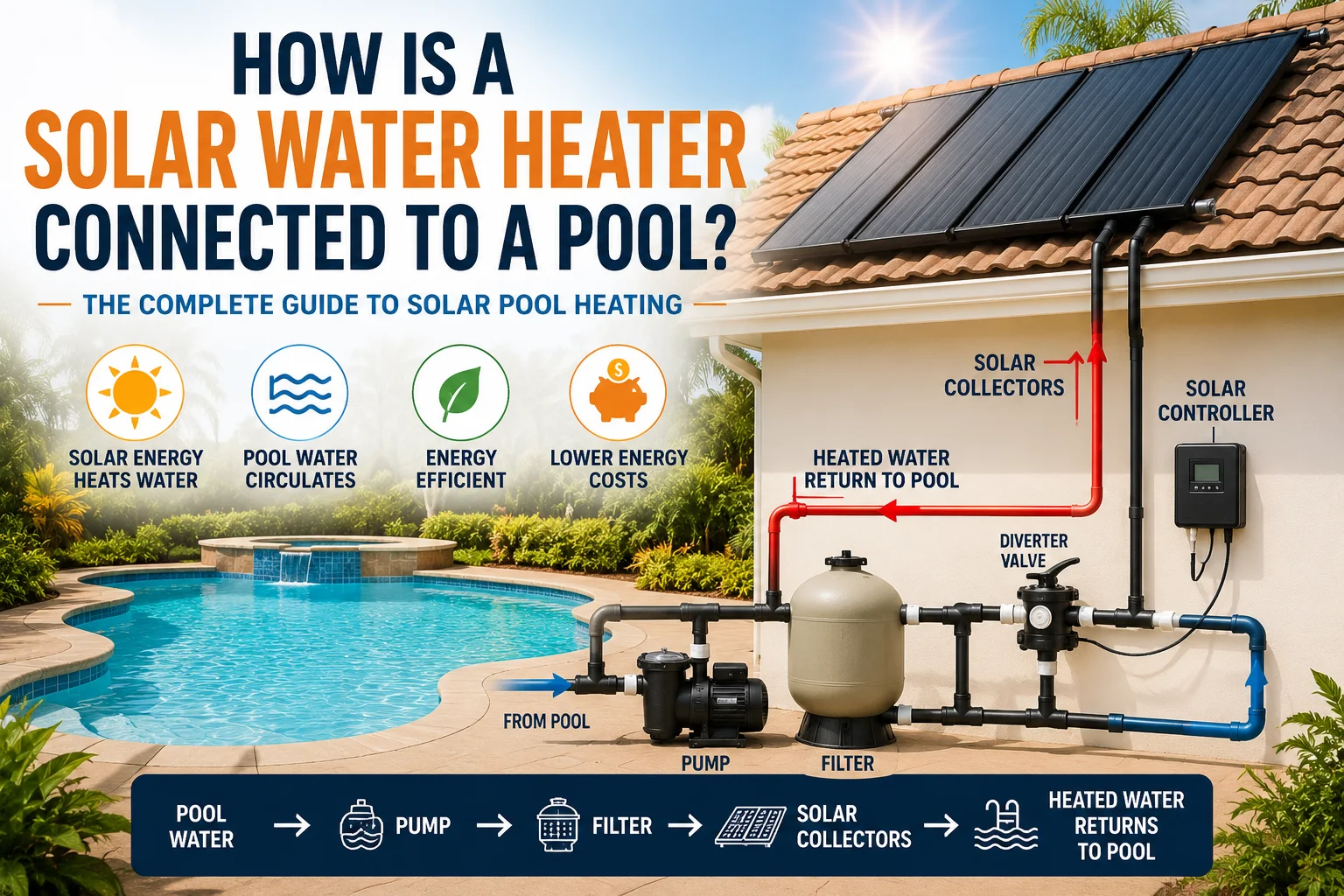
If you’ve got a pool and you’re looking into solar heating, you’ve probably wondered how the whole thing actually hooks up. Does it tie into your existing pump and filter, or does it need its own separate plumbing? In short: a solar pool heating system typically connects into your existing pool circulation system, using your pump to push pool water through solar collectors before it flows back into the pool. Temecula homeowners exploring solar pool heating usually start with this same question, and the exact setup depends on your pool, your equipment, and where the collectors are installed. Here’s how the connection actually works.
Solar Pool Heating vs. Domestic Solar Water Heating
Before going further, it’s worth clearing up a common mix-up. What people usually mean by a “solar water heater for a pool” is really a solar pool heating system — equipment built to circulate pool water through solar collectors and return it warmed. That’s a different setup than a domestic solar water heater, which heats water for showers, sinks, and other household use.
These two systems aren’t automatically interchangeable. Domestic solar water heating often involves a separate storage tank and sometimes a heat exchanger to keep the household water supply isolated from the solar loop. Solar pool heating, by contrast, usually circulates the pool water itself directly through the collectors. The plumbing, controls, and equipment involved can look quite different between the two.
How Does a Solar Pool Heating System Work?
At a basic level, a solar pool heating system follows this path:
Pool → Pump → Filter → Solar Collectors → Heated Water → Pool
- Pool – Water is drawn out of the swimming pool as part of normal circulation.
- Pump – The pool pump moves that water through the system.
- Filter – Water typically passes through the existing pool filter before it’s directed toward the collectors.
- Solar Collectors – The water flows through collectors exposed to sunlight, where it picks up heat.
- Return to Pool – The warmed water flows back into the pool, gradually raising the overall water temperature.
This is the general sequence, but the exact order and configuration can vary depending on how a specific system is designed and where the collectors are placed relative to the existing equipment.
Main Components of a Solar Pool Heating System
A typical setup includes:
- Swimming pool – The water source and destination for the whole loop.
- Pool pump – Provides the circulation that moves water through the system.
- Pool filter – Removes debris before water reaches the collectors.
- Solar collectors – Panels designed to absorb sunlight and transfer that heat to the water passing through them.
- Supply and return piping – Carries water to and from the collectors.
- Diverter valve – Redirects flow toward the collectors or bypasses them.
- Check valves – Help prevent unwanted backflow in the system, where used.
- Automatic controller – Manages when the system routes water through the collectors.
- Temperature sensors – Feed information to the controller about pool and collector temperatures.
- Collector mounting location – Typically a roof or ground-mounted structure with good sun exposure.
Each part plays a specific role, and none of them work in isolation — the system depends on all of these pieces coordinating together.
How Is the Solar Heater Connected to Existing Pool Plumbing?
This is really the core of the question. In most setups, the solar heating circuit ties directly into the pool’s existing circulation system rather than requiring a completely separate loop. The general flow works like this:
- Pool water is pulled through the existing circulation system by the pump.
- The pump pushes water through the filtration system as it normally would.
- A diverter valve directs some or all of that filtered water toward the solar collectors.
- Water travels through the collectors, where it absorbs heat.
- The heated water returns to the pool through the return line.
- When solar heating won’t add useful benefit, the controller can redirect flow away from the collectors, sending water straight back to the pool instead.
The specific valve placement, piping routes, and integration points depend on your pool’s existing equipment layout, so this isn’t a one-size-fits-all diagram — it’s the general concept most systems follow.
Where Are Solar Pool Heating Panels Connected?
Solar collectors are commonly mounted:
- On the main house roof, if orientation and structure allow
- On a pool house or detached structure roof
- On a ground-mounted rack near the pool equipment
- In another location with strong, consistent sun exposure
Where they end up depends on several factors: available sun exposure throughout the day, roof structure and orientation, how much space is available, how far the piping needs to run back to the pool equipment, and any local installation requirements. There’s no single roof direction that works best for every home — it depends on the property’s actual layout and shading.
Does a Solar Pool Heater Need a Separate Pump?
Not always. Many solar pool heating systems use the pool’s existing circulation pump to move water through the collectors, rather than requiring a second dedicated pump. That said, some installations may need additional or upgraded equipment depending on:
- Pool size
- Plumbing layout
- Total collector area
- Required flow rate through the collectors
- The existing pump’s capacity
- Distance between the pool equipment and the collectors
Whether your setup can rely on the existing pump or needs additional equipment really comes down to your specific system, so it’s not accurate to say every installation needs — or doesn’t need — a separate pump.
What Does the Pool Pump Do?
The pump is the workhorse of the whole system. It:
- Moves water out of the pool and through the plumbing
- Pushes water through the filtration system
- Provides the flow needed to circulate water through the solar collectors
- Returns the heated water back to the pool
Adequate flow matters because water needs enough time moving through the collectors to actually absorb heat, without moving so slowly that it creates other circulation problems. Pump sizing depends on the whole system, so it’s not something to guess at without more detail on your specific pool and collector setup.
How Do Valves Control Solar Pool Heating?
Valves are what let the system switch between heating mode and bypass mode. A diverter valve (sometimes automated) redirects water either toward the solar collectors or straight back to the pool, depending on conditions. When conditions are favorable for solar heating, the valve routes water through the collectors. When they’re not — say, on an overcast day when the collectors are cooler than the pool water — the system can bypass them entirely so it doesn’t waste pump energy for no benefit.
Automated systems typically pair these valves with temperature sensors and a controller that makes this decision without homeowner input.
How Does a Solar Pool Heater Know When to Heat?
Most automated systems rely on a solar controller connected to temperature sensors placed at the pool and at the collectors. The controller compares the two readings. If the collector temperature is meaningfully higher than the pool water temperature, it opens the valve to send water through the collectors. If not, it keeps water on the bypass path so the pump isn’t circulating water through cold collectors for no reason. The specific technology and sensor placement can vary between manufacturers and system designs.
Does a Solar Pool Heater Need a Heat Exchanger?
Not necessarily. Many solar pool heating systems circulate pool water directly through purpose-built collectors, without a separate heat exchanger, since the collectors are designed to handle pool water directly. That said, some system designs do use a heat exchanger, particularly when the solar loop and the pool water circuit need to stay physically separated — for reasons related to collector type, water chemistry, or specific equipment configurations. Whether a heat exchanger is part of your system depends on the equipment chosen, not a universal rule.
Can You Connect a Solar Water Heater to an Existing Pool?
Generally, yes — many existing pools can be retrofitted with solar pool heating. Whether it’s a good fit for a specific pool depends on:
- The existing pool plumbing layout
- Current pump capacity
- Available space and sun exposure for collectors
- Roof condition and structure, if roof-mounted
- Pipe routing distance
- Pool size
- The temperature increase the homeowner is hoping for
- What other pool equipment is already installed
Because these factors vary so much from property to property, an installation assessment is generally worthwhile before selecting specific equipment.
Can Solar Pool Heating Work With an Existing Pool Pump?
It often can, but compatibility depends on the pump’s capacity, the plumbing size, system pressure, how much flow the collectors require, and how the existing filtration system is set up. Some existing pumps handle the added demand of a solar loop without issue; others may need to be upgraded to support it properly. This is another area where a site-specific evaluation matters more than a blanket answer.
What Happens When There Is No Sun?
Solar pool heating depends on available solar energy, so performance naturally changes with conditions:
- Cloudy weather reduces how much heat the collectors can add.
- At night, there’s little to no solar heating happening.
- The controller can bypass the collectors when they’re not providing useful heat.
- A pool cover can help retain heat that’s already in the water, reducing overnight and cloudy-day losses.
- A backup heater, if installed, can pick up the slack when solar conditions aren’t sufficient.
Solar heating won’t maintain a constant pool temperature regardless of weather — it works with the sunlight that’s actually available.
Can Solar Pool Heating Work on Cloudy Days?
Yes, to a degree. Solar collectors can still pick up some solar radiation through cloud cover, so the system doesn’t simply shut off the moment clouds roll in. Heating performance is generally reduced compared to a clear, sunny day, but it’s not an all-or-nothing situation.
How Much Solar Collector Area Does a Pool Need?
Collector sizing depends on quite a few variables: pool surface area, how much temperature increase you’re hoping for, local climate and sun exposure, whether you use a pool cover, collector efficiency, how long your swimming season runs, wind exposure, and how the collectors are oriented. Industry guidelines sometimes suggest collector area as a general percentage of pool surface area, but these are starting points, not exact rules — a proper system design accounts for your specific site conditions rather than a flat ratio.
Solar Pool Heating in Temecula
Temecula homeowners considering solar pool heating generally need to think through the same core factors as anyone else: available sunlight throughout the season, pool size, roof or ground space for collectors, existing pool equipment and pump capacity, plumbing layout, how long you want to extend your swimming season, and how the collector location and controls will fit into your yard. Solar pool heating in Temecula isn’t a guaranteed fix for year-round swimming — actual performance depends on your property’s specific conditions, not a general assumption about local sun exposure.
Solar Pool Heating vs. Traditional Pool Heating
| Feature | Solar Pool Heating | Gas/Other Conventional Heating |
|---|---|---|
| Main energy source | Sunlight | Fuel or electricity, depending on system |
| Operating conditions | Depends on solar availability | Can generally operate on demand |
| Plumbing integration | Uses existing pool circulation system | Varies by heater type |
| Backup heating | May be added separately | Usually the primary heat source |
| Weather dependence | Higher | Lower |
| Installation considerations | Collectors, plumbing, and controls | Heater unit, plumbing, and energy connection |
Common Solar Pool Heating Installation Mistakes
A few issues tend to come up in poorly planned installations:
- Undersized collector area relative to the pool’s actual surface area
- Poor collector placement with inadequate sun exposure
- Incorrect plumbing that restricts flow or creates pressure problems
- Inadequate flow through the collectors for effective heat transfer
- Poorly positioned sensors that give the controller inaccurate readings
- Incorrect valve configuration that doesn’t properly bypass when needed
- Ignoring roof or structural considerations before mounting collectors
- Underestimating pool heat loss, especially without a cover
- Expecting solar heating to behave like an on-demand gas heater
- Skipping a pool cover, which significantly affects how well heat is retained
Most of these come down to not accounting for the specific pool and site conditions during planning.
Is Solar Pool Heating Worth It?
That depends on your priorities and circumstances. Factors that influence the answer include how much you use the pool, how long a swim season you want, your local solar exposure, your existing pool equipment, installation costs, pool size, and how much temperature increase you’re actually hoping to achieve. Solar pool heating isn’t automatically the cheapest or most effective option for every homeowner — it depends on your specific goals and setup, and there’s no guaranteed savings figure that applies across the board.
When Should a Professional Install a Solar Pool Heating System?
Professional evaluation and installation is especially worthwhile when:
- Existing pool plumbing needs to be modified
- Collectors will be roof-mounted
- New valves and automated controls need to be added
- Pump capacity is uncertain or may need upgrading
- Solar heating will be integrated with an existing gas or electric heater
- A heat exchanger may be required for the specific equipment chosen
- Structural or electrical considerations are involved
Roof work, plumbing modifications, and equipment integration aren’t areas to guess at — a professional assessment helps make sure the system is sized and connected correctly for your specific pool.
FAQs
How is a solar water heater connected to a pool?
It typically ties into the existing pool circulation system — the pump pushes filtered pool water through solar collectors, where it’s warmed before returning to the pool through the return line.
How does a solar pool heater work?
Pool water is circulated through solar collectors exposed to sunlight, which transfer heat into the water as it passes through, gradually raising the pool’s overall temperature.
Can I connect solar heating to an existing pool?
In many cases, yes. Compatibility depends on your existing plumbing, pump capacity, available collector space, and pool size, so an assessment is usually worthwhile before installation.
Does a solar pool heater use the existing pool pump?
Often, yes — many systems rely on the existing pump to circulate water through the collectors, though some setups may need additional or upgraded equipment.
Does a solar pool heater need a separate pump?
Not always. It depends on pool size, plumbing layout, collector area, and how much flow the collectors require compared to the existing pump’s capacity.
Where are solar pool heating panels installed?
Common locations include the main roof, a pool house roof, or a ground-mounted structure, chosen based on sun exposure, orientation, and available space.
Does pool water flow through solar panels?
Yes, in most systems the actual pool water is circulated directly through the solar collectors, rather than using a separate fluid loop.
Does a solar pool heater need a heat exchanger?
Not necessarily. Many systems circulate pool water directly through the collectors without one, though some designs use a heat exchanger to keep circuits separated.
Can solar pool heating work on cloudy days?
Yes, to some extent. Collectors can still absorb heat through cloud cover, though performance is generally reduced compared to full sun.
What happens to a solar pool heater at night?
There’s little to no solar heating available at night, so the system typically bypasses the collectors, and a pool cover can help retain existing heat.
How many solar panels does a pool need?
Collector area depends on pool size, desired temperature increase, climate, and other site-specific factors — general sizing guidelines exist, but proper design should account for your actual conditions.
Can solar pool heating work with an existing pool filtration system?
Usually, yes — water typically passes through the existing filter before being directed to the collectors, though pump capacity and plumbing layout affect compatibility.
Is solar pool heating worth it?
It depends on your pool usage, desired swim season, local sun exposure, and installation costs. There’s no universal answer or guaranteed savings figure.
Can a solar pool heater be installed in Temecula?
Generally, yes, though actual performance depends on your property’s specific sun exposure, pool size, and equipment rather than general assumptions about the area.
Can solar pool heating be combined with a gas pool heater?
Yes, many homeowners pair solar heating with a backup gas or electric heater to maintain temperature when solar conditions aren’t sufficient on their own.
Conclusion
A solar pool heating system generally connects into your pool’s existing circulation setup — the pump moves water through the filter, a diverter valve sends it toward the solar collectors, sunlight warms it as it passes through, and the heated water returns to the pool. Valves and controllers manage when that flow happens, redirecting water away from the collectors when solar heating won’t help. The specific plumbing, pump requirements, and whether a heat exchanger is needed all depend on your pool’s size, equipment, and collector placement, so no two installations look exactly alike.
If you’re considering solar pool heating for your Temecula home, evaluating your existing pool plumbing, pump, collector location, and heating goals can help determine whether the system is a good fit for your property.