
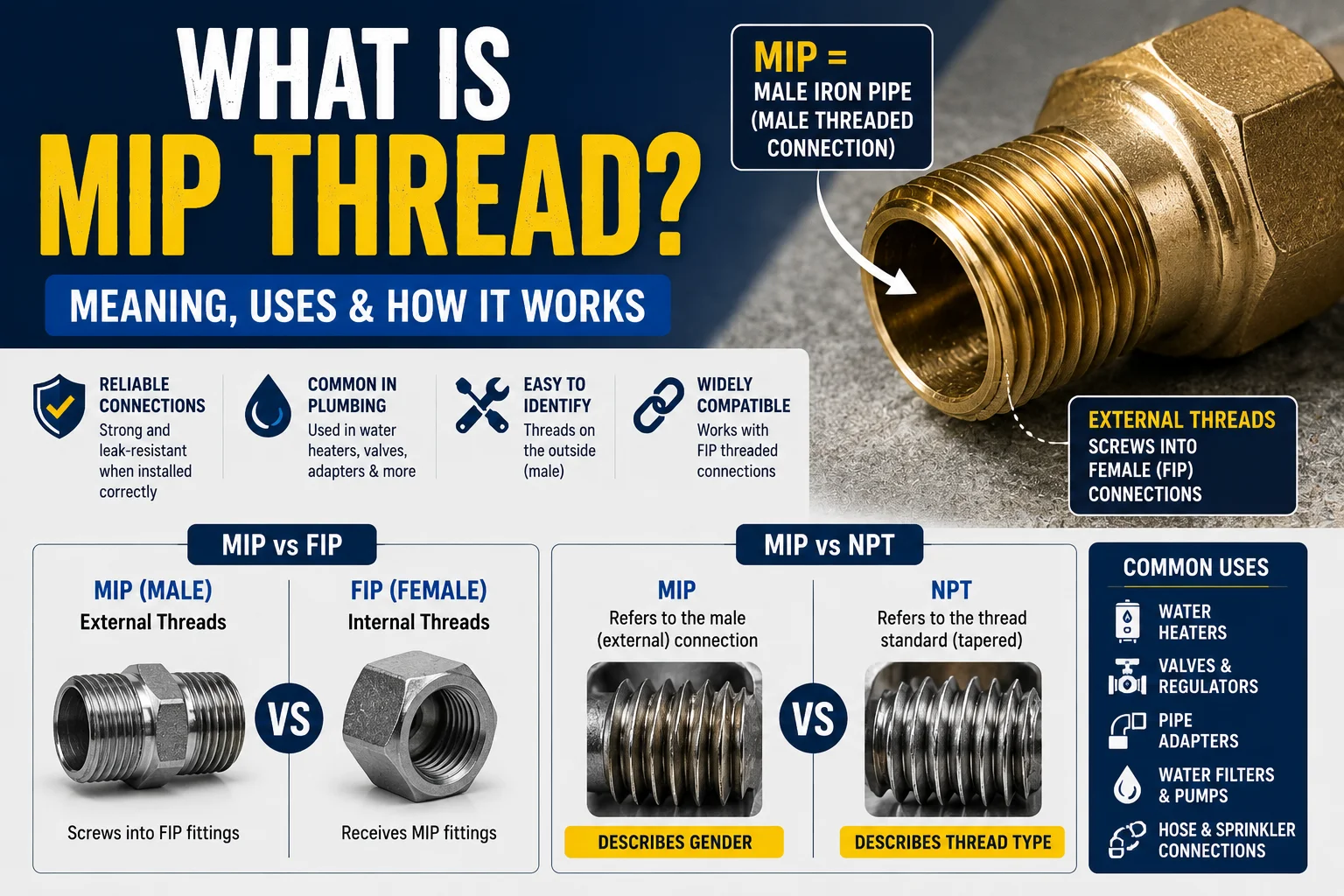
MIP thread is a common plumbing term for a male threaded pipe connection, commonly understood as Male Iron Pipe or Male Iron Pipe Thread. The male threads sit on the outside of the fitting and are designed to screw into a matching female-threaded connection. Once you understand the difference between male and female threads, MIP becomes a lot easier to recognize. You’ll commonly see MIP printed on adapters, nipples, valves, water heater connections, and other plumbing fittings at any hardware store or supply house. This guide explains what MIP thread means, how it works, and how it compares to related terms like FIP and NPT.
What Does MIP Stand For?
MIP stands for Male Iron Pipe (sometimes written as Male Iron Pipe Thread). The name comes from a time when most threaded pipe fittings were made of iron. Today, fittings labeled MIP are often made from brass, stainless steel, PVC, or other materials, but the term has stuck around in plumbing supply catalogs and product listings.
The important part of the name is “male.” In threaded plumbing terminology, “male” always refers to the fitting with threads on the outside. That’s the piece that gets screwed into another fitting, rather than the one that receives it.
What Is an MIP Fitting?
An MIP fitting is any plumbing component with external threads designed to connect into a female-threaded fitting. Because the threads are on the outside of the part, an MIP fitting is the piece that gets inserted and turned into place.
MIP fittings are used as adapters between different types of connections and are available in a range of materials and sizes. Common examples include:
- MIP adapters
- MIP nipples
- MIP valve connections
- MIP-to-PVC adapters
- MIP-to-hose connections
Not every MIP fitting is automatically compatible with every female fitting you might pair it with. Compatibility depends on the thread standard, nominal size, material, and overall fitting design, so it’s worth double-checking before assuming two parts will thread together correctly.
How Does an MIP Thread Work?
The basic process of using an MIP thread is straightforward:
- The MIP fitting has external threads.
- It’s aligned with a compatible female-threaded connection.
- The two threads engage as the fitting is turned.
- The connection is tightened to an appropriate, snug fit.
- A suitable sealing method is applied where required.
- The finished connection is checked for leaks.
Threaded plumbing connections rely on proper compatibility and, in many cases, an appropriate sealing method to prevent leaks. Overtightening won’t necessarily create a better seal and can actually damage the threads or crack the fitting, so it’s best to tighten firmly but not aggressively.
MIP vs FIP: What’s the Difference?
MIP and FIP describe the two complementary halves of a threaded pipe connection.
- MIP = Male Iron Pipe (or male pipe thread) — threads on the outside
- FIP = Female Iron Pipe (or female pipe thread) — threads on the inside
| Feature | MIP | FIP |
|---|---|---|
| Thread location | Outside | Inside |
| Connection | Screws into female thread | Receives male thread |
| Common use | Adapters, nipples, valves | Female adapters, valves, fittings |
| Visual identification | External threads visible | Internal threads visible |
MIP and FIP aren’t competing terms; they describe two sides of the same connection type. An MIP fitting is only useful when paired with a compatible FIP fitting (or another compatible female opening) of the correct size and thread standard.
MIP vs NPT: Are They the Same?
This is one of the most common points of confusion, so it’s worth explaining clearly. MIP and NPT are not the same kind of term.
- MIP describes the gender of the connection — it tells you the threads are on the outside (male).
- NPT (National Pipe Taper) refers to a specific thread standard commonly used in North American plumbing, describing the thread angle, pitch, and taper.
Because of this, you’ll sometimes see a fitting described with both terms together, such as “1/2-inch MIP x 1/2-inch NPT,” when that description accurately reflects the product. In that case, MIP tells you the connection is male, and NPT tells you which thread standard it follows. MIP by itself doesn’t guarantee a specific thread standard; it’s the “male” half of a threaded connection, which is commonly, though not universally, based on NPT in U.S. plumbing supply contexts.
MIP vs NPT vs FIP
Here’s a simple side-by-side comparison to keep these terms straight:
| Term | What It Describes | Basic Meaning |
|---|---|---|
| MIP | Male pipe-thread connection | External threads |
| FIP | Female pipe-thread connection | Internal threads |
| NPT | Thread standard | National Pipe Taper thread |
Think of it this way: MIP and FIP tell you whether a fitting is male or female, while NPT tells you which thread design is actually cut into that fitting.
What Does an MIP Thread Look Like?
An MIP thread is easy to spot once you know what to look for. The threads are visible on the outside of the fitting, usually running in a spiral pattern down a tapered or straight section. Many MIP fittings also have a hex-shaped section nearby, giving a wrench something to grip while tightening.
MIP fittings can be made from brass, steel, stainless steel, plastic, or other materials, and the threaded end is designed to connect into a matching female-threaded fitting. That said, not every externally threaded fitting you come across should automatically be assumed to be NPT or a standard MIP connection. When compatibility actually matters, such as when replacing a valve or connecting to a faucet cartridge assembly, it’s worth confirming the exact thread standard before purchasing a replacement part.
Common MIP Fittings
MIP Adapter
An MIP adapter transitions from one connection type to another, such as from a threaded male end to a solvent-weld or push-fit connection.
MIP Nipple
A nipple is a short piece of pipe with male threads on one or both ends, commonly used to connect two female fittings or extend a threaded connection.
MIP Elbow
An MIP elbow changes the direction of a pipe run while still providing a male threaded connection on one or both ends.
MIP Valve
Some valves have a male threaded inlet or outlet, allowing them to screw directly into a female fitting without an additional adapter.
MIP-to-PVC Adapter
This type of adapter allows a threaded (MIP) connection to transition into a solvent-welded PVC pipe system. Not every PVC adapter is automatically compatible with every MIP fitting, so matching size and thread standard still matters.
Common MIP Thread Sizes
MIP fittings are manufactured in a range of nominal pipe sizes, including commonly encountered options such as:
- 1/4 inch
- 3/8 inch
- 1/2 inch
- 3/4 inch
- 1 inch
- 1-1/4 inch
- 1-1/2 inch
- 2 inch
It’s important to understand that the “nominal” pipe size is a naming convention, not a direct measurement of the outside diameter of the threads. A 1/2-inch MIP fitting, for example, doesn’t have external threads that measure exactly 1/2 inch across. Because of this, homeowners should match fittings by nominal size and thread standard, rather than relying only on a tape measure or caliper reading of the outside diameter.
How to Measure an MIP Thread
If you’re trying to identify or replace an MIP fitting, follow these general steps:
- Determine whether the thread is male (external) or female (internal).
- Identify the nominal pipe size, often marked on the fitting or listed in product documentation.
- Measure the threaded portion if the size isn’t marked, understanding that this measurement is a starting point, not the final word.
- Check the thread standard, since not all threaded fittings use the same design.
- Compare your findings with the manufacturer’s specifications before purchasing a replacement.
Simply measuring the outside diameter isn’t always enough to guarantee a correct match. When in doubt, bringing the old fitting to a plumbing supply store or comparing it against manufacturer documentation is the most reliable approach.
Do MIP Threads Need Teflon Tape or Thread Sealant?
Many tapered threaded plumbing connections do require a sealing method, but the correct choice depends on several factors:
- The fitting material
- The pipe material
- The specific application
- Manufacturer instructions
- Whether the connection is meant to seal on the threads themselves or with a separate gasket or washer
PTFE (Teflon) tape and pipe thread sealant (sometimes called pipe dope) are both common options for tapered threaded connections. However, not every threaded fitting seals this way. Some connections rely on an O-ring, washer, or gasket instead, and treating that type of fitting like a standard tapered pipe thread can actually cause leaks rather than prevent them. Always check the manufacturer’s recommendation for the specific fitting you’re working with.
Common MIP Thread Problems
- Cross-threading — happens when a fitting is started at an angle, damaging the threads on one or both parts.
- Wrong thread standard — mixing incompatible thread designs can prevent a proper seal even if the fitting seems to “almost” fit.
- Wrong size — a fitting that’s close but not an exact nominal size match can leak or fail to thread correctly.
- Damaged threads — worn or corroded threads often won’t seal properly no matter how much sealant is used.
- Over-tightening — can crack fittings, especially plastic ones, or damage the sealing surface.
- Under-tightening — can leave gaps that lead to leaks.
- Incorrect sealant — using the wrong type of sealant for the application can fail to seal or damage certain materials.
- Mixing incompatible fittings — connecting parts designed for different systems can cause long-term problems even if they initially seem to work.
Can MIP and FIP Be Connected Together?
Yes, male and female threaded connections are specifically designed to mate when they share a matching nominal size and compatible thread standard. That said, not every MIP fitting will work with every FIP fitting you have on hand.
Compatibility depends on:
- Nominal size
- Thread standard
- Taper and thread design
- The specific application
- Manufacturer specifications
If you’re unsure whether two fittings are truly compatible, it’s worth confirming before assembly rather than forcing a connection that doesn’t seem to thread smoothly.
MIP vs BSP: Are They Interchangeable?
BSP (British Standard Pipe) is a different pipe-thread standard, commonly associated with British and international plumbing and mechanical applications. While BSP fittings can also be described using male and female terminology, BSP threads are not automatically interchangeable with NPT-based MIP fittings common in U.S. plumbing.
Thread angle, pitch, and taper can differ between BSP and NPT, even when a fitting appears to be a similar nominal size. Forcing together fittings from two different thread standards can result in a poor seal or damaged threads. It’s best to use fittings designed for the same thread standard throughout a connection, and to double-check product specifications if you’re working with imported parts or older equipment.
Where Are MIP Threads Commonly Used?
MIP threads show up throughout residential and light commercial plumbing, including:
- Water heater connections
- Plumbing valves
- Pipe adapters
- Pressure regulators
- Water filters
- Hose connections
- Pumps
- Irrigation equipment
- Residential plumbing fixtures
- General equipment connections
For example, when working around a water heater, you may need to shut off the water supply before disconnecting an MIP fitting, and restore the water supply once the new connection is complete. Not every plumbing application uses MIP fittings, but they’re common enough that most homeowners will encounter the term at some point.
When Should You Call a Plumber?
Consider calling a licensed plumber if:
- The fitting is badly corroded
- The threads are visibly damaged
- The connection is leaking inside a wall
- The wrong thread standard appears to have been installed
- The fitting can’t be removed safely
- A gas line is involved
- A water heater connection needs modification
- The repair requires cutting or altering fixed plumbing
- You can’t confidently identify the fitting type
If a leak seems to be coming from a fitting near a fixture, it’s also worth ruling out other common culprits first, similar to troubleshooting a leak at a garbage disposal connection, before assuming the threaded fitting itself is the problem.
Frequently Asked Questions About MIP Threads
What does MIP stand for in plumbing?
MIP stands for Male Iron Pipe, sometimes written as Male Iron Pipe Thread. It refers to a fitting with external threads, regardless of whether the fitting is actually made from iron or another material like brass or plastic.
What is an MIP thread?
An MIP thread is the external threading on a male plumbing fitting, designed to screw into a matching female-threaded (FIP) connection. It’s a common term used on adapters, nipples, valves, and other plumbing parts.
Is MIP the same as NPT?
No. MIP describes the male side of a threaded connection, while NPT (National Pipe Taper) refers to a specific thread standard. A fitting can be both MIP and NPT at the same time, but the terms describe different things.
What is the difference between MIP and FIP?
MIP has external threads and screws into a fitting, while FIP has internal threads and receives a male fitting. They’re complementary halves of the same type of threaded connection, not competing standards.
What does a MIP fitting look like?
An MIP fitting has visible threads on the outside, often with a hex-shaped section for a wrench nearby. It can be made from brass, steel, stainless steel, plastic, or other materials depending on the application.
How do I measure an MIP fitting?
Identify whether the threads are male or female, then determine the nominal pipe size rather than relying only on an outside-diameter measurement. Comparing the fitting to manufacturer specifications is the most reliable way to confirm a match.
What are common MIP thread sizes?
Common nominal sizes include 1/4 inch, 3/8 inch, 1/2 inch, 3/4 inch, 1 inch, 1-1/4 inch, 1-1/2 inch, and 2 inch. Nominal size is a naming convention and doesn’t equal the exact outside diameter of the threads.
Do MIP threads need Teflon tape?
Many tapered threaded connections use PTFE tape or pipe thread sealant, but not all MIP fittings seal this way. Some rely on a gasket, washer, or O-ring instead, so it’s best to follow the manufacturer’s specific sealing recommendation.
Can MIP connect to FIP?
Yes, as long as the nominal size, thread standard, and design are compatible. Not every MIP fitting will work with every FIP fitting, so it’s worth confirming compatibility before assembling a connection.
Are MIP and BSP threads the same?
No. BSP is a different thread standard commonly used in British and international applications, with differences in thread angle, pitch, and taper compared to NPT-based MIP fittings. They generally shouldn’t be treated as interchangeable.
Conclusion
MIP commonly refers to a male pipe-threaded connection, with the threads located on the outside of the fitting. MIP and FIP describe the male and female sides of a threaded connection, while NPT refers to the actual thread standard many of these fittings follow, so MIP and NPT are related terms but not identical ones. Matching the correct nominal size and thread standard is essential for a leak-free connection, and sealant requirements can vary depending on the specific fitting and application. When compatibility or safety is in question, checking manufacturer specifications or consulting a qualified plumber is the safest way to get the right fit the first time.