
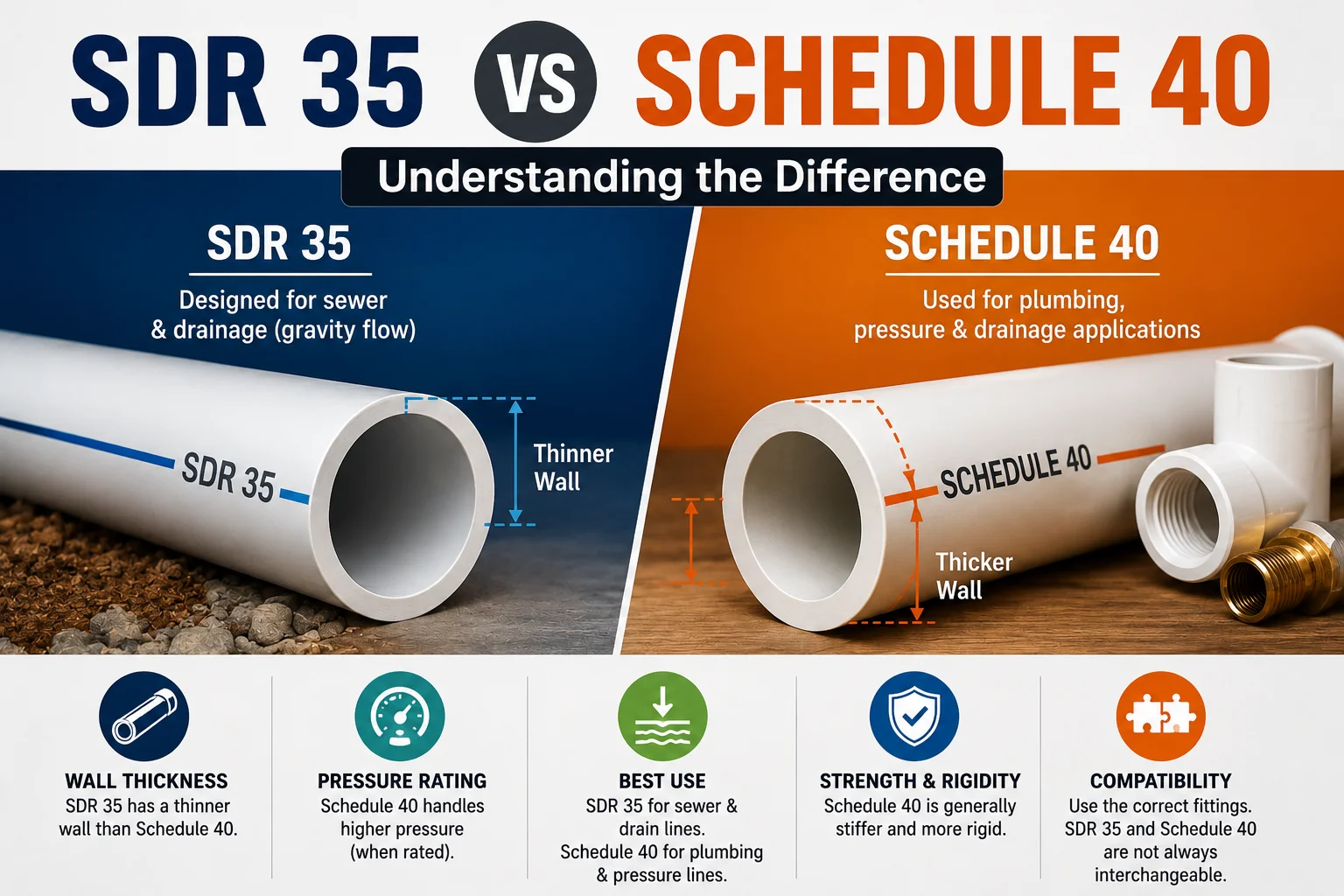
SDR 35 and Schedule 40 are both PVC pipe classifications you’ll run into on plumbing and drainage projects, but they’re built around two different standards. SDR 35 is commonly associated with gravity sewer and drainage systems, while Schedule 40 PVC shows up in general plumbing and, when the specific product is rated for it, certain pressure applications. Neither pipe is simply “the better one” — the right choice depends on the application, not on which pipe has the thicker-looking wall.
SDR 35 vs Schedule 40: Quick Answer
| Feature | SDR 35 | Schedule 40 |
|---|---|---|
| Classification | Standard Dimension Ratio | Schedule system |
| Common material | PVC | PVC |
| Common applications | Gravity sewer/drainage | Plumbing, pressure and other approved applications |
| Wall thickness | Related to outside diameter through SDR | Determined by Schedule and nominal size |
| Pressure use | Depends on product; commonly gravity applications | Depends on product and size |
| Underground drainage | Common | Possible where approved |
| Rigidity | Depends on diameter/SDR | Depends on size and wall thickness |
| Best use | Match to system design | Match to system design |
This table is a general overview, not a universal spec sheet — always confirm exact numbers for your pipe size and manufacturer before making a final decision.
What Is SDR 35 Pipe?
SDR stands for Standard Dimension Ratio, and it relates a pipe’s outside diameter to its wall thickness. SDR 35 is one specific ratio within that system, and it’s the classification you’ll most often see on gravity sewer and drainage pipe, commonly manufactured to ASTM D3034 for PVC sewer pipe applications.
Because SDR is a ratio rather than a fixed number, wall thickness scales along with outside diameter — a larger SDR 35 pipe has a proportionally thicker wall than a smaller one, while keeping that same 35:1 relationship. This differs meaningfully from the Schedule system, covered next.
What Is Schedule 40 PVC Pipe?
Schedule 40 is a pipe wall-thickness designation, not a ratio. It’s widely used across residential and commercial plumbing, and depending on the specific product, Schedule 40 PVC can be rated for drainage, water supply, or certain pressure applications.
That said, not every Schedule 40 PVC product carries the same pressure rating. Pressure capacity depends on the pipe’s diameter, the specific material formulation, operating temperature, and the manufacturer’s published specifications. Before assuming any Schedule 40 pipe is suitable for a pressurized application, check the actual rating printed on the pipe or listed in the manufacturer’s documentation.
What Does SDR Mean?
SDR (Standard Dimension Ratio) is calculated as the pipe’s outside diameter divided by its wall thickness. A lower SDR number means a thicker wall relative to the pipe’s outside diameter, while a higher SDR number — like 35 — means a comparatively thinner wall for that same outside diameter.
Think of it as a proportion rather than a fixed measurement: as the outside diameter of an SDR 35 pipe increases, the wall thickness increases right along with it, keeping that same ratio. This is different from a system that assigns one fixed wall thickness per nominal size.
What Does Schedule 40 Mean?
The Schedule system works differently. For a given nominal pipe size, Schedule 40 assigns a specific wall thickness — and that wall thickness is not the same across every nominal size in the Schedule 40 line. In other words, a 2-inch Schedule 40 pipe and a 4-inch Schedule 40 pipe don’t share the same wall thickness in absolute terms; each nominal size has its own designated dimensions within the Schedule 40 standard.
This is the core distinction: SDR sizing keeps a constant ratio between diameter and wall thickness across sizes, while Schedule sizing assigns specific wall thicknesses to specific nominal sizes based on the standard’s tables. Because dimensions vary by size and manufacturer, always check verified specification tables rather than assuming a single number applies across every size.
SDR 35 vs Schedule 40 Wall Thickness
Because these two systems calculate wall thickness differently, you can’t automatically assume one is thicker than the other without specifying the pipe size and standard you’re comparing. That said, at most common residential nominal sizes, Schedule 40 PVC is generally recognized as having a notably thicker wall than SDR 35 PVC of the same nominal diameter, which is part of why Schedule 40 is associated with higher pressure ratings and greater crush resistance.
If you need exact wall thickness figures for a specific size, check the manufacturer’s technical data sheet or the applicable ASTM standard rather than relying on a general comparison.
Is SDR 35 Stronger Than Schedule 40?
“Stronger” depends heavily on what kind of strength you mean. Ring stiffness (resistance to being crushed by external soil or traffic loads), internal pressure capacity, impact resistance, and performance under specific burial or temperature conditions can all point in different directions.
In general, Schedule 40 PVC’s thicker wall gives it a higher internal pressure rating and greater resistance to crushing forces compared to SDR 35 pipe of the same nominal size. SDR 35, meanwhile, is engineered specifically for buried gravity sewer applications — it’s designed to perform well under the loading conditions typical of a properly installed sewer line, even though its wall is thinner. Neither pipe is universally “stronger” in every sense; each is engineered around a different type of performance.
SDR 35 vs Schedule 40 for Sewer Lines
SDR 35 is commonly used for gravity sewer and drainage systems because it’s well suited to the demands of that application: moving wastewater by gravity flow, handling typical underground soil loads when properly bedded and backfilled, and working with joint systems designed for long underground runs. It’s also relatively lightweight, which makes handling and installation more manageable on long pipe runs.
Schedule 40 may also be used in some sewer or drain applications, particularly where a project specification or local code calls for it — but SDR 35 isn’t mandatory everywhere, and Schedule 40 isn’t automatically excluded from every drainage application. The applicable local plumbing or sewer code and the engineer’s or contractor’s project specifications ultimately determine what’s required for a given system.
SDR 35 vs Schedule 40 for Drainage
Residential and commercial drainage systems generally prioritize reliable gravity flow, correct slope, solid joint integrity, and the ability to handle underground loading over the long term. Both SDR 35 and Schedule 40 can be appropriate choices for drainage applications, depending on the specific project’s requirements.
Pipe selection should follow the overall system design and the applicable plumbing code rather than a blanket assumption that one pipe type is always correct for drainage. If you’re also working on related plumbing tasks nearby, like locating a water meter or addressing garbage disposal drain issues, keep in mind that drain and supply lines often use entirely different pipe standards, so don’t assume compatibility between them.
SDR 35 vs Schedule 40 for Pressure Applications
Pressure applications require a pipe that is specifically rated for pressure service — this isn’t a place to guess. SDR 35 sewer pipe is generally designed and rated for gravity flow, not pressurized water, and shouldn’t automatically be used for a pressure application just because it’s made of PVC.
The same caution applies in reverse: not all Schedule 40 PVC is automatically suitable for every pressure application either. Pressure rating depends on the pipe’s diameter, temperature conditions, the specific PVC compound used, and the manufacturer’s published specifications. Always check the actual pressure rating printed on the pipe or documented by the manufacturer before using it in a pressurized system.
SDR 35 vs Schedule 40 Underground
Underground performance depends on more than the pipe itself. Soil loading, pipe stiffness, proper bedding and backfill, anticipated traffic loads, installation depth, and local code requirements all play a role in how well a buried pipe performs over time. Proper installation practices can matter just as much as which pipe standard you choose.
There’s no single universal burial-depth rule — required depth varies based on pipe type, local soil conditions, expected loading, frost depth in your region, and local code. Always check your local requirements and the manufacturer’s installation guidelines before determining burial depth.
Can SDR 35 and Schedule 40 Be Connected?
In certain situations, yes, but the two are not automatically interchangeable. SDR 35 and Schedule 40 pipe can have different outside diameters even at the same nominal size, which affects whether standard fittings will actually seal correctly between them.
Connecting the two typically requires a coupling, adapter, or transition fitting specifically designed and manufacturer-approved for joining these different pipe standards. Never force one pipe type into a fitting designed for the other standard — a forced connection that looks like it fits can still fail to seal properly under actual operating conditions.
Can You Use Schedule 40 Fittings With SDR 35 Pipe?
Not automatically. Compatibility depends on the nominal size, the actual outside diameter of each product, the specific fitting’s design, the intended application, and the manufacturer’s specifications for that fitting.
Because drainage pipe and pressure pipe are often engineered around different dimensional standards, a Schedule 40 fitting isn’t guaranteed to fit SDR 35 pipe correctly just because the nominal sizes match on paper. Before assuming compatibility, check the actual outside diameters and the fitting manufacturer’s compatibility information — or use a fitting specifically designed for the transition.
SDR 35 vs Schedule 40 Cost
Pricing for both pipe types varies based on diameter, manufacturer, region, purchase quantity, certification requirements, and the fittings needed to complete the system. Because SDR 35 generally uses less material per foot than Schedule 40 at comparable sizes, it’s often the more budget-friendly option for long drainage runs — but exact pricing changes constantly, so get current local quotes rather than relying on general assumptions.
SDR 35 vs Schedule 40: Pros and Cons
SDR 35 Pros
- Common, well-established choice for gravity sewer and drain applications
- Designed around a proportional wall-thickness ratio that scales with diameter
- Lightweight, which simplifies handling and installation on long runs
- Appropriate joint systems (gasketed or solvent-welded) available for drainage use
SDR 35 Cons
- Not automatically suitable for pressurized applications
- Compatibility with Schedule 40 fittings may be limited without proper adapters
- Application-specific — not intended as a general-purpose plumbing pipe
- Requires proper bedding, backfill, and underground installation practices to perform as designed
Schedule 40 Pros
- Widely available and a common general-purpose plumbing material
- Manufactured in a broad range of nominal sizes
- Used in certain pressure applications when the specific product is appropriately rated
- Extensive range of compatible fittings and accessories
Schedule 40 Cons
- Not necessarily the most practical or cost-effective choice for every gravity sewer application
- Dimensions differ from SDR systems, which can complicate mixed-pipe transitions
- Can be heavier and more material-intensive than SDR 35 for comparable drainage runs
- Still must meet the specific application’s rating and code requirements — thicker doesn’t automatically mean “approved”
Common Mistakes When Choosing SDR 35 or Schedule 40
- Choosing a pipe based only on wall thickness without considering the application
- Assuming all PVC pipe is interchangeable regardless of standard
- Matching only the nominal size and ignoring actual outside diameter
- Using sewer-rated pipe for a pressurized application
- Using pressure-rated fittings without confirming compatibility with drainage pipe
- Ignoring local plumbing or sewer code requirements
- Overlooking soil and burial conditions during installation
- Mixing pipe standards without a proper transition adapter
- Assuming “Schedule 40” automatically means pressure-rated for any application
- Assuming SDR 35 is appropriate for every underground scenario without checking loading conditions
Which Is Better: SDR 35 or Schedule 40?
Neither pipe is universally better — the correct pipe is the one designed and approved for your specific application.
Choose SDR 35 when:
- The project is an appropriate gravity sewer or drainage application
- The specific product meets your project’s requirements and applicable standards
- Installation will follow proper bedding, backfill, and manufacturer instructions
Choose Schedule 40 when:
- The application specifically calls for Schedule 40 PVC
- The exact product is rated for your intended pressure or drainage service
- Compatible fittings and installation methods are readily available
How to Choose the Right Pipe
- Identify the application (drainage, sewer, water supply, etc.).
- Determine whether the system is gravity-fed or pressurized.
- Determine the required pipe size.
- Check the applicable standard (SDR, Schedule, or another system).
- Check the pressure rating if the application is pressurized.
- Check temperature requirements for the intended use.
- Check underground and burial requirements for your area.
- Verify fitting and joint compatibility before purchasing.
- Check local plumbing or building code requirements.
- Follow the manufacturer’s installation instructions closely.
When Should You Call a Professional?
Consider bringing in a licensed plumber or contractor for main sewer line replacement, underground drainage work, any pressurized water system installation, gas or other hazardous piping systems, deep excavation, work crossing roads or driveways, plumbing near structural or foundation elements, uncertainty about local code requirements, or any situation involving pipe compatibility issues you can’t confidently resolve. Underground utility work in particular carries real risk if buried lines aren’t properly located first — a professional can confirm what’s already in the ground before any digging begins.
Frequently Asked Questions
What is the difference between SDR 35 and Schedule 40?
SDR 35 uses a ratio between outside diameter and wall thickness, commonly used for gravity sewer and drainage pipe. Schedule 40 assigns a specific wall thickness per nominal size and is widely used in general plumbing and certain pressure applications.
Is SDR 35 stronger than Schedule 40?
It depends on the type of strength. Schedule 40 generally has a thicker wall and higher pressure rating, while SDR 35 is specifically engineered to perform well in buried gravity sewer conditions despite its thinner wall.
Can SDR 35 be used for pressure?
Generally, no — SDR 35 sewer pipe is designed and rated for gravity flow, not pressurized service. Always check the specific product’s actual rating before using any pipe in a pressurized application.
Is Schedule 40 good for sewer lines?
It can be used in some sewer or drain applications where local code or project specifications call for it, though SDR 35 is more commonly chosen for gravity sewer systems due to its design and typical cost advantages on long runs.
Can Schedule 40 fittings fit SDR 35 pipe?
Not automatically. Outside diameters and fitting designs can differ between the two standards even at matching nominal sizes, so compatibility must be verified against manufacturer specifications rather than assumed.
Is SDR 35 the same as PVC?
No. PVC is the material; SDR 35 is a specific dimensional classification applied to certain PVC pipe. Not all PVC pipe is manufactured to the SDR 35 standard.
Which is better for underground sewer pipe?
SDR 35 is commonly chosen for gravity sewer applications due to its design, weight, and typical cost, but the right choice ultimately depends on your project’s specific requirements, local code, and soil conditions.
What does SDR 35 mean?
SDR stands for Standard Dimension Ratio. The number 35 refers to the ratio between the pipe’s outside diameter and its wall thickness — specifically, an outside diameter that’s about 35 times the wall thickness.
What does Schedule 40 mean?
Schedule 40 is a wall-thickness classification within the Schedule pipe sizing system. Each nominal pipe size has its own designated wall thickness under the Schedule 40 standard, generally thicker than comparable SDR 35 pipe.
Can SDR 35 and Schedule 40 be connected?
Sometimes, using a proper transition fitting, coupling, or adapter designed for that purpose. They aren’t automatically interchangeable due to differences in outside diameter, so never force a direct connection without verifying compatibility first.
Conclusion
SDR 35 and Schedule 40 are different pipe classification systems, not two versions of the same standard. SDR 35 is commonly associated with gravity sewer and drainage systems, while Schedule 40 PVC is widely used in plumbing and, when appropriately rated, certain pressure applications. Neither pipe is universally better — the right choice depends on your application, pipe size, pressure requirements, burial conditions, available fittings, manufacturer specifications, and local code. Don’t assume that matching nominal size means the pipes or their fittings are automatically interchangeable; always verify compatibility before connecting different pipe standards.