
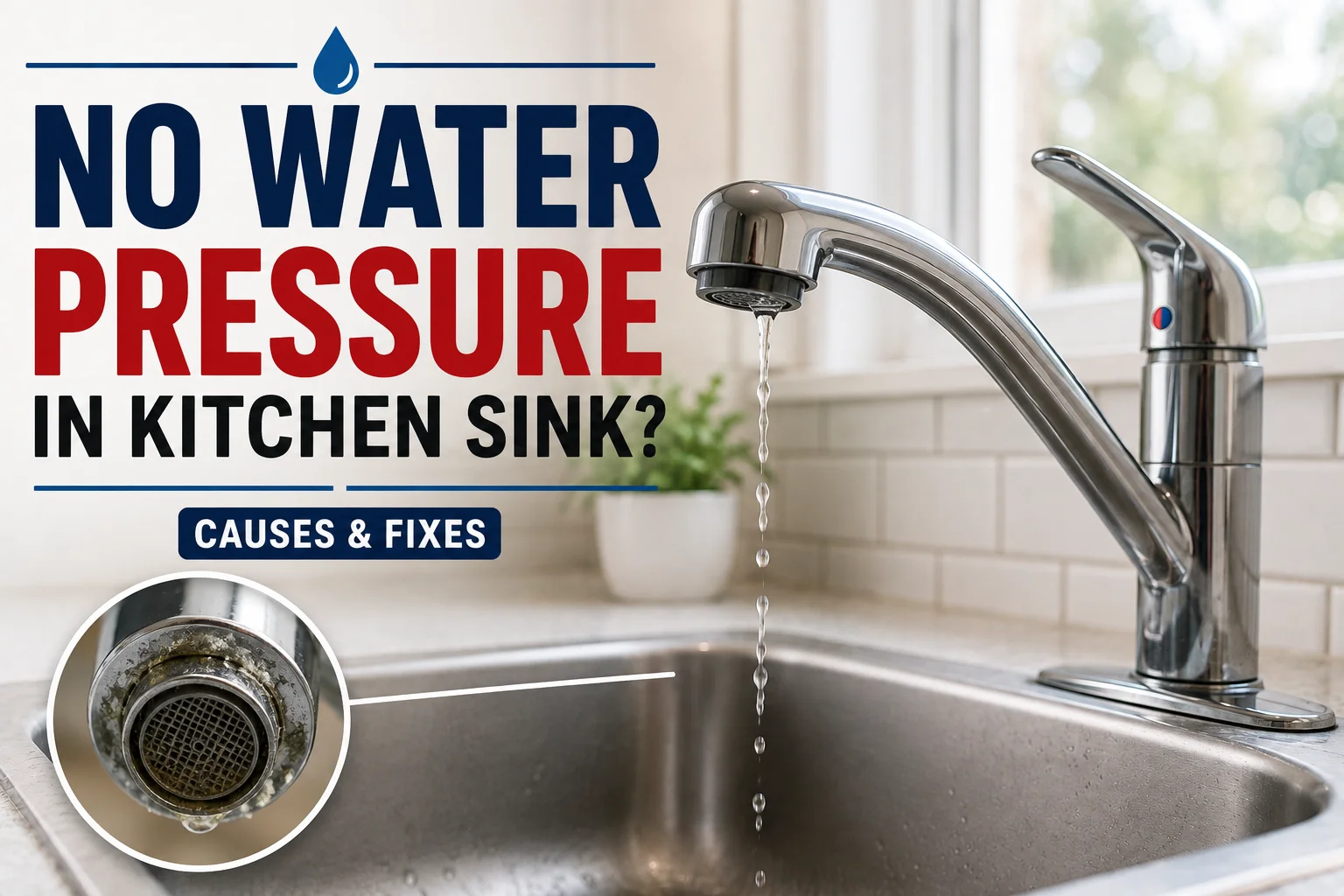
No water pressure in kitchen sink problems are usually caused by a clogged faucet aerator, a partially closed shutoff valve, a kinked or clogged supply line, a blocked cartridge, or a faucet-specific issue rather than a problem with your whole house. The fastest way to figure out what’s going on is a quick three-part test: check whether both hot and cold water are affected, check whether only one temperature is affected, and check whether other faucets in the house have normal pressure too. That single test narrows down the likely cause before you spend money replacing parts you don’t need.
Why Is There No Water Pressure in My Kitchen Sink?
Most kitchen sink pressure problems trace back to one of a handful of common causes. Here’s a quick reference before diving into the details:
| Possible Cause | What You May Notice | Likely Solution |
|---|---|---|
| Clogged aerator | Low flow at faucet outlet | Clean or replace aerator |
| Partially closed shutoff valve | Low flow at sink | Open valve fully |
| Kinked supply line | Reduced flow | Straighten or replace line |
| Clogged cartridge | Low or uneven flow | Clean or replace cartridge |
| Clogged supply line | Very low/no flow | Inspect or replace |
| Faucet-specific problem | Only kitchen faucet affected | Service faucet |
| Whole-house pressure issue | Multiple fixtures affected | Check main supply/system |
| Frozen pipe | Sudden/no flow in cold weather | Shut off water and seek professional help |
No single symptom guarantees a specific cause — this table is a starting point for narrowing things down, not a diagnosis.
First Check: Is the Problem Only at the Kitchen Sink?
Before touching anything under the sink, test a few other fixtures: the bathroom sink, the shower, any other kitchen fixture, and an outdoor faucet if you have one.
If other fixtures have normal pressure, the problem is almost certainly local to the kitchen — the faucet itself, its aerator, its cartridge, its supply lines, or its shutoff valves.
If multiple fixtures have low pressure, the cause is likely broader: the main shutoff valve, a whole-house pressure regulator, the municipal supply, a well system, or a plumbing blockage further upstream.
This one check can save you from replacing a perfectly good faucet when the real problem is somewhere else in the house.
Check Whether Hot or Cold Water Is Affected
This is one of the most useful diagnostic steps you can do, and it takes about thirty seconds. Run the hot side alone, then the cold side alone, and compare.
Low hot water pressure only points toward the hot-side shutoff valve, the hot supply line, the faucet cartridge, a restriction somewhere in the hot-water supply, or debris specifically on the hot side of the faucet.
Low cold water pressure only points toward the cold-side shutoff valve, the cold supply line, the cartridge, the aerator, or debris on the cold side.
Both hot and cold affected shifts suspicion toward the aerator, the cartridge, the faucet body itself, both shutoff valves, a faucet-specific blockage, or — if other fixtures are affected too — a broader water-pressure issue.
The exact cause still depends on your specific faucet’s internal design, so treat this as a way to narrow the search, not a final answer.
Clean the Kitchen Faucet Aerator
This is usually the easiest fix to try first, and it solves the problem more often than any other single step.
- Turn off the faucet.
- Remove the aerator carefully — some unscrew by hand or with pliers wrapped in a cloth to protect the finish, while others are recessed and need a specific removal tool.
- Inspect it for debris and mineral buildup.
- Rinse the mesh screen under running water.
- Soak stubborn mineral deposits in vinegar, then scrub gently with a soft brush.
- Reinstall the aerator.
- Turn the water back on and test the flow.
Aerators collect sediment, mineral scale, rust particles, and debris that gets stirred up during nearby plumbing work. Moen’s own aerator cleaning guide notes that aerators can accumulate debris and mineral deposits over time, which restricts water pressure or distorts the spray pattern — and that different aerator styles require different removal approaches. Don’t drill out or force a stuck screen; if an aerator won’t come clean or won’t come apart, it’s usually cheaper and safer to replace it than to damage the faucet finish trying to save it. Also note that some modern faucets use proprietary aerators or spray inserts that only fit that manufacturer’s replacement parts.
Check the Kitchen Sink Shutoff Valves
Look under the sink for the hot and cold shutoff valves — small oval or round handles on the supply lines. Make sure each one is turned fully open (counterclockwise, all the way). A valve that’s only partially open restricts flow even though water is technically still getting through.
If a valve looks damaged, corroded, or leaks when you touch it, don’t force it. Older valves can fail internally or seize up, and forcing a stuck valve can snap the stem or crack the body, turning a simple check into an emergency shutoff situation. If a valve is stuck or leaking, that’s a good candidate for professional replacement rather than a DIY fix.
Inspect the Faucet Supply Lines
The flexible supply lines running from the shutoff valves to the faucet can develop problems of their own. Look for:
- Kinks or sharp bends
- Spots where the line is pinched or crushed
- Corrosion on the fittings
- Any visible leaks
- Loose or damaged connections
A kinked supply line restricts flow the same way a kinked garden hose does — sometimes the fix is as simple as gently straightening it, and sometimes the line needs to be replaced. Always shut off the water at the valve before disconnecting or replacing a supply line; never work on a pressurized connection.
Check the Faucet Cartridge
Many single-handle kitchen faucets, and some two-handle designs, control flow and temperature with an internal cartridge. A clogged, worn, or damaged cartridge can cause low flow, uneven hot-to-cold flow, reduced overall pressure, dripping, or trouble holding a steady temperature.
Cartridge removal steps vary significantly by brand and model — a Delta cartridge doesn’t come out the same way a Moen or Kohler one does, and using the wrong technique can damage the faucet. Look up your specific faucet model’s manufacturer instructions before attempting to remove or replace a cartridge. Delta’s parts and product identification tool and Kohler’s service parts finder are good starting points if you’re not sure which cartridge your faucet uses.
Check for a Clogged Faucet or Internal Debris
Debris can get trapped in places you can’t easily see: inside the faucet body, in the cartridge, on internal screens, at the supply connection, in the spray head, or in other internal passages. Nearby plumbing work, water-main repairs, corrosion inside older pipes, and general sediment can all introduce this kind of debris into your line.
If you suspect internal debris rather than a simple aerator clog, cleaning or flushing may help — but exactly how depends on your faucet’s design. Check the manufacturer’s instructions before disassembling anything beyond the aerator, since some faucet internals aren’t meant to be taken apart by hand.
What If the Kitchen Faucet Has No Water at All?
“No water” is a different problem from “low pressure,” and it’s worth treating separately. Work through this order:
- Confirm the home’s main water supply is on.
- Check the kitchen’s hot and cold shutoff valves.
- Inspect the supply lines for a full blockage or disconnection.
- Check the aerator for a total clog.
- Check the faucet cartridge.
- Check the spray head or diverter, if your faucet has one.
If both hot and cold stop completely at the kitchen sink while other fixtures in the house work fine, the problem is more likely a local supply restriction or a faucet-internal blockage than a whole-house issue.
Pull-Down and Pull-Out Faucets: Check the Spray Head and Hose
Faucets with a pull-down or pull-out spray head add a few more places debris can collect: the spray head itself, the flexible hose, and the diverter valve that switches between the main stream and spray mode.
Test both modes separately. If the main stream is weak but spray mode is fine (or vice versa), the problem is likely in the diverter or the spray head screen rather than the supply side. If both modes are weak, check whether the hose is kinked inside the faucet body, and check the spray head screen for the same kind of mineral buildup that clogs standard aerators. A clogged spray head can look and feel exactly like a whole-faucet pressure problem, so don’t skip this check on faucets with a pull-out or pull-down head.
Could the Garbage Disposal Cause Low Water Pressure?
No, not under normal circumstances. The garbage disposal is connected to the sink’s drain system, while the faucet’s water pressure comes entirely through the separate water-supply plumbing. These are two different systems that don’t interact under normal operation. That said, if someone recently worked on the disposal, the drain, or nearby plumbing, it’s possible the work disturbed a supply connection nearby — but the disposal itself isn’t the mechanism causing a pressure drop. If you’re also dealing with a leak near the disposal, that’s worth addressing separately, since it’s unrelated to faucet pressure.
Could a Water Heater Cause Low Kitchen Sink Pressure?
Possibly, but only for the hot side. If hot water pressure is low at the kitchen sink while cold water is normal, the water heater or the hot-water plumbing leading to it could be involved — sediment buildup, a partially closed valve on the heater, or a restriction somewhere in the hot supply piping. If you’re troubleshooting a broader water heater issue at the same time, our guide on how long a water heater takes to heat up covers related hot-water performance questions.
If cold water pressure is also low, though, the water heater is much less likely to be the direct cause, since cold water typically bypasses it entirely. Don’t assume the water heater is responsible just because hot water is involved — confirm cold water is normal first.
How to Tell If the Problem Is the Faucet or the Plumbing
Only the kitchen faucet is affected: check the aerator, spray head, cartridge, supply lines, and shutoff valves.
Kitchen sink hot and cold are both affected: check the aerator, the faucet body, both shutoff valves, and the supply connections.
Only the hot side is affected: check the hot shutoff valve, hot supply line, cartridge, and hot-water plumbing.
Only the cold side is affected: check the cold shutoff valve, cold supply line, and cartridge.
Multiple fixtures throughout the house are affected: check the main shutoff valve, the whole-house pressure regulator if you have one, the municipal or well supply, and broader plumbing.
How to Fix No Water Pressure in Kitchen Sink
Work through these steps in order, starting with the easiest and least risky:
- Test another faucet in the house.
- Test hot and cold water separately at the kitchen sink.
- Check that both under-sink shutoff valves are fully open.
- Inspect the supply hoses for kinks or damage.
- Clean the faucet aerator.
- Clean the spray head, if your faucet has one.
- Check the faucet cartridge, following your model’s instructions.
- If multiple fixtures are affected, investigate whole-house pressure instead of the faucet.
- Call a plumber if the problem isn’t resolved after these checks.
Starting with the aerator and valves before moving to cartridge work or supply-line replacement saves time and avoids unnecessary part replacement.
Common Mistakes to Avoid
- Replacing the entire faucet before diagnosing the actual problem
- Assuming low flow at one faucet means the whole house has low pressure
- Skipping the aerator check because it seems too simple to matter
- Forgetting to confirm the shutoff valves are fully open
- Forcing an old, stuck shutoff valve
- Replacing a cartridge without first identifying the exact faucet model
- Overlooking a kinked supply hose
- Blaming the water heater when cold water pressure is also low
- Ignoring a small leak that could be related to the pressure drop
- Using excessive force on faucet components, risking cracked fittings or a damaged finish
Each of these mistakes tends to either miss the real cause or create a new problem on top of the original one.
When to Call a Plumber
Bring in a professional if multiple fixtures suddenly lose pressure at once, overall house pressure seems very low, a shutoff valve is stuck or leaking, a supply line is damaged, you suspect a hidden pipe blockage, a pipe may be frozen, there’s an active water leak, the faucet needs plumbing modifications beyond a simple parts swap, a whole-house pressure regulator may be failing, a well pressure system is malfunctioning, or pressure changes dramatically and unpredictably throughout the house.
Frequently Asked Questions
1. Why is there no water pressure in my kitchen sink?
The most common causes are a clogged aerator, a partially closed shutoff valve, a kinked or clogged supply line, or a faulty cartridge. Testing hot and cold separately, and checking whether other faucets are affected, helps narrow down which one it is.
2. Why does my kitchen faucet have low pressure but other faucets work?
This points to a problem local to the kitchen faucet itself rather than the whole house — most likely the aerator, cartridge, supply lines, or shutoff valves for that specific sink.
3. Why is only the hot water pressure low?
Low hot-only pressure usually points to the hot-side shutoff valve, the hot supply line, the cartridge, or a restriction in the hot-water plumbing. If cold water is normal, the issue is likely isolated to the hot side.
4. Why is only the cold water pressure low?
This usually points to the cold-side shutoff valve, the cold supply line, the cartridge, or debris specifically affecting the cold side of the faucet.
5. Can a clogged aerator cause low water pressure?
Yes — a clogged aerator is one of the most common causes of low pressure at a single faucet. Mineral deposits and sediment build up in the mesh screen over time and restrict flow.
6. Can a faucet cartridge cause low water pressure?
Yes. A worn, clogged, or damaged cartridge can restrict flow, cause uneven hot/cold balance, or create dripping alongside reduced pressure. Cartridge removal varies by faucet brand and model.
7. Can a shutoff valve reduce water pressure?
Yes. A valve that isn’t fully open restricts flow even though water still passes through. Damaged or aging valves can also fail internally and reduce flow further.
8. Why does my kitchen faucet have no water but other faucets work?
This suggests a local blockage or closed valve rather than a whole-house issue — check the kitchen’s shutoff valves, supply lines, aerator, and cartridge before assuming a bigger problem.
9. Can the water heater cause low hot-water pressure at the kitchen sink?
It can, if only hot water pressure is affected. Sediment or a restriction in the water heater’s supply piping is a possible cause. If cold water is also low, the water heater is less likely to be responsible.
10. When should I call a plumber for low kitchen sink pressure?
Call a plumber if multiple fixtures are affected, a valve is stuck or leaking, you notice a leak, a pipe may be frozen, or basic troubleshooting doesn’t resolve the problem. These situations often involve plumbing beyond simple faucet parts.
Conclusion
Diagnosing no water pressure in a kitchen sink starts with a simple process: check whether other fixtures in the house have normal pressure, test hot and cold water separately, check that the shutoff valves are fully open, inspect the supply lines, and clean the aerator and spray head. If those checks don’t solve it, look at the faucet cartridge next. If multiple fixtures are affected rather than just the kitchen sink, the cause is likely broader than the faucet itself. Call a plumber when the problem involves leaks, main supply issues, a stuck valve, hidden plumbing, or anything beyond straightforward faucet maintenance.