
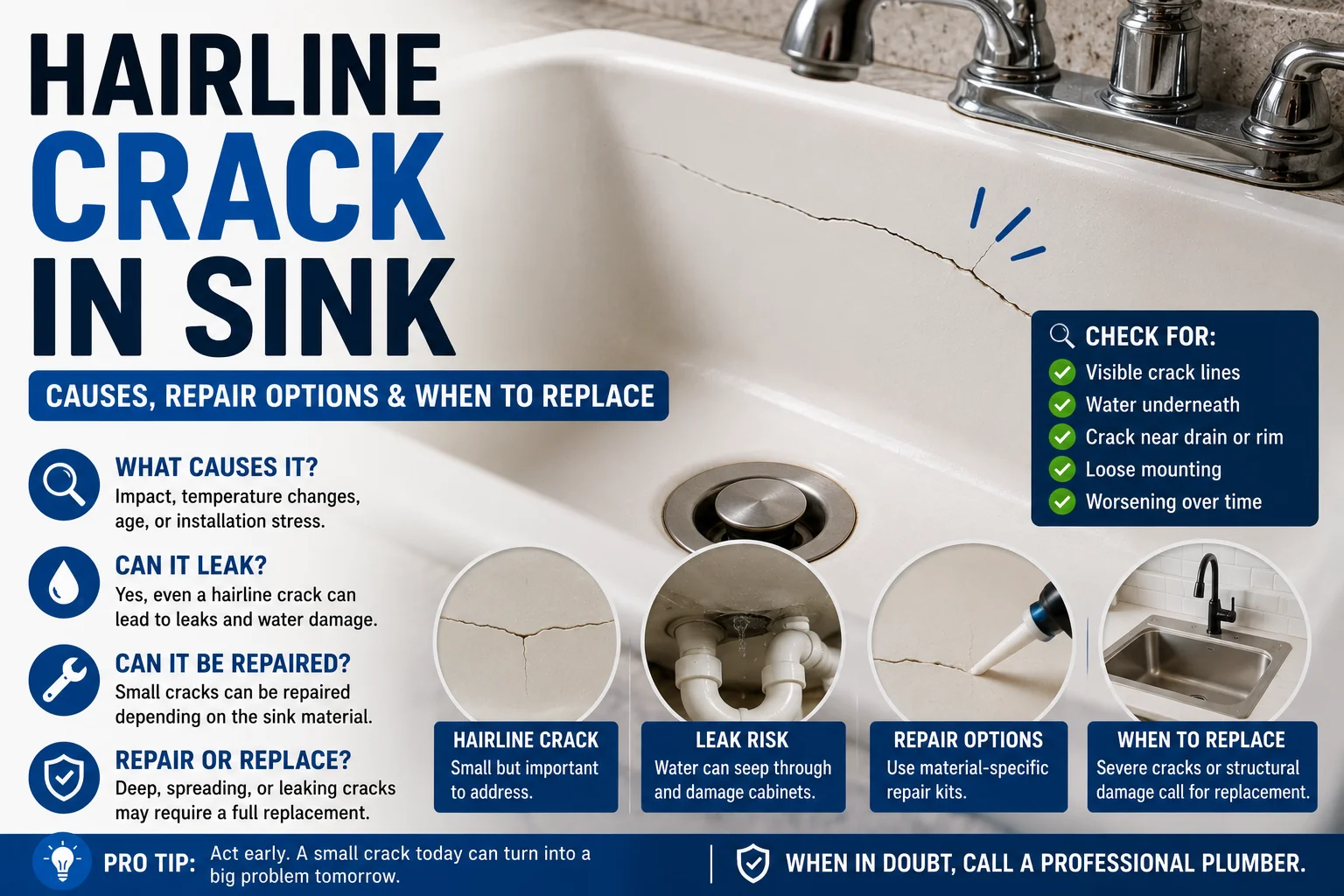
A hairline crack in a sink is not automatically an emergency, but it is also not something you should ignore. Some hairline cracks are purely cosmetic and stay that way for years. Others let water seep into the sink material or the cabinet below, and a few are early warning signs of a bigger structural problem.
Before deciding what to do, figure out four things: what the sink is made of, whether the crack is only on the surface or goes deeper, whether water is actually reaching through it, and whether it sits near the drain, faucet, or mounting hardware. A small, stable, surface-only crack may be repairable. A crack that is leaking, spreading, or located at a stress point is usually safer to replace.
What Is a Hairline Crack in a Sink?
A hairline crack is a very thin line in the sink’s surface or finish, often just a hair’s width wide. It can be easy to miss unless the light hits it at the right angle, and it may only become obvious when the sink is wet or dirty and the crack collects moisture or grime.
The tricky part is that appearance does not tell you much about depth. A hairline crack in porcelain or ceramic sinks can look purely cosmetic while actually reaching through the glaze into the base material underneath. That is why a visual check alone is not always enough to judge how serious the damage is — you also need to think about location, material, and whether it is changing over time.
What Causes Hairline Cracks in Sinks?
There is rarely a single cause. Most cracked sinks are the result of one of the following:
Thermal shock. Pouring very hot water into a sink right after very cold water (or the reverse) can stress certain materials, especially older or heavily glazed porcelain and vitreous china. Not every sink is vulnerable to this, and many modern materials are engineered to tolerate normal hot-and-cold use, but sudden extreme temperature swings are still worth avoiding as routine practice. Manufacturer care guidance, such as KOHLER’s cast iron sink care instructions, typically distinguishes normal wear from misuse when it comes to warranty coverage.
Impact damage. A dropped cast iron pan, a heavy glass bottle, a metal curling iron, or any hard object striking the sink at the wrong angle can chip the surface or create a crack, particularly near the edges or drain opening.
Manufacturing defects. Occasionally a crack traces back to a flaw in the original casting or glazing process. This is not common, and it should not be assumed without other evidence — most cracks have an identifiable cause like impact or stress.
Improper installation. A sink that was clamped too tightly, set on an uneven support, or forced into a countertop cutout that is not quite the right size can develop stress cracks over time, especially at the mounting points.
Age and wear. Like any material, sink surfaces can become more brittle or more prone to stress cracking as they age, particularly with years of temperature cycling and cleaning product exposure.
Structural movement. If the countertop, cabinet, or wall behind the sink shifts slightly — from settling, humidity changes, or a loose mounting bracket — that movement can transfer stress into the sink itself.
How Serious Is a Hairline Crack in a Sink?
Severity depends heavily on where the crack is and what it is doing over time, not just how it looks.
| Crack Type | Potential Concern | Recommended Action |
|---|---|---|
| Very fine surface crack | Mainly cosmetic | Monitor, or repair if appropriate for the material |
| Crack becoming longer | May worsen | Repair or have it inspected |
| Crack near drain | Higher leak concern | Inspect promptly |
| Crack near mounting point | Possible structural concern | Professional assessment |
| Crack through sink body | Leak/structural risk | Consider replacement |
| Active leak | Water damage risk | Stop using and repair or replace |
A crack sitting far from the drain and mounting hardware, with no signs of spreading or moisture, is the lowest-concern scenario. A crack anywhere near a stress point or fitting deserves a closer look even if it looks small.
Can a Hairline Crack in a Sink Cause a Leak?
Yes, but not always. A crack that only affects the glaze or top finish layer may never let water through. A crack that penetrates the full thickness of the sink material can allow water to travel underneath, especially during regular use.
Watch for these warning signs:
- A damp cabinet floor or shelf under the sink
- Visible water droplets on the underside of the basin
- Water stains or discoloration on the cabinet material
- Swelling or softening of particleboard or wood under the sink
- A musty or mildew smell coming from the cabinet
- Water appearing after the sink has been used, even briefly
Check the underside of the sink where you can safely access it. You do not need to remove or disassemble a mounted sink to do this — a flashlight and a look inside the cabinet is usually enough for an initial check.
How to Check Whether a Sink Crack Is Leaking
Step 1: Dry the sink completely. Remove all standing water so you are not looking at surface moisture.
Step 2: Inspect the crack with good lighting. A flashlight held at a low angle makes hairline cracks much easier to see and trace.
Step 3: Check underneath the sink. Look at the underside of the basin and the cabinet floor for moisture, drips, or old water stains.
Step 4: Run a small amount of water. Let water run near the crack and watch both the crack itself and the underside for any sign of seepage.
Step 5: Check around the drain separately. Water pooling near the drain assembly may be coming from the drain seal, not the crack itself.
Not every leak found near a crack is actually caused by that crack. It is worth ruling out other sources before assuming the crack is the culprit. If water pressure at the fixture also seems off, it’s worth checking whether you’re dealing with a separate issue like no water pressure in your kitchen sink, since crack-related leaks and pressure problems are unrelated but can show up around the same time.
Hairline Crack vs. Sink Drain Leak
This mix-up is common enough that it deserves its own section. Homeowners often blame a visible crack for a leak that is actually coming from the drain assembly.
Typical drain-related causes include:
- A failed or dried-out drain seal or plumber’s putty
- A loose drain flange or basket strainer
- A damaged rubber gasket
- Improper drain installation
Crack-related leak: water tends to appear directly below or near the crack itself, tracing a path consistent with the crack’s location.
Drain-related leak: water shows up around the drain assembly or where the drain pipe connects underneath, regardless of where the crack is.
If you are not sure which one is happening, a plumber can pressure-test the drain connection and inspect the crack separately rather than guessing. In kitchens with a disposal unit, also check whether the garbage disposal is leaking at the bottom, since that is another common source of water pooling under a kitchen sink that has nothing to do with the sink basin itself.
Can You Repair a Hairline Crack in a Sink?
Sometimes, yes. Whether repair makes sense depends on:
- The sink material
- How deep the crack goes
- Where the crack is located
- How long the crack is
- Whether the sink plays a structural role (like supporting a garbage disposal or heavy fixture)
- Whether water is already penetrating the material
Repair tends to be a reasonable option for minor, stable, non-structural damage that has not started leaking. A large crack, a spreading crack, or one near a mounting point is usually a poor candidate for a DIY fix, and no repair — done by a homeowner or a professional — should be assumed to be permanent without monitoring afterward.
How to Repair a Hairline Crack in a Porcelain or Ceramic Sink
Repair kits for porcelain and vitreous china sinks are widely available, but products vary by manufacturer, so always check that the kit is rated for your specific sink material and follow its instructions exactly. For general care of this material, KOHLER’s guide to cleaning vitreous china and fireclay sinks is a useful reference for what these surfaces can and cannot tolerate. A general approach looks like this:
- Clean the damaged area thoroughly, removing soap scum, mineral deposits, and debris.
- Let the area dry completely — trapped moisture can prevent proper bonding.
- Choose a repair product made specifically for porcelain or ceramic sink surfaces.
- Prepare the surface as the product instructions specify (this may include light sanding in some cases).
- Apply the repair compound carefully and sparingly, following the product’s application method.
- Allow the product to cure for the full time listed on the packaging — rushing this step is a common reason repairs fail.
- Smooth or polish the repaired area only if the manufacturer’s instructions call for it.
- Run water and check the area again once curing is complete to confirm there is no leakage.
Never substitute a generic household glue for a purpose-made sink repair compound — it will not bond or seal correctly on a glazed surface.
How to Repair Cracks in Acrylic, Fiberglass, and Composite Sinks
Acrylic, fiberglass, and granite-composite sinks (like BLANCO’s Silgranit line) use different repair systems than porcelain, since the base materials react differently to fillers and adhesives. Manufacturers generally note that these composite surfaces are highly resistant to everyday impact and heat, but they are not indestructible against a hard, direct blow.
For these materials, repair generally involves:
- A repair kit matched specifically to the resin or composite type
- Careful surface preparation, often including cleaning and light abrasion
- Color-matching the filler to the sink’s finish, since these materials are often pigmented all the way through
- Sanding and finishing only where the product instructions allow it
- An honest assessment of whether the damage is truly cosmetic or has compromised the structure
Deep cracks or cracks caused by a hard impact on acrylic, fiberglass, or composite sinks are often better handled by a professional or addressed through replacement, since a botched repair can be more visible than the original damage.
What About Stainless Steel Sinks?
Stainless steel behaves very differently from porcelain, ceramic, or composite materials. A visible line in a stainless sink is not always a crack — it could be:
- A surface scratch
- Stress marks around a dent
- A weld or seam issue
- An actual crack in the metal
Because stainless steel is a metal, it does not respond to the same fillers or glazing compounds used on porcelain or composite sinks — see KOHLER’s stainless steel sink cleaning guidance for material-appropriate care. Applying a porcelain repair kit to stainless steel will not work and can make the surface look worse. A genuine crack in stainless steel — particularly near a seam, drain opening, or weld point — often calls for a metal-specific repair method or replacement, depending on severity and location.
Can You Seal a Hairline Crack in a Sink?
There is a real difference between a cosmetic repair, a surface seal, and a structural repair, and it matters which one you are actually doing.
A sealant can sometimes stop water from penetrating a minor surface crack temporarily, but it should not be treated as a permanent structural fix, especially on a crack that is already showing signs of leaking or spreading. Ordinary bathroom caulk is not designed to bear structural stress and should never be used as a substitute for a proper sink repair or replacement — it may hide a leak temporarily while the underlying damage continues.
Will a Hairline Crack in a Sink Get Bigger?
It depends. Some hairline cracks stay exactly the same for years. Others grow because of ongoing factors such as:
- Continued impact or pressure on the same spot
- Repeated temperature swings
- Water penetrating and expanding within the material (especially in freezing conditions)
- Structural movement in the countertop or cabinet
- Improper installation that keeps stressing the same area
- An underlying weakness in the material itself
The safest approach is to monitor a hairline crack over several weeks, note whether it changes in length or opens up, and address the root cause — such as a loose mounting bracket — rather than only treating the crack itself.
Should I Repair or Replace My Cracked Sink?
| Situation | Repair | Replace |
|---|---|---|
| Tiny cosmetic surface crack | Often reasonable | Not always necessary |
| Small stable crack | May be possible | Depends on material |
| Active leak | Temporary option at most | Often better |
| Structural crack | Usually not ideal | Recommended |
| Crack around mounting area | Professional assessment | May be necessary |
| Large spreading crack | Limited value | Usually better |
| Old, heavily worn sink | May not be worthwhile | Often practical |
Replacement tends to make more financial sense once a crack is structural, actively leaking, or sitting on an old sink that already shows other signs of wear, since a repair on a failing sink may only buy a short amount of time.
How Much Does It Cost to Repair or Replace a Cracked Sink?
Costs vary too widely to quote a single number responsibly. What actually drives the price includes:
- The sink material (porcelain, composite, and cast iron repairs differ in product cost)
- The sink type (drop-in, undermount, farmhouse)
- The size and location of the crack
- Whether the repair is DIY or professional
- Labor and accessibility, especially for undermount sinks set into stone countertops
- The cost of a comparable replacement sink
- Plumbing reconnection work, including the drain, faucet, and supply lines
- Any countertop or cabinet modifications needed for a different sink size or shape
If you want current local pricing, it is worth getting a quote from a licensed plumber in your area, since prices shift by region and by year. If you suspect a crack has been leaking for a while, you can also compare recent water use by checking how to find your water meter and watching for unexplained increases.
How to Prevent Hairline Cracks in Your Sink
- Avoid dropping heavy or hard objects into the basin
- Follow the manufacturer’s guidance on hot-and-cold water use, especially for older porcelain sinks
- Never stand or sit on a sink or use it as a step
- Make sure the sink is properly installed and evenly supported
- Fix loose mounting hardware as soon as you notice it
- Skip harsh, abrasive cleaners that can weaken the finish over time
- Follow the manufacturer’s specific care instructions for your sink material
- Repair small chips or scratches before they turn into cracks
- Check under the sink periodically for early signs of moisture
Common Mistakes to Avoid
- Assuming every hairline crack is automatically harmless
- Reaching for ordinary super glue as a “quick fix”
- Using bathroom caulk in place of a structural repair
- Applying a repair product that is not rated for the sink’s material
- Ignoring water found under the sink because “it’s probably fine”
- Continuing to use a sink with a growing structural crack
- Testing a crack with extreme heat or cold to “see what happens”
- Sanding a repaired area without checking whether the material allows it
- Replacing the whole sink before confirming the leak isn’t actually a drain problem
When Should You Call a Plumber?
Bring in a professional when:
- The crack is actively leaking
- The crack sits near the drain or mounting area
- The crack is visibly spreading
- Water is reaching the cabinet or surrounding structure
- The sink feels loose or structurally unstable
- You can’t tell whether the leak is from the crack or the drain
- The sink needs to be removed and reinstalled
- The countertop may need modification for a replacement sink
- Plumbing connections need to be disconnected and reconnected safely
A quick professional assessment is often far cheaper than water damage repair down the road, especially for cracks near plumbing connections. If your sink replacement involves reconnecting supply lines or drain fittings, it also helps to understand basics like what a dielectric union is and the difference between Teflon tape vs. pipe dope, both of which commonly come up during sink and faucet reinstallation.
Frequently Asked Questions
Can a hairline crack in a sink cause a leak?
Yes, if the crack goes all the way through the sink material rather than staying on the surface. A surface-only crack in the glaze or finish may never leak, but one that penetrates deeper can let water reach the cabinet below, especially with regular use.
Can a porcelain sink crack be repaired?
Often, yes, if the crack is small, stable, and not actively leaking. Use a repair kit specifically made for porcelain or vitreous china, follow the manufacturer’s instructions closely, and test for leaks after the product fully cures.
Can a ceramic sink crack be repaired?
Similar to porcelain, minor and stable ceramic cracks can often be repaired with a compatible ceramic repair compound. Deeper or structural cracks, or ones near the drain, are usually better handled by replacement or professional evaluation.
Will a hairline crack in a sink get worse?
It depends on the cause. Cracks from ongoing stress, temperature swings, or structural movement tend to spread over time, while some stable cosmetic cracks stay the same for years. Monitoring the crack periodically is the safest approach.
Is it safe to use a sink with a hairline crack?
A small, dry, surface-only crack is generally low risk for continued daily use. A crack that is leaking, growing, or near a structural point is a different situation and should be repaired or replaced rather than ignored.
What causes hairline cracks in sinks?
Common causes include impact from dropped objects, sudden extreme temperature changes, improper installation, age-related wear, and occasionally a manufacturing defect. Structural movement in the countertop or cabinet can also contribute.
Can I seal a cracked sink myself?
You can apply a sealant to a minor surface crack, but treat it as a temporary fix rather than a permanent structural repair, especially if there’s any sign of leaking. Ordinary caulk should never be used as a structural repair.
Should I repair or replace a cracked sink?
Repair is a reasonable option for small, stable, non-leaking cracks, particularly on newer sinks. Replacement generally makes more sense for structural cracks, active leaks, cracks near mounting points, or sinks that are already old and worn.
How can I tell if the crack is actually leaking?
Dry the sink completely, then run a small amount of water while checking both the crack and the underside of the basin for moisture. Also check around the drain separately, since drain leaks are often mistaken for crack leaks.
When should I call a plumber?
Call a plumber if the crack is actively leaking, located near the drain or mounting hardware, spreading over time, or if you can’t determine whether the water source is the crack or the drain assembly. Professional help is also worthwhile if the sink needs to be removed for repair or replacement.
Conclusion
A hairline crack in a sink can be a minor cosmetic issue or an early sign of a bigger problem — the difference comes down to material, location, and whether water is actually getting through. Check for signs of leaking, rule out the drain as the real source before blaming the crack, and consider the sink’s material before choosing a repair method, since porcelain, ceramic, acrylic, composite, and stainless steel all respond differently. A small, stable, non-leaking crack may be a good candidate for a repair kit made for that specific material. A structural crack, a spreading crack, or one that’s already leaking is usually a sign that replacement — ideally with a professional inspection first — is the safer long-term choice.